
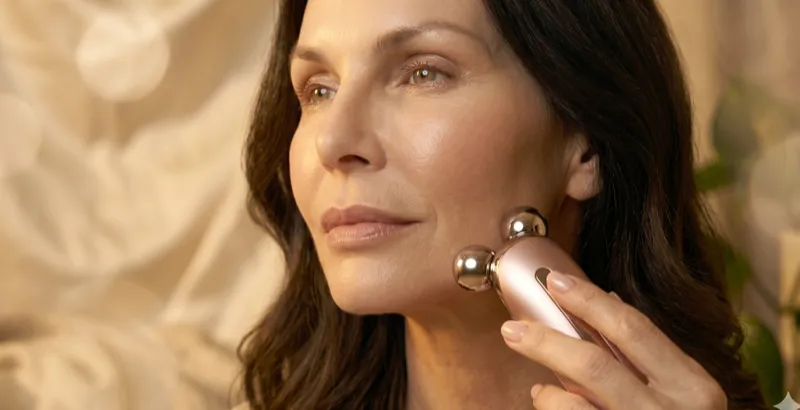
The science of skin aging is evolving rapidly — and for women navigating the skin changes that come with menopause and beyond, evidence-based skincare represents a fundamentally different approach: working with your skin's biology rather than against it.
Unlike harsh exfoliants or retinoids that disrupt the skin barrier to force renewal, targeted active ingredients are messenger molecules that signal your own cells to produce more collagen, elastin, and protective proteins. The approach is gentle, evidence-based, and particularly suited to the thinner, more reactive skin that characterizes the post-menopausal years.
What to Look For in At-Home Facial Toning Technology
The at-home microcurrent device market has grown rapidly, with prices ranging from $50 to $500+ and claims ranging from modest to miraculous. Navigating this market requires understanding the technical specifications that determine whether a device can deliver clinically meaningful results — because not all microcurrent devices are created equal. The three critical specifications are: current intensity (measured in microamperes), waveform pattern, and electrode design. Devices that get these three factors right produce measurable results; devices that don't are expensive facial massagers.[1]
Current intensity is the most important specification. Clinical studies showing facial toning benefits used intensities between 200-600 microamperes. Below 100 microamperes, the current is insufficient to stimulate meaningful ATP production or muscle contraction. Above 1000 microamperes (1 milliamp), ATP production actually decreases — the Cheng study demonstrated an inverted U-shaped dose-response curve. Devices should specify their maximum output in microamperes; devices that only list 'microcurrent technology' without specifying intensity may operate below therapeutic thresholds. Professional devices typically operate at 300-600 microamperes; the best at-home devices match or approach this range.
Clinical research confirms that waveform pattern determines how the current is delivered. The most effective waveforms for facial toning are biphasic (alternating polarity, which prevents ion accumulation under the electrodes) and pulsed (delivered in brief bursts that mimic natural bioelectrical signaling). Monophasic continuous current can cause skin irritation and ion buildup with repeated use. Some premium devices offer multiple waveform options for different treatment goals — a square wave for muscle stimulation and a sinusoidal wave for ATP stimulation. Electrode design affects current distribution: dual-probe devices (two separate metal spheres) allow targeted treatment of specific muscles, while flat-pad devices distribute current more broadly for general toning.
Device categories by clinical evidence level: Tier 1 (strongest evidence): NuFace Trinity and Mini — the most-studied at-home microcurrent device, with published clinical trials showing measurable facial lifting and toning. ZIIP — uses nano-current (even lower intensity) with proprietary waveforms; emerging clinical data. Tier 2 (moderate evidence): Bear by Foreo — combines microcurrent with T-sonic pulsation; limited independent clinical data but positive user-reported outcomes. MyoLift — higher intensity option (up to 400 microamperes) targeting professional-level results at home. Tier 3 (limited evidence): Budget devices under $100 — typically lower intensity and simpler waveforms. May provide mild benefits but generally lack clinical validation. The investment principle: a device in the $200-400 range from a reputable brand with published clinical data produces results that justify the cost over 12-24 months of daily use — the per-treatment cost drops below $1 after the first year.
Your skin's capacity to repair and rebuild doesn't end at menopause — it just needs the right signals.
— Dr. Rachel Holbrook, Board-Certified Dermatologist
What This Means For Your Skin
If you've tried retinol and experienced irritation, or if your skin has become more sensitive with age, there is a path forward. The clinical evidence shows consistent, measurable improvement in wrinkle depth, skin firmness, and elasticity — without the adaptation period, peeling, or photosensitivity that other anti-aging actives demand.
Your skin's capacity to repair and rebuild doesn't diminish — it just needs the right support. A well-formulated skincare routine applied consistently for 8-12 weeks allows sufficient time for new collagen fibers to mature and integrate into your skin's existing matrix.
The science is clear. The evidence is consistent. The results are measurable.
What happens next is up to you.