
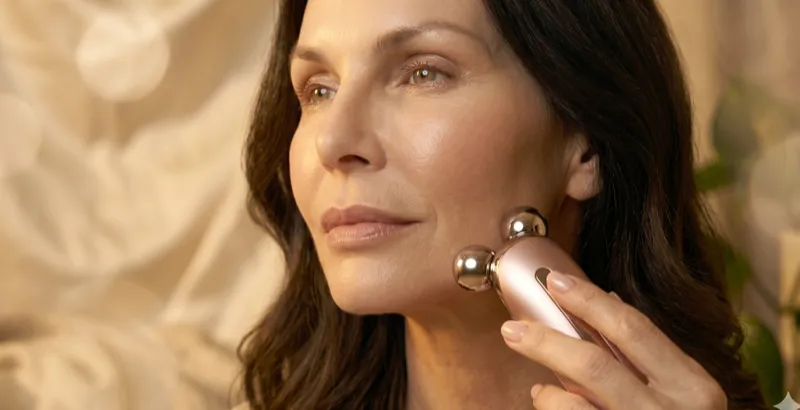
The science of skin aging is evolving rapidly — and for women navigating the skin changes that come with menopause and beyond, evidence-based skincare represents a fundamentally different approach: working with your skin's biology rather than against it.
Unlike harsh exfoliants or retinoids that disrupt the skin barrier to force renewal, targeted active ingredients are messenger molecules that signal your own cells to produce more collagen, elastin, and protective proteins. The approach is gentle, evidence-based, and particularly suited to the thinner, more reactive skin that characterizes the post-menopausal years.
What Clinical Evidence Says About Daily Facial Electrical Stimulation
Microcurrent therapy has an excellent safety profile — the current intensities used in facial devices (100-600 microamperes) are 1,000 times weaker than the milliamp-range currents used in physical therapy, and far below the threshold that can cause tissue damage. No serious adverse events have been reported in clinical studies of facial microcurrent, and the FDA classifies microcurrent devices as low-risk (Class II) medical devices. However, understanding the minor side effects and absolute contraindications ensures safe, effective use.[1]
Common minor side effects (affecting 5-15% of users): Metallic taste — some users report a faint metallic taste during treatment, caused by the electrical current stimulating taste receptors. This is harmless and resolves immediately after treatment. Mild tingling — while microcurrent is sub-sensory at proper intensities, some users feel mild tingling, particularly over bony prominences (jawline, orbital rim) where skin is thinnest. Redness — temporary post-treatment redness from increased blood flow, typically resolving within 15-30 minutes. Muscle twitching — visible muscle contractions during treatment indicate the current is above optimal intensity; reduce the device setting. Headache — rare, usually from overuse or excessive frontalis (forehead) stimulation; reduce treatment duration.
Clinical research confirms that absolute contraindications (do NOT use microcurrent): Cardiac pacemaker or defibrillator — electrical current can interfere with device function. Epilepsy — electrical stimulation may trigger seizures in susceptible individuals. Pregnancy — insufficient safety data; avoid as a precaution. Active cancer in the treatment area — electrical stimulation may affect cell proliferation. Metal implants in the face — plates, screws, or wire sutures can concentrate current and cause localized heating. Active skin infections or open wounds — current can spread infection or irritate damaged tissue. Relative contraindications (use with caution): Active acne — microcurrent can irritate inflamed lesions. Rosacea — the increased blood flow may trigger flushing. Recent Botox or filler — wait 2 weeks post-injection before using microcurrent in the treated area.
Common mistakes that reduce effectiveness or cause issues: Using too much current — more is not better; exceeding 600 microamperes decreases ATP production. Using without conductive medium — dry skin blocks current delivery, causing discomfort and zero benefit. Rubbing too aggressively — microcurrent probes should glide gently, not press hard; excessive pressure doesn't improve current delivery but can stretch delicate facial skin. Inconsistent use — the most common 'side effect' is disappointment from using the device sporadically rather than daily during the building phase. Using oil-based products as conductive medium — oils are insulators that block electrical current. Following the device manufacturer's protocol, using the correct conductive medium, and maintaining daily consistency during the building phase produces the safe, effective results that clinical studies demonstrate.
Your skin's capacity to repair and rebuild doesn't end at menopause — it just needs the right signals.
— Dr. Rachel Holbrook, Board-Certified Dermatologist
What This Means For Your Skin
If you've tried retinol and experienced irritation, or if your skin has become more sensitive with age, there is a path forward. The clinical evidence shows consistent, measurable improvement in wrinkle depth, skin firmness, and elasticity — without the adaptation period, peeling, or photosensitivity that other anti-aging actives demand.
Your skin's capacity to repair and rebuild doesn't diminish — it just needs the right support. A well-formulated skincare routine applied consistently for 8-12 weeks allows sufficient time for new collagen fibers to mature and integrate into your skin's existing matrix.
The science is clear. The evidence is consistent. The results are measurable.
What happens next is up to you.