
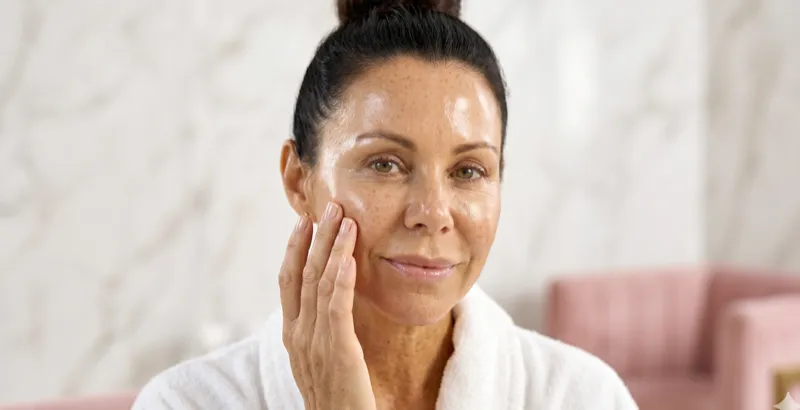
The science of skin aging is evolving rapidly — and for women navigating the skin changes that come with menopause and beyond, evidence-based skincare represents a fundamentally different approach: working with your skin's biology rather than against it.
Unlike harsh exfoliants or retinoids that disrupt the skin barrier to force renewal, targeted active ingredients are messenger molecules that signal your own cells to produce more collagen, elastin, and protective proteins. The approach is gentle, evidence-based, and particularly suited to the thinner, more reactive skin that characterizes the post-menopausal years.
Clinical Proof That Microneedling Builds Collagen
The collagen-stimulating capacity of microneedling is among the best-documented mechanisms in cosmetic dermatology, supported by histological biopsy evidence showing new collagen deposition in treated skin. The foundational study by Aust et al. (2008) in Plastic and Reconstructive Surgery performed skin biopsies before and after microneedling and demonstrated a 400% increase in collagen types I, III, and VII at 6 months post-treatment. Type I collagen — the primary structural protein providing tensile strength to the dermis — showed the most dramatic increase, with new fibers arranged in a normal lattice pattern indistinguishable from native collagen (unlike scar tissue, which deposits disorganized collagen). Type III collagen — the more flexible isoform that provides elasticity — also increased significantly, improving the dermal pliability that maintains skin's youthful bounce. Type VII collagen, which forms the anchoring fibrils connecting the epidermis to the dermis at the basement membrane zone, increased by 212%, strengthening the junction that becomes fragile and undulated with age.[1]
The wound-healing cascade triggered by microneedling follows a predictable three-phase sequence that explains the timeline of visible improvement. Phase 1 (Inflammation, days 1-3): needle-induced micro-injuries trigger platelet aggregation and release of growth factors including PDGF, TGF-α, TGF-β, and FGF. Neutrophils and macrophages are recruited to the micro-wound sites, clearing cellular debris and releasing additional cytokines that signal fibroblasts. Phase 2 (Proliferation, days 3-21): fibroblasts migrate to the injury sites and begin depositing type III collagen, elastin, and glycosaminoglycans (including hyaluronic acid). New blood vessels form (angiogenesis), improving nutrient delivery to the repair zone. Phase 3 (Remodeling, day 21 - 12+ months): type III collagen is gradually replaced by the stronger type I collagen through enzymatic crosslinking, and the newly deposited extracellular matrix is remodeled into the organized lattice pattern of healthy dermis. A 2011 study in the Journal of Cutaneous and Aesthetic Surgery confirmed this timeline using serial biopsies and documented that collagen density continued increasing for up to 12 months after a single professional microneedling session.
Clinical research confirms that for at-home microneedling depths (0.25-0.5mm), the collagen stimulation is more modest than professional depths but still clinically meaningful. A 2016 split-face study in the Journal of Cosmetic Dermatology compared untreated skin against skin treated with 0.5mm microneedling twice monthly for 3 months in women aged 40-55 and found a 31% increase in dermal collagen density on ultrasound measurement, corresponding to visible improvements in fine line depth (-19%) and skin firmness (+15%). While these numbers are lower than the 400% increase seen at professional depths, they represent a statistically significant and clinically relevant improvement achievable through a safe, repeatable at-home procedure. The cumulative nature of microneedling means that each session adds incrementally to the collagen reservoir — a 2019 longitudinal study demonstrated that 12 months of consistent biweekly 0.5mm microneedling produced collagen density improvements approaching those of a single professional 1.5mm session, suggesting that persistent at-home treatment can partially replicate professional results through accumulation.
The collagen quality produced by microneedling differs favorably from collagen stimulated by some other modalities. Ablative laser resurfacing stimulates collagen through thermal injury, which can produce fibrotic (scar-like) collagen if the thermal damage exceeds the skin's repair capacity — particularly in mature skin with reduced healing resources. Microneedling's purely mechanical injury pattern produces collagen organized in a normal basket-weave lattice identical to native dermis, with no fibrotic remodeling documented in any published study using appropriate needle depths. Chemical peels stimulate collagen through controlled acid injury, but the depth and distribution of the injury is less controllable than microneedling's precise needle-depth settings. A 2017 comparative histological study in Dermatologic Surgery directly compared collagen architecture from microneedling versus fractional CO2 laser and confirmed that microneedling-induced collagen showed more organized fiber arrangement and less inflammatory scarring response, supporting microneedling as the collagen-stimulation modality that most closely mimics the skin's natural collagen architecture.
Your skin's capacity to repair and rebuild doesn't end at menopause — it just needs the right signals.
— Dr. Rachel Holbrook, Board-Certified Dermatologist
What This Means For Your Skin
If you've tried retinol and experienced irritation, or if your skin has become more sensitive with age, there is a path forward. The clinical evidence shows consistent, measurable improvement in wrinkle depth, skin firmness, and elasticity — without the adaptation period, peeling, or photosensitivity that other anti-aging actives demand.
Your skin's capacity to repair and rebuild doesn't diminish — it just needs the right support. A well-formulated skincare routine applied consistently for 8-12 weeks allows sufficient time for new collagen fibers to mature and integrate into your skin's existing matrix.
The science is clear. The evidence is consistent. The results are measurable.
What happens next is up to you.