
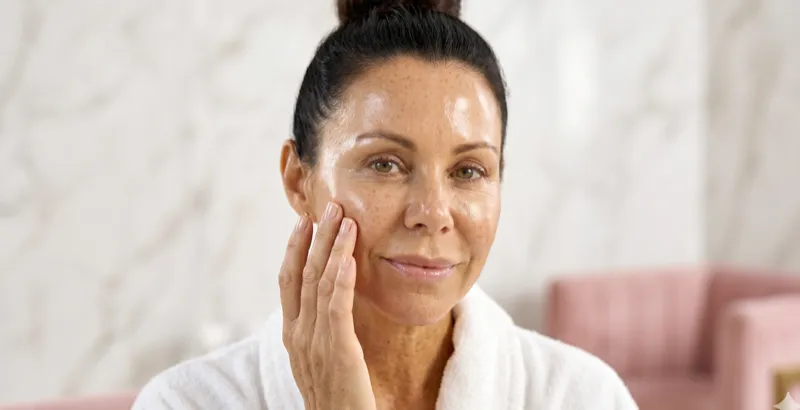
The science of skin aging is evolving rapidly — and for women navigating the skin changes that come with menopause and beyond, evidence-based skincare represents a fundamentally different approach: working with your skin's biology rather than against it.
Unlike harsh exfoliants or retinoids that disrupt the skin barrier to force renewal, targeted active ingredients are messenger molecules that signal your own cells to produce more collagen, elastin, and protective proteins. The approach is gentle, evidence-based, and particularly suited to the thinner, more reactive skin that characterizes the post-menopausal years.
How to Combine Microneedling and Retinoids Without Overdoing It
Combining microneedling with retinol is one of the most effective collagen-stimulating strategies for mature skin, but the timing and coordination of these two treatments requires careful protocol design to prevent the compounded irritation that can result from simultaneously disrupting the skin barrier (microneedling) and accelerating cell turnover (retinol). The fundamental principle is temporal separation: retinol and microneedling should never occur on the same day, and a buffer period of 48-72 hours in each direction ensures that neither treatment compromises the other's efficacy or safety. A 2019 combination study in the Journal of Cosmetic Dermatology evaluated three protocols — retinol applied immediately after microneedling, retinol applied 48 hours after microneedling, and retinol applied 72 hours after microneedling — and found that the 48-hour and 72-hour groups achieved equivalent collagen improvement (43% and 41% respectively at 12 weeks) while the immediate-application group showed 28% improvement with significantly more adverse events including persistent erythema and peeling.[1]
The optimal protocol for combining at-home microneedling with retinol on mature skin follows a weekly schedule that respects both treatments' requirements. Pause retinol for 48 hours before microneedling (allowing the retinol-sensitized barrier to partially recover before needle penetration), perform the microneedling session with hyaluronic acid serum, then resume retinol 48 hours after microneedling (allowing the micro-channels to close and initial wound healing to begin before introducing the mildly irritating retinoid). In practice, this creates a 4-day retinol-free window around each microneedling session. For biweekly 0.5mm microneedling: if needling occurs on Saturday, stop retinol on Thursday evening, resume retinol on Monday evening — this provides retinol application on Monday through Thursday evenings (4 applications) before the next Thursday-stop in preparation for Saturday needling. This schedule delivers 8-9 retinol applications per 14-day microneedling cycle, maintaining sufficient retinoid exposure for ongoing collagen stimulation.
Clinical research confirms that the synergy between microneedling and retinol operates through complementary collagen-stimulating mechanisms. Microneedling triggers the wound-healing cascade (growth factor release → fibroblast activation → collagen deposition) through mechanical injury to the dermis. Retinol activates collagen synthesis through a completely different pathway: enzymatic conversion to retinoic acid → RAR/RXR receptor binding → direct transcriptional upregulation of procollagen genes. Because these mechanisms are independent and non-redundant, their combined effect on collagen production is additive — each pathway stimulates collagen genes through different transcription factor complexes, and the fibroblasts that have been activated by microneedling-induced growth factors are more responsive to retinoid signaling. A 2020 in vitro study in Experimental Dermatology confirmed this synergy at the cellular level: fibroblasts pre-treated with growth factors (simulating the post-microneedling environment) showed 67% greater collagen gene upregulation in response to retinoic acid compared to non-pre-treated fibroblasts.
For women over 40 who find the microneedling-retinol combination too aggressive for their barrier tolerance, bakuchiol offers a synergistic alternative that provides retinol-like collagen stimulation without the barrier-disrupting retinoid effects. Bakuchiol can be applied the same day as microneedling (both before and after, with appropriate waiting for micro-channels to close) because its TGF-β-mediated mechanism does not involve the epidermal disruption that makes retinol problematic around needling sessions. The bakuchiol-microneedling combination provides dual collagen stimulation — mechanical wound healing plus TGF-β signaling — without any retinoid-associated irritation layered on top of the needling-induced inflammation. For women who use both retinol and bakuchiol in their routine, a protocol that uses bakuchiol on microneedling days and in the 48-hour buffer periods, with retinol on non-needling days, provides continuous collagen stimulation through three independent pathways (wound healing, TGF-β, RAR/RXR) without any treatment-free gaps.
Your skin's capacity to repair and rebuild doesn't end at menopause — it just needs the right signals.
— Dr. Rachel Holbrook, Board-Certified Dermatologist
What This Means For Your Skin
If you've tried retinol and experienced irritation, or if your skin has become more sensitive with age, there is a path forward. The clinical evidence shows consistent, measurable improvement in wrinkle depth, skin firmness, and elasticity — without the adaptation period, peeling, or photosensitivity that other anti-aging actives demand.
Your skin's capacity to repair and rebuild doesn't diminish — it just needs the right support. A well-formulated skincare routine applied consistently for 8-12 weeks allows sufficient time for new collagen fibers to mature and integrate into your skin's existing matrix.
The science is clear. The evidence is consistent. The results are measurable.
What happens next is up to you.