
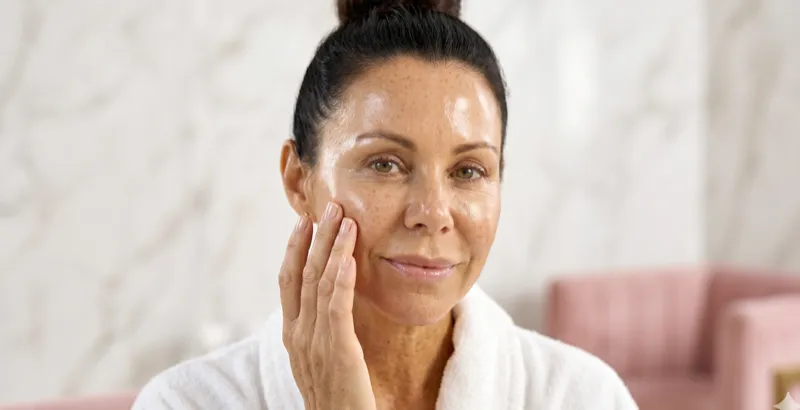
The science of skin aging is evolving rapidly — and for women navigating the skin changes that come with menopause and beyond, evidence-based skincare represents a fundamentally different approach: working with your skin's biology rather than against it.
Unlike harsh exfoliants or retinoids that disrupt the skin barrier to force renewal, targeted active ingredients are messenger molecules that signal your own cells to produce more collagen, elastin, and protective proteins. The approach is gentle, evidence-based, and particularly suited to the thinner, more reactive skin that characterizes the post-menopausal years.
Microneedling Beyond the Face: Neck and Chest
The neck and décolleté are among the most neglected areas in anti-aging care despite being among the first to reveal age — the thin dermis, minimal sebaceous gland density, and decades of sun exposure create an environment where collagen degradation is often more advanced than on the treated face. Microneedling offers a particularly effective treatment for these areas because it directly stimulates the collagen production that topical products struggle to deliver through the unique dermal architecture of neck and chest skin. The neck dermis averages 0.8-1.0mm in thickness (versus 1.5-2.0mm on the cheeks), with correspondingly lower collagen density and a thinner epidermis that makes topical penetration more variable. A 2017 study in Dermatologic Surgery evaluated microneedling specifically for neck and décolleté rejuvenation in 30 women aged 45-65 and documented a mean 28% improvement in crepiness scores and 23% improvement in wrinkle depth at 3 months post-treatment — results that exceeded those typically achieved with topical retinoids alone on these areas.[1]
Needle depth for neck and décolleté microneedling must be reduced compared to facial treatment due to the thinner dermis and the proximity of important structures (thyroid gland, carotid vessels in the anterior neck, bony prominences of the clavicles and sternum on the décolleté). The clinical recommendation for at-home treatment is 0.25mm for the neck (where the skin is thinnest and most sensitive) and 0.25-0.5mm for the décolleté (where the skin is slightly thicker but still thinner than facial skin). Never use 0.5mm or deeper on the anterior neck — the skin here is comparable in thickness to periorbital skin and has similarly fragile capillary networks that are easily damaged. The lateral neck and décolleté can tolerate 0.5mm depth in most women, but should be introduced cautiously with a patch test on a small area before full treatment. A 2019 protocol study in the Journal of Cosmetic Dermatology recommended starting with 0.25mm on all neck and chest areas for the first 3 sessions before advancing to 0.5mm on the décolleté only, monitoring for adverse events at each step.
Clinical research confirms that technique modifications for neck and décolleté microneedling address the anatomical differences from facial treatment. The neck has more mobile skin with less underlying tissue support than the face, requiring the non-treating hand to gently stretch the skin taut during needling to ensure consistent needle penetration rather than the skin simply deflecting under the device pressure. On the décolleté, the bony prominences of the clavicles and sternum create areas where skin is very thin and stretched directly over bone — avoid needling directly over these bony landmarks where the lack of subcutaneous padding increases the risk of excessive trauma. Treat the soft tissue between and below the clavicles, the medial chest above the breast tissue, and the lateral décolleté where the skin has more adipose support. Post-treatment care for neck and décolleté is identical to facial protocol: hyaluronic acid serum during and immediately after treatment, ceramide moisturizer to seal, and rigorous mineral sunscreen for 72 hours — the latter being especially important for the décolleté, which receives significant direct sun exposure that the jaw and chin partially shade from the face.
The treatment schedule for neck and décolleté should be less aggressive than the facial microneedling schedule, reflecting the thinner skin's reduced recovery capacity. For collagen induction: 0.25mm every 14 days on the neck, 0.5mm every 21 days on the décolleté. For product absorption: 0.25mm weekly on both areas with hyaluronic acid serum. Combine microneedling with a daily retinol or bakuchiol application to the neck and chest (many women apply anti-aging products to the face but neglect these areas), and ensure that morning sunscreen extends from the face down to the décolleté — the chest receives substantial UV exposure that drives the crepey, hyperpigmented aging pattern common in this area. Results on the neck and décolleté typically take longer to become visible than on the face (16-24 weeks versus 8-12 weeks), reflecting the lower collagen density and slower healing in these thinner-skinned areas. Patience and consistency are essential — the cumulative collagen deposition from monthly sessions builds gradually into visible texture and firmness improvement.
Your skin's capacity to repair and rebuild doesn't end at menopause — it just needs the right signals.
— Dr. Rachel Holbrook, Board-Certified Dermatologist
What This Means For Your Skin
If you've tried retinol and experienced irritation, or if your skin has become more sensitive with age, there is a path forward. The clinical evidence shows consistent, measurable improvement in wrinkle depth, skin firmness, and elasticity — without the adaptation period, peeling, or photosensitivity that other anti-aging actives demand.
Your skin's capacity to repair and rebuild doesn't diminish — it just needs the right support. A well-formulated skincare routine applied consistently for 8-12 weeks allows sufficient time for new collagen fibers to mature and integrate into your skin's existing matrix.
The science is clear. The evidence is consistent. The results are measurable.
What happens next is up to you.