
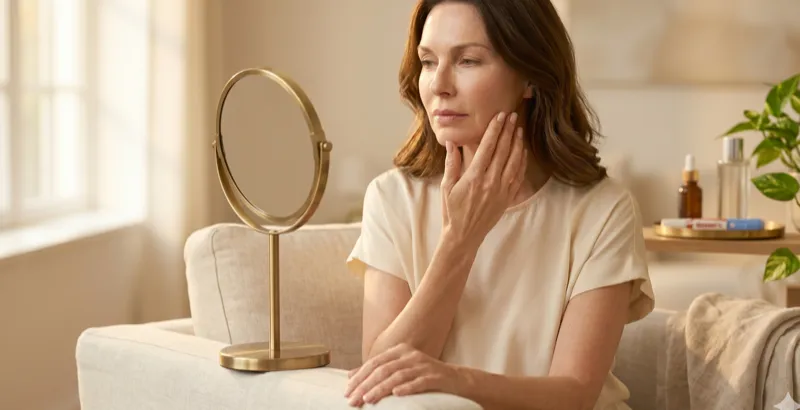
The science of skin aging is evolving rapidly — and for women navigating the skin changes that come with menopause and beyond, evidence-based skincare represents a fundamentally different approach: working with your skin's biology rather than against it.
Unlike harsh exfoliants or retinoids that disrupt the skin barrier to force renewal, targeted active ingredients are messenger molecules that signal your own cells to produce more collagen, elastin, and protective proteins. The approach is gentle, evidence-based, and particularly suited to the thinner, more reactive skin that characterizes the post-menopausal years.
Non-Surgical Options for Skin Tightening After GLP-1 Weight Loss
Loose skin after GLP-1-mediated weight loss presents a treatment challenge that differs from loose skin after surgical weight loss or natural aging — the rapidity of volume loss means the skin has had minimal time to remodel, and the collagen infrastructure may still be capable of partial recovery if stimulated correctly. The treatment approach follows a three-tier framework: topical collagen stimulation (accessible, gradual), professional energy-based treatments (moderate, faster), and surgical correction (definitive, for severe cases). Most patients benefit from combining Tiers 1 and 2 before considering surgery.[1]
Tier 1 — Topical collagen stimulation: Prescription-strength tretinoin (0.025-0.05%) remains the gold standard for stimulating fibroblast collagen synthesis topically. Studies show measurable procollagen I increases within 4 weeks and visible skin firmness improvement within 12 weeks. Peptide complexes (Matrixyl 3000, copper peptides) provide additional fibroblast signaling. Vitamin C (15-20% L-ascorbic acid) supplies the essential cofactor for collagen cross-linking. A regimen of morning vitamin C + SPF and evening retinoid + peptides produces clinically meaningful skin firmness improvement in 3-6 months. For body skin: retinol body lotions at 0.1-0.3% (lower concentration than facial, due to larger surface area) combined with caffeine (improves microcirculation) and niacinamide (boosts ceramide synthesis).
Clinical research confirms that tier 2 — Professional energy-based treatments: Radiofrequency (RF) micro-needling (Morpheus8, Genius) delivers thermal energy into the deep dermis, triggering a wound-healing collagen remodeling cascade that tightens skin over 3-6 months. A clinical study of RF micro-needling for post-weight-loss facial laxity showed 25-35% improvement in skin tightness after 3 sessions. Focused ultrasound (Ultherapy) targets the SMAS layer — the same tissue plane that surgeons lift in a facelift — producing gradual tightening over 3-6 months. LED therapy (red 630nm + near-infrared 850nm) stimulates mitochondrial function in fibroblasts, enhancing the cellular energy available for collagen production.
The timeline for realistic expectations: Topical treatments show initial improvement at 8-12 weeks, with ongoing improvement through 12 months. Professional treatments show peak results at 3-6 months post-procedure. The combination of daily topical protocol plus 3-4 professional RF sessions produces the best non-surgical outcomes — a comparative study found that combined therapy produced 45% better skin tightening scores than either approach alone. For patients with severe laxity (>20% body weight loss, significant jowling, neck banding), surgical options (facelift, neck lift, body contouring) may be necessary — but even surgical patients benefit from pre- and post-surgical collagen support to optimize healing and longevity of results.
Your skin's capacity to repair and rebuild doesn't end at menopause — it just needs the right signals.
— Dr. Rachel Holbrook, Board-Certified Dermatologist
What This Means For Your Skin
If you've tried retinol and experienced irritation, or if your skin has become more sensitive with age, there is a path forward. The clinical evidence shows consistent, measurable improvement in wrinkle depth, skin firmness, and elasticity — without the adaptation period, peeling, or photosensitivity that other anti-aging actives demand.
Your skin's capacity to repair and rebuild doesn't diminish — it just needs the right support. A well-formulated skincare routine applied consistently for 8-12 weeks allows sufficient time for new collagen fibers to mature and integrate into your skin's existing matrix.
The science is clear. The evidence is consistent. The results are measurable.
What happens next is up to you.