
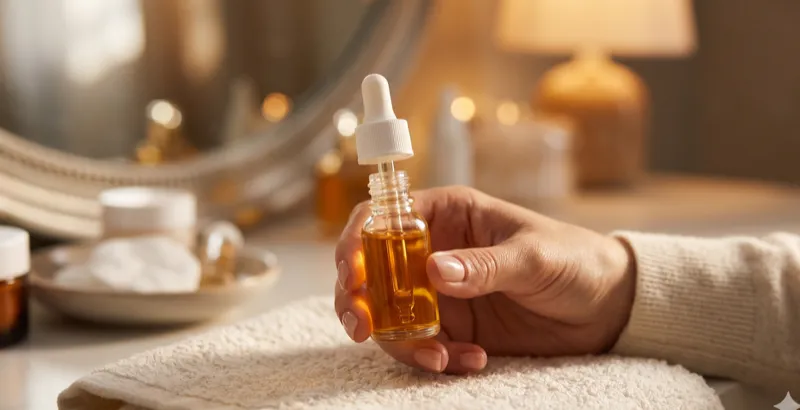
The science of skin aging is evolving rapidly — and for women navigating the skin changes that come with menopause and beyond, evidence-based skincare represents a fundamentally different approach: working with your skin's biology rather than against it.
Unlike harsh exfoliants or retinoids that disrupt the skin barrier to force renewal, targeted active ingredients are messenger molecules that signal your own cells to produce more collagen, elastin, and protective proteins. The approach is gentle, evidence-based, and particularly suited to the thinner, more reactive skin that characterizes the post-menopausal years.
The Clinical Evidence Shows Retinol Thickens Skin — Not Thins It
The myth that retinol thins the skin is perhaps the most persistent and most harmful misconception in skincare, because it discourages women from using the one ingredient most capable of reversing the skin thinning that actually occurs with age. The clinical evidence is unequivocal: retinoids thicken the skin, not thin it. This has been demonstrated in dozens of controlled studies using objective measurement techniques including skin biopsies, ultrasound thickness measurements, and histological analysis. Griffiths et al. (1993) in the New England Journal of Medicine showed that topical tretinoin increased epidermal thickness by 25% and stimulated new collagen formation in the papillary dermis. Kang et al. (2001) confirmed these findings with retinol specifically (not just prescription tretinoin), demonstrating increased epidermal thickness and dermal collagen deposition after 7 days of retinol application, with progressive thickening over 12 months of use.[1]
Where does the thinning myth come from? The confusion arises from two observable phenomena that occur during the retinol adaptation period: (1) The peeling response — retinoids accelerate keratinocyte turnover, shedding the outermost layers of the stratum corneum faster than the skin is accustomed to. This desquamation (peeling) creates the visual impression that the skin is becoming thinner, when in reality it is shedding accumulated dead cells while simultaneously stimulating new cell production underneath. The net effect is a thicker, healthier epidermis — but the surface peeling during the first 2-4 weeks looks and feels like thinning. (2) Increased transparency — as retinol compacts and smooths the stratum corneum, the skin surface becomes more optically transparent. Blood vessels beneath the skin become more visible, creating an appearance of thinner, more delicate skin. This is a cosmetic effect of improved surface quality, not actual structural thinning.
Clinical research confirms that the measurable reality: skin thickness measurements before and after retinoid treatment consistently show increases across every study methodology: (a) Epidermal thickness increases by 20-30% over 12-24 weeks of consistent retinol use. Retinoids stimulate keratinocyte proliferation in the basal layer, producing more cells that migrate upward, creating a thicker living epidermis. (b) Dermal thickness increases through new collagen deposition — retinoid receptor activation upregulates procollagen I and III gene expression in fibroblasts, producing measurable increases in dermal collagen density. This is the primary mechanism by which retinol reverses the skin thinning that occurs with chronological aging and photodamage. (c) The stratum corneum (the dead outer layer) initially becomes thinner as accumulated corneocytes are shed, but this is the removal of non-functional dead tissue, not thinning of living skin. The stratum corneum then normalizes to a healthier, more compact configuration.
The clinical bottom line: if you are concerned about skin thinning — whether from aging, menopause, or sun damage — retinol is one of the most effective interventions available to reverse it. The very ingredient feared for causing thinning is in fact the strongest evidence-based treatment for thickening aging skin. The key is proper use: start at 0.25% retinol, introduce gradually (once per week, increasing over 8-12 weeks), use the ceramide sandwich method to buffer irritation, and expect the adaptation period (mild peeling, slight redness) to resolve within 4-8 weeks. After adaptation, the skin is measurably thicker, denser, and more resilient than before treatment began. Women who avoid retinol because of the thinning myth are inadvertently allowing their skin to continue the thinning trajectory that aging imposes — the very outcome they feared retinol would cause.
Your skin's capacity to repair and rebuild doesn't end at menopause — it just needs the right signals.
— Dr. Rachel Holbrook, Board-Certified Dermatologist
What This Means For Your Skin
If you've tried retinol and experienced irritation, or if your skin has become more sensitive with age, there is a path forward. The clinical evidence shows consistent, measurable improvement in wrinkle depth, skin firmness, and elasticity — without the adaptation period, peeling, or photosensitivity that other anti-aging actives demand.
Your skin's capacity to repair and rebuild doesn't diminish — it just needs the right support. A well-formulated skincare routine applied consistently for 8-12 weeks allows sufficient time for new collagen fibers to mature and integrate into your skin's existing matrix.
The science is clear. The evidence is consistent. The results are measurable.
What happens next is up to you.