
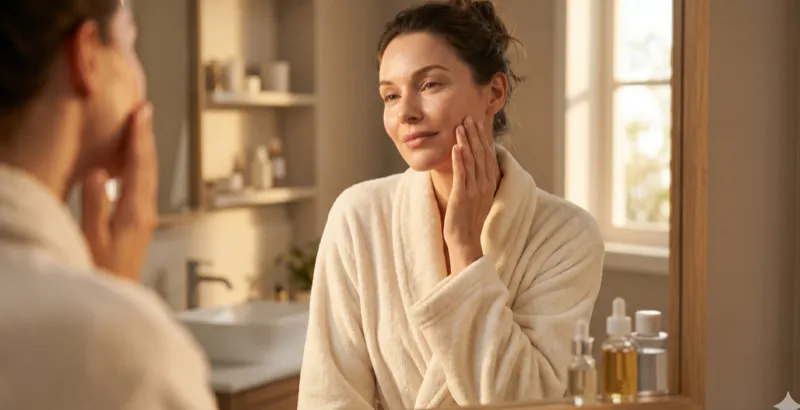
The science of skin aging is evolving rapidly — and for women navigating the skin changes that come with menopause and beyond, evidence-based skincare represents a fundamentally different approach: working with your skin's biology rather than against it.
Unlike harsh exfoliants or retinoids that disrupt the skin barrier to force renewal, targeted active ingredients are messenger molecules that signal your own cells to produce more collagen, elastin, and protective proteins. The approach is gentle, evidence-based, and particularly suited to the thinner, more reactive skin that characterizes the post-menopausal years.
The Evidence-Based Essentials That Deliver Results Without Premium Pricing
The relationship between skincare product price and anti-aging efficacy is far weaker than the beauty industry suggests. The active ingredients that produce measurable anti-aging results — retinol, vitamin C, peptides, ceramides, niacinamide, hyaluronic acid — are well-characterized molecules that function identically regardless of the brand or price of the product containing them. A $15 retinol at 0.5% activates the same RAR/RXR receptors as a $150 retinol at 0.5%. The fibroblast does not know or care about the price tag. The factors that differentiate expensive from affordable products — elegant textures, luxury packaging, brand prestige, exotic secondary ingredients, sophisticated fragrance — provide sensory pleasure but do not increase the efficacy of the active ingredients that drive structural anti-aging results.[1]
The budget-optimized anti-aging routine — 4 essential products: (1) Retinol serum or cream (0.3-0.5%) — the most evidence-based anti-aging active. Affordable options: The Ordinary Retinol 0.5% in Squalane (~$7), CeraVe Resurfacing Retinol Serum (~$18), La Roche-Posay Retinol B3 Serum (~$35). All contain retinol at functional concentrations in stable formulations. (2) Vitamin C serum (15-20% L-ascorbic acid) — collagen cofactor and antioxidant. Affordable options: Timeless 20% Vitamin C+E Ferulic Acid Serum (~$25), The Ordinary Vitamin C Suspension 23% (~$6), La Roche-Posay Vitamin C Serum (~$30). The Timeless formulation is a close analogue to the original SkinCeuticals CE Ferulic at one-sixth the price. (3) Ceramide moisturizer — barrier repair and product seal. CeraVe Moisturizing Cream (~$16 for 19oz) contains ceramides NP, AP, and EOP with cholesterol and hyaluronic acid in a physiological ratio. This is the gold-standard barrier repair formulation at a drugstore price. (4) SPF 50 broad-spectrum sunscreen — the most impactful single anti-aging product. Affordable options: CeraVe Ultra-Light Moisturizing Lotion SPF 30 (~$15), La Roche-Posay Anthelios (~$25), Neutrogena Ultra Sheer SPF 50 (~$12).
Clinical research confirms that total monthly cost of the budget-optimized routine: approximately $8-15 per month (based on product lifespan of 2-4 months per product at the prices listed). This is less than the cost of two specialty coffees per week — yet it provides the same active ingredients, at the same functional concentrations, through the same biological mechanisms, as routines costing $200+ per month. Where premium products may justify higher prices: (1) Formulation elegance — expensive products often have superior texture, spread, and cosmetic feel. If this elegance increases your enjoyment and consistency, the premium is a consistency investment. (2) Stability engineering — some premium brands invest heavily in stabilization technology (airless pumps, encapsulated actives, anhydrous formulations) that extends shelf life and ensures active ingredient delivery. (3) Combined formulations — premium products may combine multiple actives in a single, well-formulated product, simplifying the routine (fewer products to buy and apply).
Where premium products do NOT justify higher prices: (1) Higher-than-functional concentrations — retinol at 1.0% does not produce proportionally better results than retinol at 0.5% and causes more irritation. Paying more for higher concentration often pays for worse outcomes. (2) Proprietary complexes — marketing terms like 'exclusive regenerating complex' or 'patented youth matrix' typically describe combinations of standard ingredients (peptides, antioxidants, plant extracts) at undisclosed concentrations. Without concentration transparency, efficacy cannot be evaluated. (3) Luxury secondary ingredients — gold, diamond powder, caviar extract, truffle oil, and other luxury-signaling ingredients have negligible or no evidence for anti-aging efficacy. They justify premium pricing through perceived luxury, not demonstrated results. The bottom line: effective anti-aging skincare is accessible at every budget. The four essential actives (retinol, vitamin C, ceramides, SPF) are available for under $15/month total. Consistency of application matters infinitely more than product price. Save the luxury budget for the silk pillowcase — that is a proven investment.
Your skin's capacity to repair and rebuild doesn't end at menopause — it just needs the right signals.
— Dr. Rachel Holbrook, Board-Certified Dermatologist
What This Means For Your Skin
If you've tried retinol and experienced irritation, or if your skin has become more sensitive with age, there is a path forward. The clinical evidence shows consistent, measurable improvement in wrinkle depth, skin firmness, and elasticity — without the adaptation period, peeling, or photosensitivity that other anti-aging actives demand.
Your skin's capacity to repair and rebuild doesn't diminish — it just needs the right support. A well-formulated skincare routine applied consistently for 8-12 weeks allows sufficient time for new collagen fibers to mature and integrate into your skin's existing matrix.
The science is clear. The evidence is consistent. The results are measurable.
What happens next is up to you.