
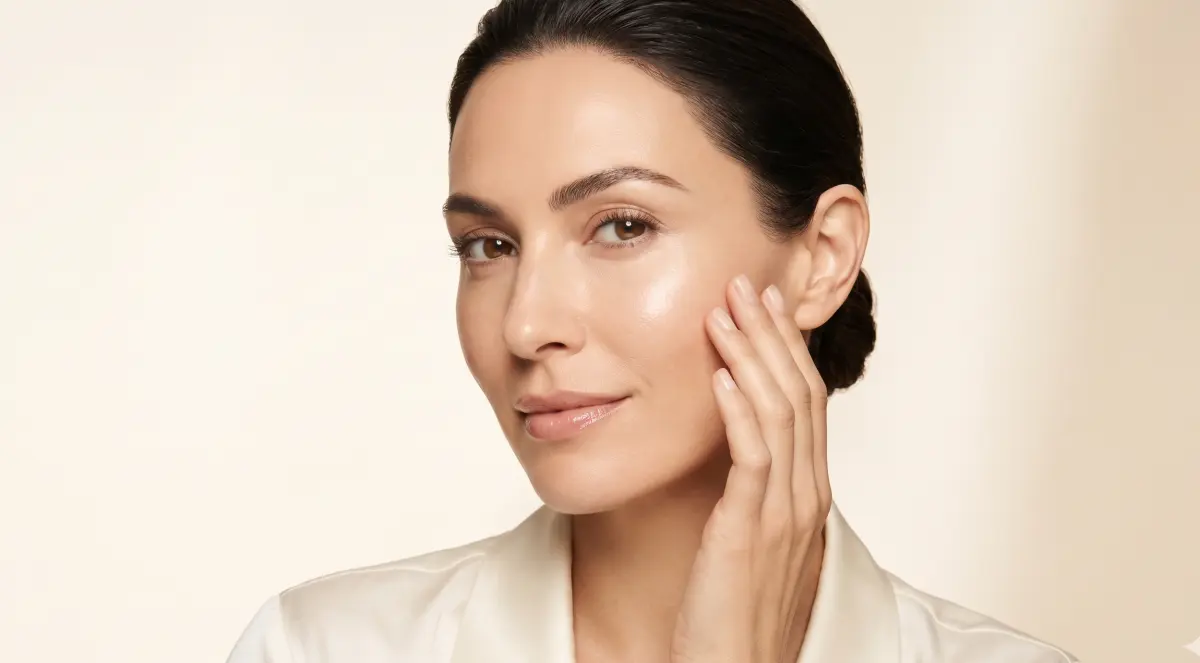
The science of skin aging is evolving rapidly — and for women navigating the skin changes that come with menopause and beyond, evidence-based skincare represents a fundamentally different approach: working with your skin's biology rather than against it.
Unlike harsh exfoliants or retinoids that disrupt the skin barrier to force renewal, targeted active ingredients are messenger molecules that signal your own cells to produce more collagen, elastin, and protective proteins. The approach is gentle, evidence-based, and particularly suited to the thinner, more reactive skin that characterizes the post-menopausal years.
Evidence-Based Strategies for Smoother, More Refined Skin After 40
Skin texture deterioration after 40 is one of the most universal yet least understood aspects of facial aging. While most women focus on wrinkles and pigmentation, texture changes — roughness, enlarged pores, uneven surface, loss of luminosity — are often the earliest visible aging markers and the most significant contributors to the perception of 'aged' skin. Texture is determined by the regularity of the skin's surface topography: young skin has a fine, uniform micro-relief pattern created by evenly spaced furrows (sulci cutis) intersecting at regular angles. With aging, this organized pattern degrades into an irregular, coarser surface as keratinocyte turnover slows, the epidermis thins unevenly, and dermal collagen support weakens.[1]
The biology of texture decline after 40 involves four simultaneous processes. First, epidermal turnover slows dramatically — keratinocyte transit time from basal layer to surface increases from approximately 28 days in young skin to 40-60 days after 40, creating a thicker layer of dead cells (corneocytes) that scatters light irregularly and feels rough. Second, sebaceous gland function changes with hormonal shifts during perimenopause — decreased estrogen alters sebum composition, contributing to enlarged pores and uneven oil distribution. Third, dermal collagen fragmentation disrupts the structural support beneath the epidermis, causing surface irregularities that manifest as visible texture. Fourth, cumulative photodamage creates focal areas of elastosis (damaged elastic tissue) interspersed with normal skin, producing the characteristic 'mottled' texture of photoaged skin.
Clinical research confirms that clinical assessment of skin texture uses several objective measures. Surface roughness can be quantified using profilometry (optical or contact-based measurement of surface topography), while skin luminosity — which is directly related to texture smoothness — can be measured spectrophotometrically. Studies using these instruments have demonstrated that women over 40 show 30-50% greater surface roughness values compared to women in their 20s, with the steepest decline occurring during perimenopause when estrogen withdrawal accelerates epidermal thinning and collagen loss simultaneously. Importantly, perceived age correlates more strongly with skin texture and luminosity than with wrinkle depth — a smooth, luminous complexion reads as 'younger' even in the presence of expression lines.
Improving skin texture after 40 requires a multi-target approach that addresses all four underlying mechanisms. Accelerating epidermal turnover with retinoids and chemical exfoliants removes the dead cell buildup that creates roughness. Stimulating collagen production with retinoids and peptides restores the dermal support that creates surface smoothness. Normalizing sebaceous function with niacinamide and hormonal support reduces pore enlargement. And protecting against further photodamage with daily sunscreen prevents additional texture degradation. The most effective programs combine these approaches in a systematic routine that produces measurable improvement within 8-12 weeks and continues improving for 6-12 months.
Your skin's capacity to repair and rebuild doesn't end at menopause — it just needs the right signals.
— Dr. Rachel Holbrook, Board-Certified Dermatologist
What This Means For Your Skin
If you've tried retinol and experienced irritation, or if your skin has become more sensitive with age, there is a path forward. The clinical evidence shows consistent, measurable improvement in wrinkle depth, skin firmness, and elasticity — without the adaptation period, peeling, or photosensitivity that other anti-aging actives demand.
Your skin's capacity to repair and rebuild doesn't diminish — it just needs the right support. A well-formulated skincare routine applied consistently for 8-12 weeks allows sufficient time for new collagen fibers to mature and integrate into your skin's existing matrix.
The science is clear. The evidence is consistent. The results are measurable.
What happens next is up to you.