
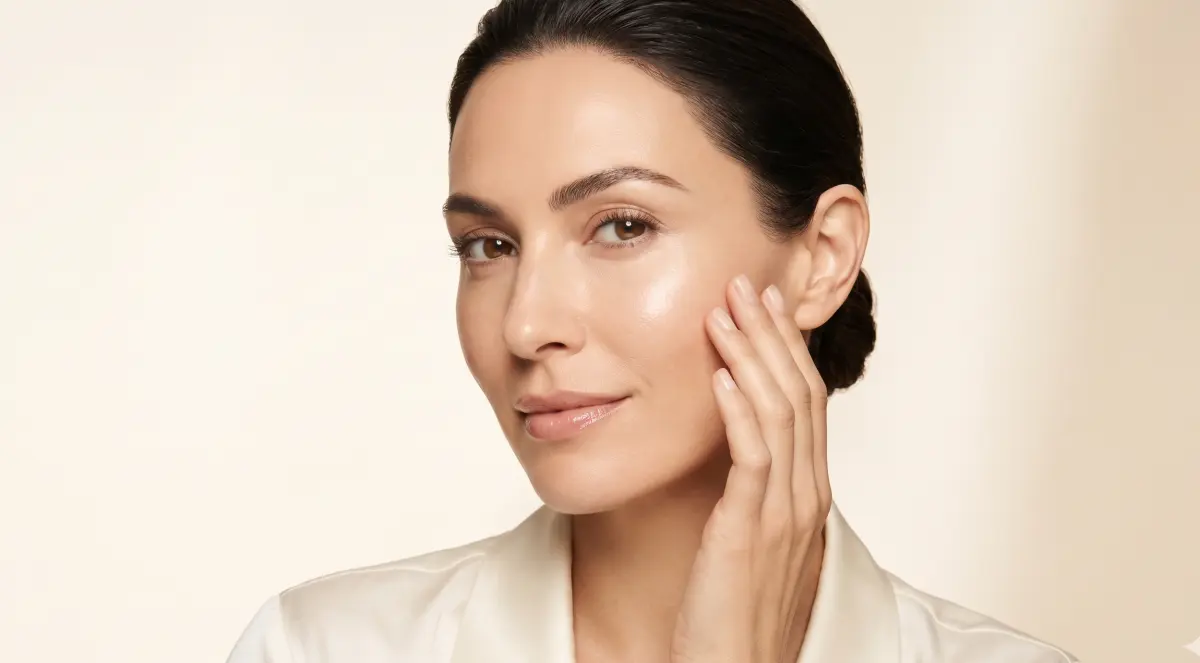
The science of skin aging is evolving rapidly — and for women navigating the skin changes that come with menopause and beyond, evidence-based skincare represents a fundamentally different approach: working with your skin's biology rather than against it.
Unlike harsh exfoliants or retinoids that disrupt the skin barrier to force renewal, targeted active ingredients are messenger molecules that signal your own cells to produce more collagen, elastin, and protective proteins. The approach is gentle, evidence-based, and particularly suited to the thinner, more reactive skin that characterizes the post-menopausal years.
How Retinoids Resurface and Refine Skin at the Cellular Level
Retinoids are the single most effective topical ingredient for skin texture improvement — a status supported by over four decades of clinical research and a mechanism of action that addresses every major cause of textural decline simultaneously. Retinoids (tretinoin, retinol, retinaldehyde, adapalene) work by binding to nuclear retinoic acid receptors (RARs) in keratinocytes and fibroblasts, activating gene transcription programs that accelerate epidermal turnover, stimulate collagen synthesis, normalize keratinization, and regulate sebaceous activity. No other single ingredient addresses this breadth of texture-relevant pathways.[1]
The epidermal effects of retinoids on texture are measurable within 4-8 weeks. Retinoids increase keratinocyte proliferation in the basal layer, reducing transit time from approximately 50+ days back toward the youthful 28-day cycle. This accelerated turnover sheds the accumulated dead cells that create roughness, while the newly formed epidermis has more regular corneocyte stacking and improved barrier lipid organization. The result is a smoother surface that reflects light more uniformly, producing the characteristic 'retinol glow.' Histological studies confirm that retinoid-treated skin shows a thicker, more organized epidermis with regular rete ridge architecture — the structural pattern associated with young, smooth skin.
Clinical research confirms that the dermal effects on texture develop more slowly but are more significant long-term. Tretinoin increases procollagen I and III mRNA expression in fibroblasts, producing measurable increases in dermal collagen density after 12-24 weeks of use. Simultaneously, retinoids reduce MMP-1 (collagenase) expression, shifting the collagen balance from net degradation to net production. This restored collagen creates a smoother dermal surface that the epidermis reflects, improving the macro-texture of the skin. Kang et al. demonstrated that 0.1% tretinoin applied for 12 months produced an 80% increase in procollagen I staining in the papillary dermis — a dramatic structural improvement that translates directly to surface smoothness.
For texture-focused retinoid therapy, the protocol matters as much as the ingredient. Starting with retinol 0.3% three nights weekly allows the skin to build tolerance without the excessive peeling and irritation that cause many women to abandon treatment prematurely. After 4-6 weeks, increasing to 0.5% retinol nightly provides the therapeutic dose for epidermal turnover acceleration. After 3-6 months of established tolerance, transitioning to prescription tretinoin 0.025-0.05% delivers the maximum collagen-stimulating benefit. The texture improvement timeline: weeks 2-4, initial purging and mild peeling (the retinoid is accelerating turnover, pushing old cells out faster); weeks 4-8, noticeable smoothness and improved light reflection; weeks 8-16, visible pore refinement and reduced roughness; months 4-12, progressive improvement in overall texture, tone, and luminosity as collagen remodeling matures.
Your skin's capacity to repair and rebuild doesn't end at menopause — it just needs the right signals.
— Dr. Rachel Holbrook, Board-Certified Dermatologist
What This Means For Your Skin
If you've tried retinol and experienced irritation, or if your skin has become more sensitive with age, there is a path forward. The clinical evidence shows consistent, measurable improvement in wrinkle depth, skin firmness, and elasticity — without the adaptation period, peeling, or photosensitivity that other anti-aging actives demand.
Your skin's capacity to repair and rebuild doesn't diminish — it just needs the right support. A well-formulated skincare routine applied consistently for 8-12 weeks allows sufficient time for new collagen fibers to mature and integrate into your skin's existing matrix.
The science is clear. The evidence is consistent. The results are measurable.
What happens next is up to you.