
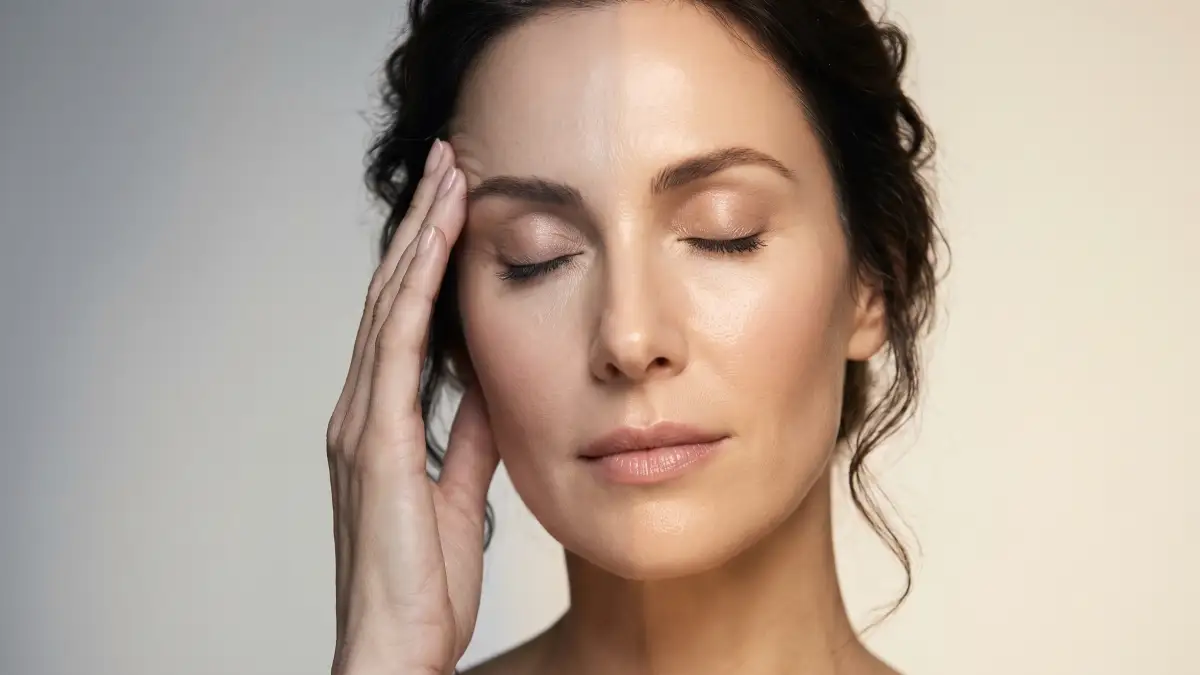
The science of skin aging is evolving rapidly — and for women navigating the skin changes that come with menopause and beyond, evidence-based skincare represents a fundamentally different approach: working with your skin's biology rather than against it.
Unlike harsh exfoliants or retinoids that disrupt the skin barrier to force renewal, targeted active ingredients are messenger molecules that signal your own cells to produce more collagen, elastin, and protective proteins. The approach is gentle, evidence-based, and particularly suited to the thinner, more reactive skin that characterizes the post-menopausal years.
Why Cortisol Impact Intensifies After Perimenopause Begins
The impact of stress on skin aging intensifies dramatically after 40 due to a hormonal shift that removes the skin's primary protective buffer against cortisol damage: estrogen. Estrogen is a potent stimulator of collagen synthesis, hyaluronic acid production, and skin barrier lipid formation — it directly counterbalances cortisol's degradative effects. During the reproductive years, estrogen provides a protective shield: even when cortisol is elevated, estrogen-stimulated collagen production partially offsets cortisol-driven collagen degradation. After perimenopause begins (typically in the early-to-mid 40s), estrogen declines by 2-3% per year, progressively removing this counterbalance and leaving cortisol's effects unopposed.[1]
The numbers quantify the vulnerability: in the five years following menopause, women lose approximately 30% of their dermal collagen — a decline driven primarily by estrogen loss but significantly amplified by cortisol. A woman experiencing chronic stress during perimenopause faces a compounding triple assault: declining estrogen-stimulated collagen production, normal age-related fibroblast slowdown (1-1.5% decline per year), and cortisol-driven MMP activation that actively degrades existing collagen. Slominski's research on neuroendocrine regulation of skin function demonstrated that the skin's local HPA axis becomes more reactive after menopause, producing higher levels of local cortisol in response to the same stress stimulus — meaning the same stressor at 45 produces more skin damage than the identical stressor at 35.
Clinical research confirms that the cortisol-estrogen imbalance after 40 creates specific clinical patterns. Accelerated volume loss: estrogen-supported fat pads in the cheeks and periorbital area lose volume faster under cortisol influence, creating hollow cheeks and deepened tear troughs. Rapid barrier deterioration: without estrogen's lipid-stimulating effect, cortisol's barrier-damaging action produces increasingly severe dryness, sensitivity, and TEWL. Inflammatory amplification: estrogen has anti-inflammatory properties that temper cortisol's paradoxical inflammatory effects; without this modulation, stress-driven inflammation becomes more pronounced and persistent. Hair and scalp changes: cortisol accelerates telogen effluvium (stress-related hair shedding) more aggressively when estrogen is no longer supporting the anagen growth phase.
Managing stress-hormone skin aging after 40 requires a more aggressive and comprehensive approach than the same woman needed at 30. Topical strategy: retinoids become essential (not optional) to compensate for lost estrogen-driven collagen gene activation. Peptides (Matrixyl, GHK-Cu) provide supplementary fibroblast stimulation. Ceramide-rich moisturizers address the barrier vulnerability that estrogen withdrawal creates. Phytoestrogen-containing products (soy isoflavones, red clover) may provide mild local estrogenic activity. Systemic strategy: stress management transitions from beneficial to medically necessary — cortisol reduction through meditation, exercise, sleep optimization, and potentially adaptogenic supplementation directly protects the collagen that topical products are trying to rebuild. The women who age most gracefully through perimenopause are those who recognize that managing stress is not separate from skincare — it is the foundation upon which every topical product's efficacy depends.
Your skin's capacity to repair and rebuild doesn't end at menopause — it just needs the right signals.
— Dr. Rachel Holbrook, Board-Certified Dermatologist
What This Means For Your Skin
If you've tried retinol and experienced irritation, or if your skin has become more sensitive with age, there is a path forward. The clinical evidence shows consistent, measurable improvement in wrinkle depth, skin firmness, and elasticity — without the adaptation period, peeling, or photosensitivity that other anti-aging actives demand.
Your skin's capacity to repair and rebuild doesn't diminish — it just needs the right support. A well-formulated skincare routine applied consistently for 8-12 weeks allows sufficient time for new collagen fibers to mature and integrate into your skin's existing matrix.
The science is clear. The evidence is consistent. The results are measurable.
What happens next is up to you.