
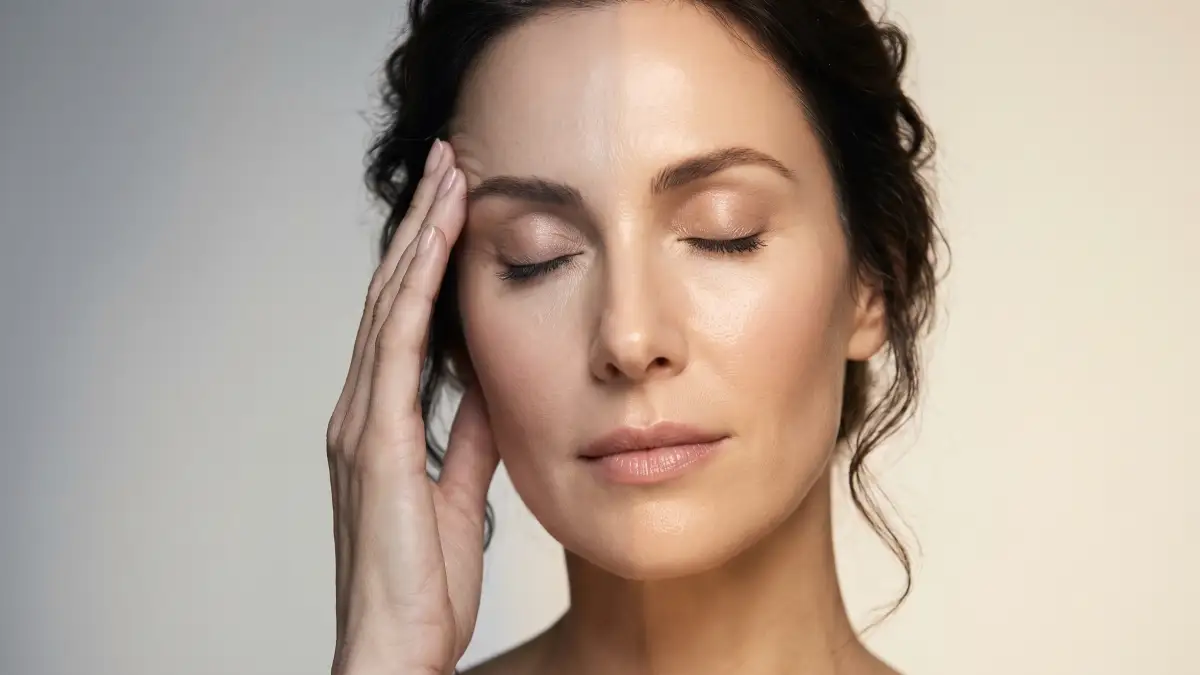
The science of skin aging is evolving rapidly — and for women navigating the skin changes that come with menopause and beyond, evidence-based skincare represents a fundamentally different approach: working with your skin's biology rather than against it.
Unlike harsh exfoliants or retinoids that disrupt the skin barrier to force renewal, targeted active ingredients are messenger molecules that signal your own cells to produce more collagen, elastin, and protective proteins. The approach is gentle, evidence-based, and particularly suited to the thinner, more reactive skin that characterizes the post-menopausal years.
How Psychological Stress Accelerates Visible Skin Aging
The brain-skin axis — the bidirectional communication pathway between the central nervous system and the skin — has emerged as one of the most significant discoveries in dermatological aging research. Chen and Lyga's landmark review established that psychological stress activates the hypothalamic-pituitary-adrenal (HPA) axis, triggering a cascade that begins with corticotropin-releasing hormone (CRH) in the brain and ends with cortisol flooding the dermis. This is not a metaphorical connection: the skin possesses its own fully functional HPA axis, complete with CRH receptors, ACTH production, and local cortisol synthesis. When you are stressed, your skin is literally manufacturing its own stress hormones independently of the adrenal glands.[1]
The aging consequences of chronic stress operate through four distinct biological pathways. First, cortisol directly upregulates matrix metalloproteinases (MMPs) — the enzymes responsible for collagen degradation. MMP-1, MMP-3, and MMP-9 are all elevated during sustained stress, creating an environment where collagen is being actively dismantled faster than fibroblasts can rebuild it. Second, stress triggers a systemic inflammatory response through pro-inflammatory cytokines (IL-1β, IL-6, TNF-α) that damage cellular structures throughout the dermis. Third, oxidative stress increases dramatically — cortisol impairs the skin's antioxidant defense systems, allowing reactive oxygen species to damage DNA, lipids, and proteins. Fourth, stress accelerates telomere shortening in skin cells, pushing them toward senescence and reducing the regenerative capacity of the entire tissue.
Clinical research confirms that clinical evidence quantifies the impact: a study of chronically stressed caregivers showed skin that measured 4-7 years biologically older than their chronological age, with significantly thinner epidermis, reduced collagen density, and higher transepidermal water loss (TEWL) compared to age-matched controls. Perceived stress scores correlated directly with measurable skin aging markers — the higher the stress, the older the skin appeared and measured. This correlation held even after controlling for sun exposure, smoking, diet, and skincare habits, confirming that stress is an independent aging accelerator.
For women over 40, the stress-aging connection becomes particularly dangerous because it compounds the natural decline in collagen production, estrogen levels, and cellular repair capacity that occurs with chronological aging. A woman experiencing chronic stress at 45 faces a dual assault: age-related collagen loss of 1-1.5% per year plus stress-driven MMP activation that may double or triple the degradation rate. The result is accelerated formation of wrinkles, loss of facial volume, barrier compromise leading to dryness and sensitivity, and a dull, sallow complexion that skincare products struggle to correct without addressing the underlying stress physiology.
Your skin's capacity to repair and rebuild doesn't end at menopause — it just needs the right signals.
— Dr. Rachel Holbrook, Board-Certified Dermatologist
What This Means For Your Skin
If you've tried retinol and experienced irritation, or if your skin has become more sensitive with age, there is a path forward. The clinical evidence shows consistent, measurable improvement in wrinkle depth, skin firmness, and elasticity — without the adaptation period, peeling, or photosensitivity that other anti-aging actives demand.
Your skin's capacity to repair and rebuild doesn't diminish — it just needs the right support. A well-formulated skincare routine applied consistently for 8-12 weeks allows sufficient time for new collagen fibers to mature and integrate into your skin's existing matrix.
The science is clear. The evidence is consistent. The results are measurable.
What happens next is up to you.