
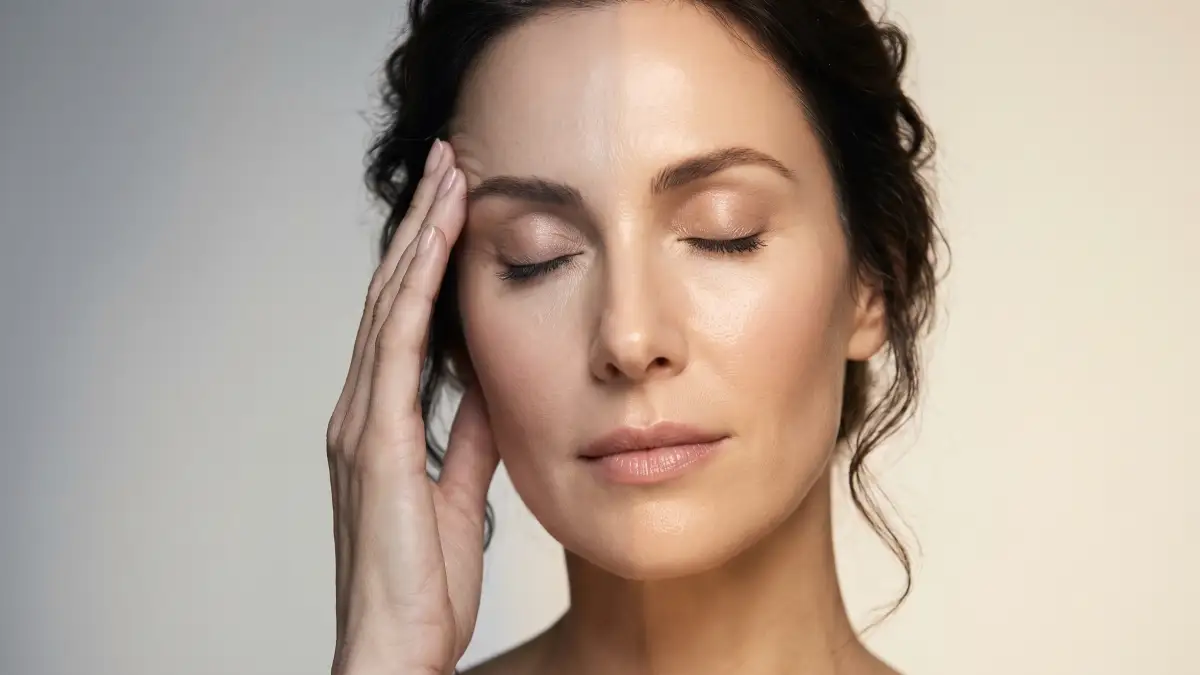
The science of skin aging is evolving rapidly — and for women navigating the skin changes that come with menopause and beyond, evidence-based skincare represents a fundamentally different approach: working with your skin's biology rather than against it.
Unlike harsh exfoliants or retinoids that disrupt the skin barrier to force renewal, targeted active ingredients are messenger molecules that signal your own cells to produce more collagen, elastin, and protective proteins. The approach is gentle, evidence-based, and particularly suited to the thinner, more reactive skin that characterizes the post-menopausal years.
Visible Markers That Reveal Chronic Stress on Your Skin
Chronic stress produces a recognizable pattern of facial aging that dermatologists increasingly refer to as 'stress face' — a constellation of visible changes that differ from purely chronological aging or photoaging. While sun damage tends to affect the cheeks, temples, and décolletage most severely, and chronological aging produces diffuse volume loss, stress-driven aging creates a distinctive signature centered on the upper face, periorbital region, and jawline. Recognizing these patterns is the first step toward targeted intervention.[1]
The hallmark signs of stress-driven facial aging include: Glabellar furrows and forehead lines — chronic stress activates the corrugator supercilii and frontalis muscles through persistent tension, creating deep vertical lines between the brows ('elevens') and horizontal forehead creases that deepen faster than chronological aging would predict. Periorbital changes — cortisol disrupts microcirculation and lymphatic drainage around the eyes, producing dark circles (periorbital hyperpigmentation) and puffiness that become chronic rather than occasional. The combination of darkened under-eyes and volume loss in the tear trough creates the characteristic 'stressed and tired' appearance. Skin dullness — elevated cortisol impairs keratinocyte turnover and reduces blood flow to the dermis, producing a complexion that appears sallow, grey, or lifeless regardless of topical treatments.
Clinical research confirms that additional stress markers include: Jaw tension and masseter hypertrophy — chronic stress often manifests as bruxism (teeth grinding) and jaw clenching, which enlarges the masseter muscle and creates a wider, squarer lower face with deepened marionette lines. Lip area changes — the orbicularis oris muscle tenses under stress, creating perioral lines ('smoker's lines') in women who have never smoked. Neck tension lines — chronic stress creates persistent platysma tension, deepening horizontal neck bands and vertical cords. Skin texture deterioration — cortisol impairs the moisture barrier, leading to roughness, flakiness, and an increase in fine lines across the entire face that develops faster than expected for the woman's age.
The distinguishing feature of stress-driven aging versus photoaging is the pattern of muscle tension involvement. Photoaging produces textural changes (mottling, roughness, solar lentigines) in sun-exposed areas but does not affect muscle tone. Stress aging creates deep expression lines in specific muscle groups (corrugator, frontalis, masseter, orbicularis oris) that appear disproportionately aged compared to the surrounding skin. A dermatologist evaluating stress-related aging can often identify the primary facial muscle tension patterns and recommend targeted treatments — Botox for overactive corrugators, jaw relaxation therapy for masseter hypertrophy, and a comprehensive stress management protocol to address the underlying cortisol elevation driving all of these changes simultaneously.
Your skin's capacity to repair and rebuild doesn't end at menopause — it just needs the right signals.
— Dr. Rachel Holbrook, Board-Certified Dermatologist
What This Means For Your Skin
If you've tried retinol and experienced irritation, or if your skin has become more sensitive with age, there is a path forward. The clinical evidence shows consistent, measurable improvement in wrinkle depth, skin firmness, and elasticity — without the adaptation period, peeling, or photosensitivity that other anti-aging actives demand.
Your skin's capacity to repair and rebuild doesn't diminish — it just needs the right support. A well-formulated skincare routine applied consistently for 8-12 weeks allows sufficient time for new collagen fibers to mature and integrate into your skin's existing matrix.
The science is clear. The evidence is consistent. The results are measurable.
What happens next is up to you.