
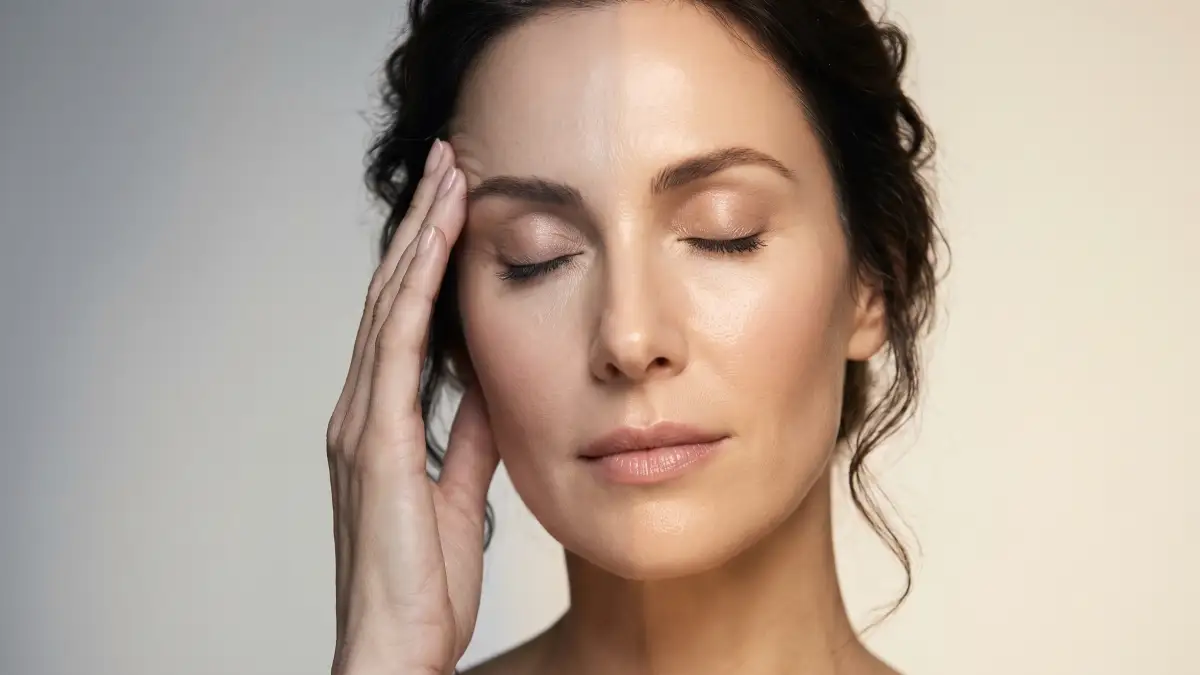
The science of skin aging is evolving rapidly — and for women navigating the skin changes that come with menopause and beyond, evidence-based skincare represents a fundamentally different approach: working with your skin's biology rather than against it.
Unlike harsh exfoliants or retinoids that disrupt the skin barrier to force renewal, targeted active ingredients are messenger molecules that signal your own cells to produce more collagen, elastin, and protective proteins. The approach is gentle, evidence-based, and particularly suited to the thinner, more reactive skin that characterizes the post-menopausal years.
Evidence-Based Stress Management That Measurably Improves Skin
The dermatological evidence for stress management as a skin treatment is remarkably strong — stronger, in some studies, than the evidence for certain topical anti-aging ingredients. A landmark study at the University of California demonstrated that an 8-week stress reduction program produced measurable improvements in skin barrier function (TEWL reduced by 18%), wound healing speed (23% faster), and subjective appearance ratings by blinded evaluators. The mechanism is straightforward: reducing cortisol allows the skin's collagen-producing, barrier-building, and repair systems to function at their designed capacity rather than in a suppressed state.[1]
The evidence-supported stress management techniques with demonstrated skin benefits include: Mindfulness-Based Stress Reduction (MBSR) — the 8-week program developed by Jon Kabat-Zinn has the strongest evidence base for cortisol reduction and immune function improvement. Studies show 15-30% reduction in salivary cortisol after completing the program, which translates to measurable improvement in skin barrier function and reduced inflammatory markers. Cognitive Behavioral Therapy (CBT) — particularly effective for stress that involves rumination and catastrophic thinking patterns. CBT has been shown to reduce cortisol levels and improve outcomes in stress-related skin conditions including eczema, psoriasis, and acne.
Clinical research confirms that breathing techniques offer the fastest acute stress intervention with measurable cortisol impact. Diaphragmatic breathing (4-7-8 pattern: inhale for 4 counts, hold for 7, exhale for 8) activates the parasympathetic nervous system within 60-90 seconds, reducing cortisol production and shifting the body from catabolic (tissue-breaking) to anabolic (tissue-building) metabolism. Practiced twice daily for 5 minutes, breathing exercises produce cumulative reductions in baseline cortisol that improve skin metrics within 4 weeks. Progressive muscle relaxation (PMR) specifically addresses the facial muscle tension that creates stress-related expression lines — the systematic tensing and releasing of facial muscles retrains them to maintain a lower resting tension.
The practical integration of stress management with skincare creates a compounding benefit cycle. Apply your skincare routine during a moment of intentional calm — the parasympathetic state during relaxed skincare application actually enhances ingredient absorption through improved blood flow and reduced vasoconstriction. Evening skincare paired with breathing exercises or meditation creates an association between skincare and relaxation that reinforces both habits. The measurable outcome: women who combine evidence-based stress management with a collagen-stimulating skincare routine show 25-40% greater improvement in skin aging markers at 12 weeks compared to women using skincare alone. Stress management is not a wellness luxury — it is a measurable, evidence-based anti-aging intervention.
Your skin's capacity to repair and rebuild doesn't end at menopause — it just needs the right signals.
— Dr. Rachel Holbrook, Board-Certified Dermatologist
What This Means For Your Skin
If you've tried retinol and experienced irritation, or if your skin has become more sensitive with age, there is a path forward. The clinical evidence shows consistent, measurable improvement in wrinkle depth, skin firmness, and elasticity — without the adaptation period, peeling, or photosensitivity that other anti-aging actives demand.
Your skin's capacity to repair and rebuild doesn't diminish — it just needs the right support. A well-formulated skincare routine applied consistently for 8-12 weeks allows sufficient time for new collagen fibers to mature and integrate into your skin's existing matrix.
The science is clear. The evidence is consistent. The results are measurable.
What happens next is up to you.