
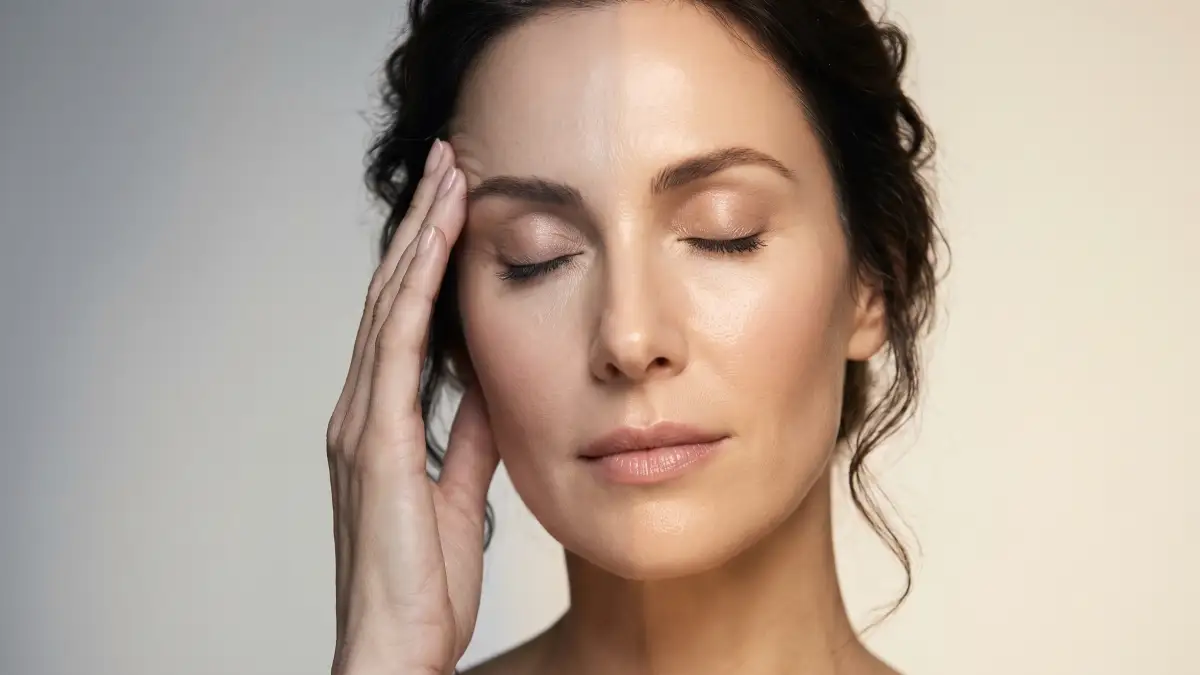
The science of skin aging is evolving rapidly — and for women navigating the skin changes that come with menopause and beyond, evidence-based skincare represents a fundamentally different approach: working with your skin's biology rather than against it.
Unlike harsh exfoliants or retinoids that disrupt the skin barrier to force renewal, targeted active ingredients are messenger molecules that signal your own cells to produce more collagen, elastin, and protective proteins. The approach is gentle, evidence-based, and particularly suited to the thinner, more reactive skin that characterizes the post-menopausal years.
How Poor Sleep Accelerates Every Visible Sign of Aging
Sleep deprivation is one of the most potent stress-related accelerators of skin aging — and it operates through mechanisms that are both cortisol-dependent and independent of stress itself. A landmark study commissioned by Estée Lauder and conducted at University Hospitals Case Medical Center found that poor sleepers (defined as fewer than 5 hours or poor quality sleep) showed significantly increased signs of skin aging including fine lines, uneven pigmentation, reduced elasticity, and slower recovery from UV-induced erythema. The poor sleepers' skin barrier recovered 30% more slowly after tape-stripping than good sleepers, and their perceived age was rated 4-7 years older by blinded observers.[1]
The sleep-skin connection operates through multiple pathways. Cortisol pathway: cortisol follows a circadian rhythm, dropping to its lowest point during deep sleep (between 10 PM and 2 AM) and rising in the early morning. Sleep deprivation prevents cortisol from reaching its nightly nadir, maintaining it at levels 30-45% higher than in well-rested individuals throughout the night. This eliminates the 'repair window' during which the skin's collagen-building and barrier-restoration processes are most active. Growth hormone pathway: human growth hormone (HGH), which stimulates fibroblast activity and collagen synthesis, is released primarily during deep (Stage 3/4 NREM) sleep. Sleep deprivation reduces HGH secretion by 70-80%, effectively shutting down the skin's primary nighttime repair stimulus.
Clinical research confirms that melatonin pathway: melatonin, released during darkness and deep sleep, functions as a potent antioxidant in the skin, scavenging the reactive oxygen species that accumulated during daytime UV and environmental exposure. Sleep deprivation reduces melatonin production, leaving the skin inadequately protected against overnight oxidative damage. The net result is that the skin enters each new day with unrepaired damage from the previous day, creating a cumulative deficit that manifests as accelerated aging. Circadian disruption: the skin's repair processes are clock-gene regulated — fibroblast collagen synthesis, keratinocyte proliferation, and epidermal stem cell activity all peak during specific nighttime hours. Disrupted sleep disrupts these circadian rhythms, desynchronizing repair processes and reducing their efficiency even when total sleep hours are adequate.
Optimizing sleep for skin health requires addressing both sleep quantity and quality. The evidence-based targets are: 7-8 hours of total sleep (below 6 hours, skin aging acceleration is measurable and significant), consistent sleep-wake times (circadian rhythm stability is as important as duration), dark sleeping environment (maximizes melatonin production), cool temperature 65-68°F (facilitates deep sleep where HGH is released), and limited alcohol before bed (alcohol disrupts REM and deep sleep stages even when total sleep duration is adequate). For women using retinoids, the timing alignment is critical: applying retinoid at bedtime and achieving deep sleep during the peak repair window creates a synergistic effect where retinoid-stimulated collagen gene activation coincides with HGH-stimulated fibroblast activity — maximizing the overnight collagen production that sleep is designed to facilitate.
Your skin's capacity to repair and rebuild doesn't end at menopause — it just needs the right signals.
— Dr. Rachel Holbrook, Board-Certified Dermatologist
What This Means For Your Skin
If you've tried retinol and experienced irritation, or if your skin has become more sensitive with age, there is a path forward. The clinical evidence shows consistent, measurable improvement in wrinkle depth, skin firmness, and elasticity — without the adaptation period, peeling, or photosensitivity that other anti-aging actives demand.
Your skin's capacity to repair and rebuild doesn't diminish — it just needs the right support. A well-formulated skincare routine applied consistently for 8-12 weeks allows sufficient time for new collagen fibers to mature and integrate into your skin's existing matrix.
The science is clear. The evidence is consistent. The results are measurable.
What happens next is up to you.