
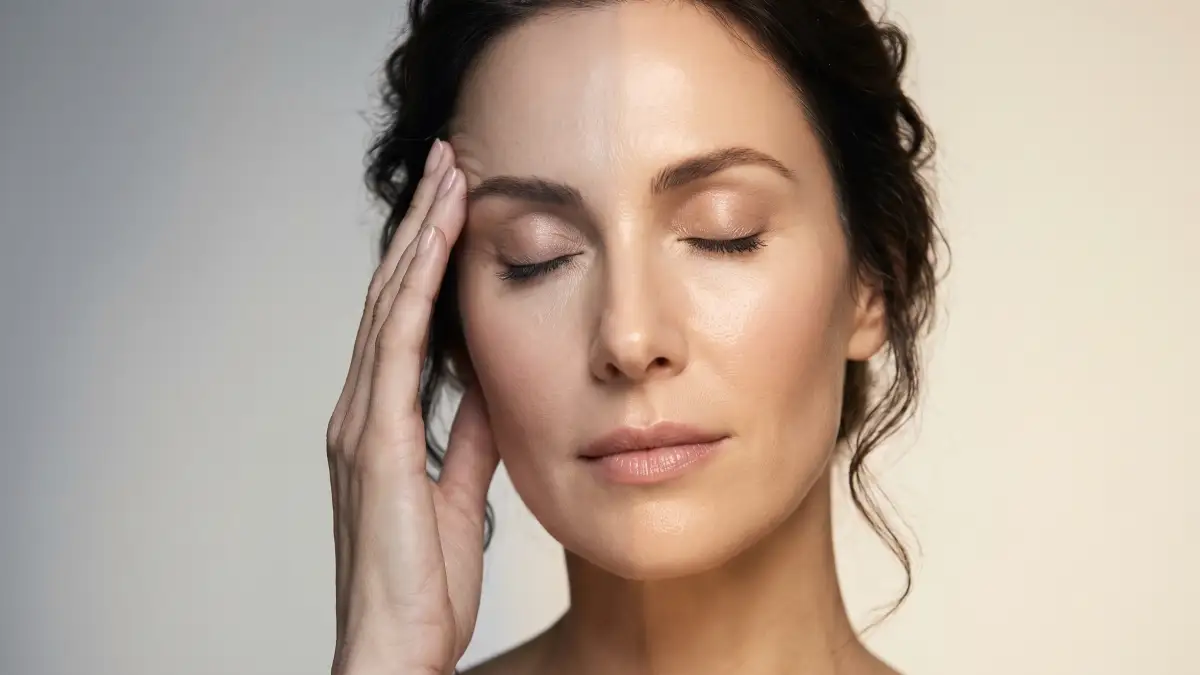
The science of skin aging is evolving rapidly — and for women navigating the skin changes that come with menopause and beyond, evidence-based skincare represents a fundamentally different approach: working with your skin's biology rather than against it.
Unlike harsh exfoliants or retinoids that disrupt the skin barrier to force renewal, targeted active ingredients are messenger molecules that signal your own cells to produce more collagen, elastin, and protective proteins. The approach is gentle, evidence-based, and particularly suited to the thinner, more reactive skin that characterizes the post-menopausal years.
How Cortisol Compromises Your Moisture Barrier Function
The skin barrier — the stratum corneum's lipid-rich matrix of ceramides, cholesterol, and fatty acids that prevents water loss and blocks environmental irritants — is exquisitely sensitive to psychological stress. Altemus et al.'s pioneering study demonstrated that even a single stressful interview disrupted skin barrier recovery in healthy women, slowing the repair of experimentally compromised barrier function by 30-40% compared to non-stressed controls. The mechanism is direct: cortisol inhibits the synthesis of the three key lipid classes (ceramides, cholesterol, and free fatty acids) that form the intercellular mortar of the stratum corneum.[1]
Under chronic stress conditions, the barrier damage becomes self-perpetuating. Elevated cortisol reduces epidermal lipid synthesis, which increases transepidermal water loss (TEWL). Higher TEWL triggers an inflammatory response in the epidermis, which further elevates local cortisol production through the skin's own HPA axis. This creates a vicious cycle: stress damages the barrier, the damaged barrier creates local inflammation, local inflammation produces more cortisol, and more cortisol further impairs barrier repair. Clinical measurement shows that chronically stressed individuals have 20-40% higher TEWL than non-stressed controls, even when using identical skincare routines.
Clinical research confirms that the downstream consequences of stress-impaired barrier function extend far beyond dryness. A compromised barrier allows greater penetration of environmental irritants, allergens, and microbes, triggering reactive skin conditions. Women who develop new-onset sensitivity, rosacea flares, eczema exacerbations, or unexplained facial redness during stressful periods are often experiencing stress-mediated barrier failure rather than a new allergy or skin disease. The barrier compromise also reduces the efficacy of topical treatments — active ingredients like retinoids and vitamin C are more likely to cause irritation when the barrier is impaired, and beneficial ingredients are less well-retained in the skin when TEWL is elevated.
Restoring barrier function under stress requires a dual approach: protecting the compromised barrier topically while addressing the cortisol elevation systemically. Topical barrier repair focuses on ceramide-rich moisturizers, cholesterol-containing formulations, and occlusive agents (petrolatum, squalane) that physically reduce TEWL while providing the lipid building blocks the stressed epidermis cannot produce efficiently. Niacinamide at 4-5% concentration has demonstrated specific barrier-repair benefits under stress conditions by increasing ceramide synthesis independently of the cortisol-impaired pathway. Systemic stress reduction — through the techniques detailed in the stress management articles in this series — is essential for long-term barrier recovery, as no topical product can fully compensate for chronically elevated cortisol's suppression of epidermal lipid production.
Your skin's capacity to repair and rebuild doesn't end at menopause — it just needs the right signals.
— Dr. Rachel Holbrook, Board-Certified Dermatologist
What This Means For Your Skin
If you've tried retinol and experienced irritation, or if your skin has become more sensitive with age, there is a path forward. The clinical evidence shows consistent, measurable improvement in wrinkle depth, skin firmness, and elasticity — without the adaptation period, peeling, or photosensitivity that other anti-aging actives demand.
Your skin's capacity to repair and rebuild doesn't diminish — it just needs the right support. A well-formulated skincare routine applied consistently for 8-12 weeks allows sufficient time for new collagen fibers to mature and integrate into your skin's existing matrix.
The science is clear. The evidence is consistent. The results are measurable.
What happens next is up to you.