
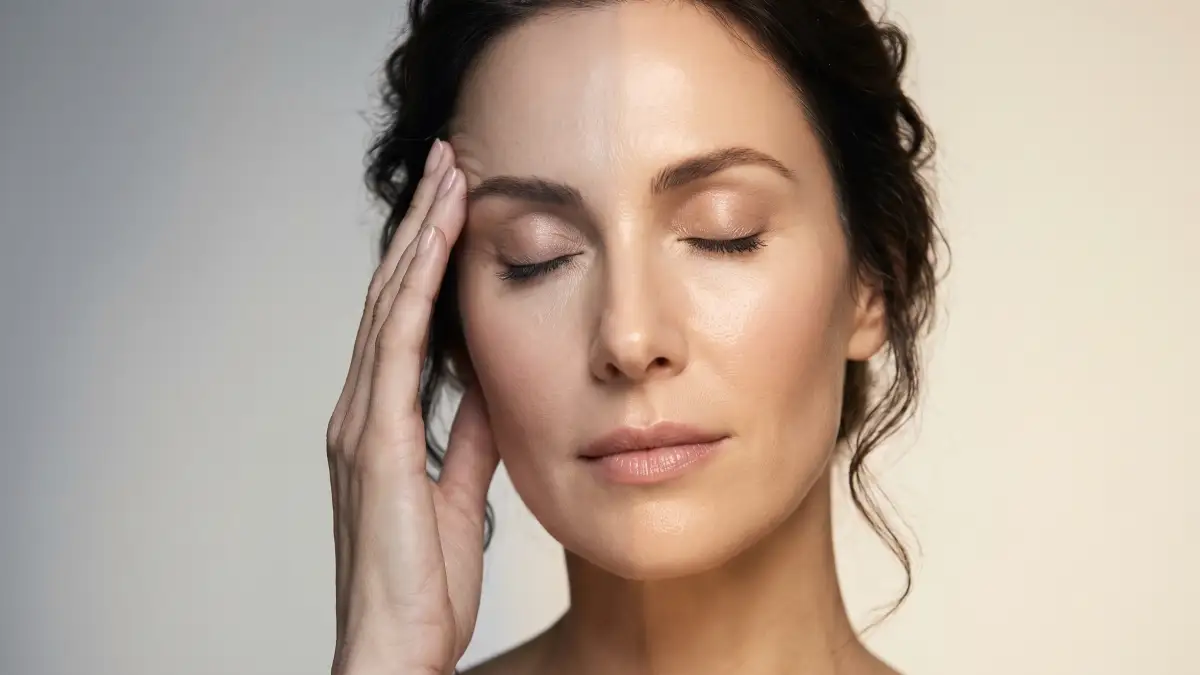
The science of skin aging is evolving rapidly — and for women navigating the skin changes that come with menopause and beyond, evidence-based skincare represents a fundamentally different approach: working with your skin's biology rather than against it.
Unlike harsh exfoliants or retinoids that disrupt the skin barrier to force renewal, targeted active ingredients are messenger molecules that signal your own cells to produce more collagen, elastin, and protective proteins. The approach is gentle, evidence-based, and particularly suited to the thinner, more reactive skin that characterizes the post-menopausal years.
The Inflammatory Cascade That Turns Acute Stress Into Chronic Aging
Inflammaging — the chronic, low-grade inflammation that accelerates biological aging — is dramatically amplified by psychological stress. While some inflammaging occurs naturally with age as the immune system becomes dysregulated, chronic stress acts as an accelerant that can advance inflammatory aging by 5-10 years. The mechanism begins with cortisol's paradoxical effect on inflammation: while acute cortisol is anti-inflammatory (which is why corticosteroids are used to treat inflammation), chronic cortisol exposure produces glucocorticoid resistance, where immune cells become desensitized to cortisol's suppressive effects and begin producing pro-inflammatory cytokines unchecked.[1]
The inflammatory cascade in stressed skin follows a specific sequence. Stress activates NF-κB (nuclear factor kappa-B), the master transcription factor for inflammatory gene expression. NF-κB upregulates production of IL-1β, IL-6, and TNF-α — cytokines that individually and collectively degrade extracellular matrix components, impair fibroblast function, and accelerate cellular senescence. TNF-α alone has been shown to increase MMP-1 expression by 300% in dermal fibroblasts, while IL-6 promotes the senescence-associated secretory phenotype (SASP) that turns aging cells into inflammation-broadcasting stations that damage their neighbors.
Clinical research confirms that the visible consequences of stress-driven inflammation are distinct from other aging mechanisms. Inflammatory aging produces: persistent redness and uneven skin tone (from dilated capillaries and increased vascular permeability), textural roughness and loss of luminosity (from impaired keratinocyte maturation), accelerated formation of fine lines across the entire face rather than in specific expression areas (from diffuse collagen degradation), and hyperpigmentation and age spots (from inflammation-stimulated melanogenesis). Women experiencing chronic stress often report that their skin looks 'inflamed' or 'angry' — a clinically accurate description of the underlying cytokine activity.
Breaking the stress-inflammation-aging cycle requires intervention at multiple points. Topical anti-inflammatory agents — niacinamide, centella asiatica, green tea extract (EGCG), and resveratrol — can suppress NF-κB activation and reduce cytokine production at the skin surface. Oral anti-inflammatory strategies — omega-3 fatty acids (2-3g daily), curcumin, and antioxidant-rich diets — address systemic inflammation. But the most effective intervention is stress reduction itself: studies show that an 8-week mindfulness program reduces IL-6 levels by 15-25% and significantly lowers NF-κB gene expression in immune cells. Without addressing the stress that drives the inflammatory cascade, topical and dietary anti-inflammatory strategies are treating symptoms while the cause continues operating.
Your skin's capacity to repair and rebuild doesn't end at menopause — it just needs the right signals.
— Dr. Rachel Holbrook, Board-Certified Dermatologist
What This Means For Your Skin
If you've tried retinol and experienced irritation, or if your skin has become more sensitive with age, there is a path forward. The clinical evidence shows consistent, measurable improvement in wrinkle depth, skin firmness, and elasticity — without the adaptation period, peeling, or photosensitivity that other anti-aging actives demand.
Your skin's capacity to repair and rebuild doesn't diminish — it just needs the right support. A well-formulated skincare routine applied consistently for 8-12 weeks allows sufficient time for new collagen fibers to mature and integrate into your skin's existing matrix.
The science is clear. The evidence is consistent. The results are measurable.
What happens next is up to you.