
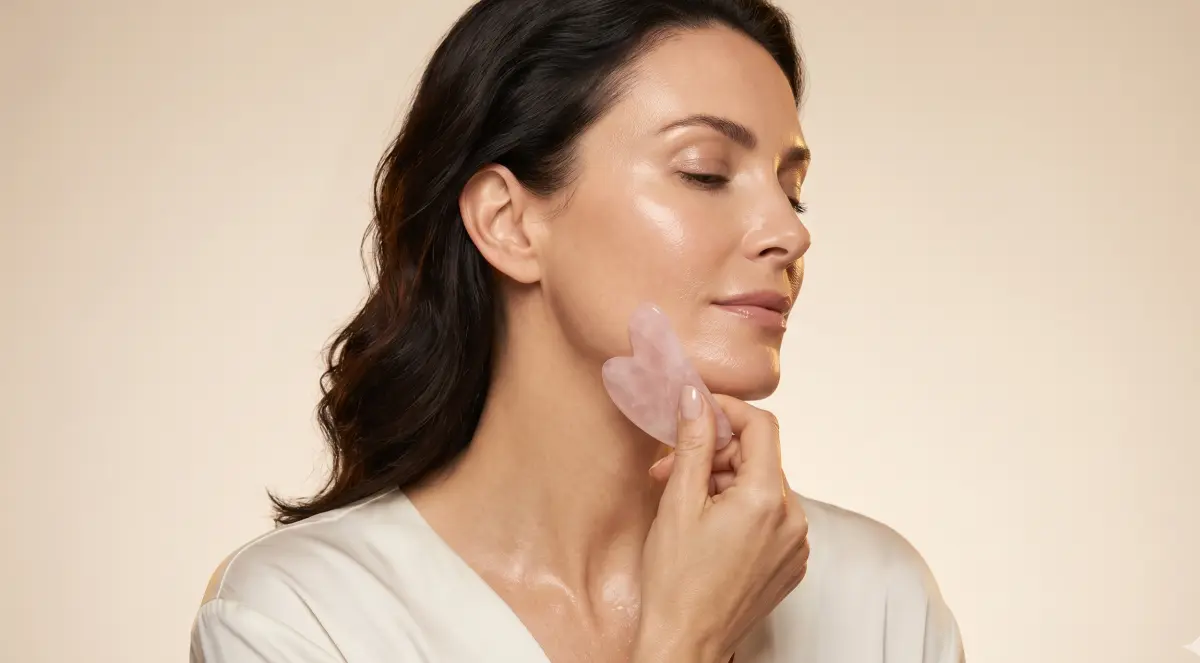
The science of skin aging is evolving rapidly — and for women navigating the skin changes that come with menopause and beyond, evidence-based skincare represents a fundamentally different approach: working with your skin's biology rather than against it.
Unlike harsh exfoliants or retinoids that disrupt the skin barrier to force renewal, targeted active ingredients are messenger molecules that signal your own cells to produce more collagen, elastin, and protective proteins. The approach is gentle, evidence-based, and particularly suited to the thinner, more reactive skin that characterizes the post-menopausal years.
How Poly-L-Lactic Acid Rebuilds Temple Volume Through Collagen
Sculptra (injectable poly-L-lactic acid, or PLLA) represents a fundamentally different approach to temple volume restoration compared to hyaluronic acid fillers. Rather than adding exogenous volume that the body will eventually metabolize, Sculptra triggers a controlled foreign body response that stimulates the production of new type I collagen — the same structural protein that the body loses with aging. The result is volume that is created by the patient's own tissue, producing an exceptionally natural appearance and feel that many injectors and patients prefer to HA filler for the temporal region.[1]
The mechanism of action is well-characterized: PLLA microparticles are injected into the deep subcutaneous or supraperiosteal plane of the temporal fossa. These microparticles trigger a subclinical inflammatory response that recruits fibroblasts to the injection site. Over 6-12 weeks, the fibroblasts deposit new type I and type III collagen around each microparticle, gradually building a collagen scaffold that provides volume. The PLLA particles themselves are bioabsorbed over 12-18 months, but the collagen scaffold they stimulated remains, providing structural support for 2-3 years or longer. This 'grow your own volume' approach means the result improves gradually over months — patients see progressive filling over 3-6 months rather than immediate correction.
Clinical research confirms that the Sculptra protocol for temples typically requires 2-3 treatment sessions spaced 4-6 weeks apart. Each session uses 1-2 vials of reconstituted PLLA diluted to a concentration appropriate for the temporal region (typically more dilute than body treatments to ensure smooth, even distribution). Post-injection massage of the temporal area is essential — the '5-5-5 rule' (massage the area for 5 minutes, 5 times daily, for 5 days) ensures even distribution of the PLLA particles and prevents nodule formation. The gradual onset means that the injector can assess the collagen response at each session and adjust the volume accordingly, reducing the risk of overcorrection.
The advantages of Sculptra over HA fillers for temples include: longer duration (2-3+ years vs. 12-18 months for HA), more natural tissue quality (your own collagen vs. a gel implant), progressive improvement that avoids the 'just filled' look, and cumulative benefit with maintenance treatments. The disadvantages include: delayed results (not suitable for patients wanting immediate correction), inability to dissolve the product if overcorrected (HA fillers can be dissolved with hyaluronidase), higher total treatment cost (multiple sessions required), and the need for post-injection massage. For women who prioritize natural-appearing, long-lasting results and are comfortable with a gradual improvement timeline, Sculptra is often the preferred choice for temple restoration.
Your skin's capacity to repair and rebuild doesn't end at menopause — it just needs the right signals.
— Dr. Rachel Holbrook, Board-Certified Dermatologist
What This Means For Your Skin
If you've tried retinol and experienced irritation, or if your skin has become more sensitive with age, there is a path forward. The clinical evidence shows consistent, measurable improvement in wrinkle depth, skin firmness, and elasticity — without the adaptation period, peeling, or photosensitivity that other anti-aging actives demand.
Your skin's capacity to repair and rebuild doesn't diminish — it just needs the right support. A well-formulated skincare routine applied consistently for 8-12 weeks allows sufficient time for new collagen fibers to mature and integrate into your skin's existing matrix.
The science is clear. The evidence is consistent. The results are measurable.
What happens next is up to you.