
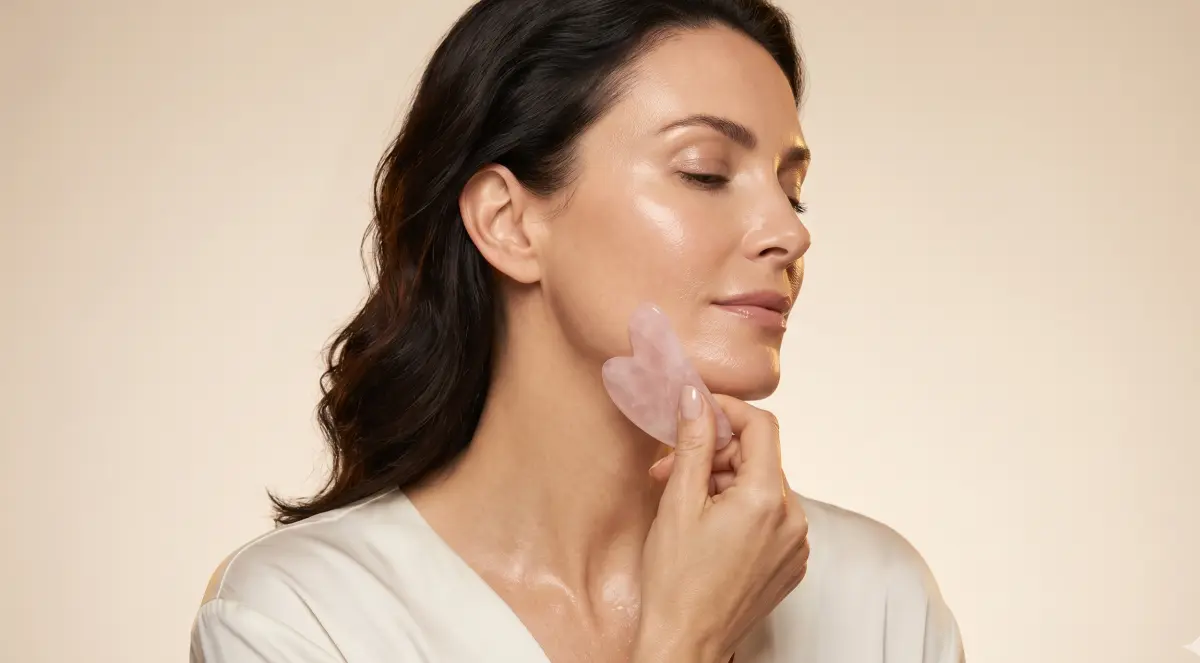
The science of skin aging is evolving rapidly — and for women navigating the skin changes that come with menopause and beyond, evidence-based skincare represents a fundamentally different approach: working with your skin's biology rather than against it.
Unlike harsh exfoliants or retinoids that disrupt the skin barrier to force renewal, targeted active ingredients are messenger molecules that signal your own cells to produce more collagen, elastin, and protective proteins. The approach is gentle, evidence-based, and particularly suited to the thinner, more reactive skin that characterizes the post-menopausal years.
Non-Surgical and Surgical Solutions for Temple Volume Restoration
Temple volume restoration has become one of the most requested procedures in facial rejuvenation, driven by growing recognition that temple hollowing ages the face as dramatically as midface volume loss. The treatment landscape ranges from non-invasive topical approaches (limited efficacy for established hollowing) to injectable fillers (the most popular option) to surgical fat transfer (the most permanent solution). The choice depends on the degree of hollowing, the woman's goals, her tolerance for procedures, and her budget.[1]
Hyaluronic acid (HA) fillers are the most common treatment for temple hollowing, with Juvéderm Voluma XC being the first and only HA filler FDA-approved specifically for the temple region. The procedure involves injecting 1-2 syringes of high-viscosity HA filler deep to the superficial temporal fascia or directly onto the periosteum, restoring the convex contour that defines youthful temple fullness. Results are immediate, with refinement over 2-4 weeks as the filler integrates and any swelling resolves. Duration is typically 12-18 months, though some studies report up to 24 months of clinically significant correction. The safety profile is excellent when performed by experienced injectors, though the temporal region requires specific anatomical knowledge due to the proximity of the superficial temporal artery and the temporal branch of the facial nerve.
Clinical research confirms that collagen biostimulators — Sculptra (poly-L-lactic acid) and Radiesse (calcium hydroxylapatite) — offer an alternative approach that stimulates the body's own collagen production rather than adding exogenous volume. Sculptra is injected in a dilute solution into the temporal fossa, where it triggers a foreign body response that produces new type I collagen over 6-12 weeks. The result is gradual, natural-looking volume restoration that improves over months and lasts 2-3 years. Typically 2-3 treatment sessions are required, spaced 4-6 weeks apart. Radiesse works similarly but provides immediate volume from the calcium hydroxylapatite microspheres while simultaneously stimulating collagen. Both biostimulators are particularly well-suited to temple hollowing because the gradual volume increase produces an exceptionally natural appearance.
Surgical fat transfer represents the most permanent solution for temple hollowing. The procedure harvests fat from the abdomen, thighs, or flanks via liposuction, processes it to isolate healthy adipocytes, and injects it into the temporal fossa in precise layers. The advantage is permanence — transplanted fat that survives the initial period (typically 60-70% retention) becomes a living part of the facial tissue, aging naturally with the face. The disadvantage is that it requires a more invasive procedure with general or deep sedation, potential for asymmetry if fat resorption is uneven, and a recovery period of 1-2 weeks. For women with moderate-to-severe temple hollowing seeking a long-term solution, fat transfer combined with biostimulator treatment offers the most comprehensive volume restoration.
Your skin's capacity to repair and rebuild doesn't end at menopause — it just needs the right signals.
— Dr. Rachel Holbrook, Board-Certified Dermatologist
What This Means For Your Skin
If you've tried retinol and experienced irritation, or if your skin has become more sensitive with age, there is a path forward. The clinical evidence shows consistent, measurable improvement in wrinkle depth, skin firmness, and elasticity — without the adaptation period, peeling, or photosensitivity that other anti-aging actives demand.
Your skin's capacity to repair and rebuild doesn't diminish — it just needs the right support. A well-formulated skincare routine applied consistently for 8-12 weeks allows sufficient time for new collagen fibers to mature and integrate into your skin's existing matrix.
The science is clear. The evidence is consistent. The results are measurable.
What happens next is up to you.