
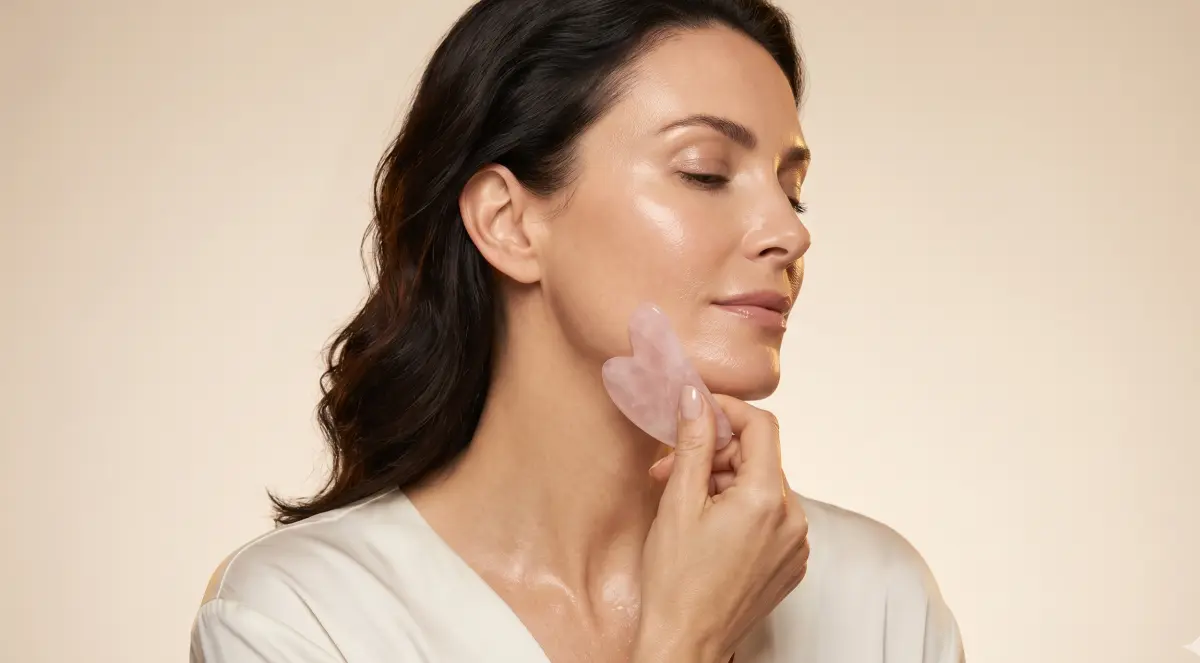
The science of skin aging is evolving rapidly — and for women navigating the skin changes that come with menopause and beyond, evidence-based skincare represents a fundamentally different approach: working with your skin's biology rather than against it.
Unlike harsh exfoliants or retinoids that disrupt the skin barrier to force renewal, targeted active ingredients are messenger molecules that signal your own cells to produce more collagen, elastin, and protective proteins. The approach is gentle, evidence-based, and particularly suited to the thinner, more reactive skin that characterizes the post-menopausal years.
Why the Temples Lose Volume and How It Changes Your Face
Temple hollowing is one of the most underrecognized yet visually impactful signs of facial aging. The temporal fossa — the concave area between the lateral orbital rim, the hairline, and the zygomatic arch — loses volume progressively after age 30, creating a hollowed, skeletonized appearance that fundamentally alters facial proportions. While most women focus on wrinkles and nasolabial folds, temple volume loss actually ages the face more globally: it narrows the upper face, makes the cheekbones appear more prominent in an unflattering way, contributes to brow descent, and creates a 'drawn' or 'gaunt' appearance that communicates exhaustion and illness rather than healthy aging.[1]
The anatomy of temple hollowing involves three tissue layers that all atrophy simultaneously. The superficial temporal fat pad — a discrete fat compartment located beneath the temporoparietal fascia — deflates and descends with aging, reducing the convex contour of youth. The temporal muscle (temporalis) — one of the muscles of mastication — atrophies with age, losing approximately 20-30% of its volume between ages 40 and 70. And the temporal bone itself undergoes resorption, with CT studies demonstrating measurable reduction in the bony framework that supports the overlying soft tissues. This triple-layer volume loss creates the characteristic concavity that deepens progressively with each decade.
Clinical research confirms that the visual impact of temple hollowing extends far beyond the temple area itself. When the temples are full (as in youth), the face has a smooth, convex transition from forehead to cheekbone, creating the 'heart-shaped' or 'oval' facial silhouette associated with youthfulness. When the temples hollow, this transition becomes concave — the forehead appears wider, the zygomatic arch becomes more prominent, and the overall facial shape shifts from heart to rectangular or even skull-like. This geometric change is one of the reasons that people appear to 'age suddenly' in their late 40s — the cumulative temple volume loss reaches a tipping point where the facial silhouette changes visibly.
For women over 40, temple hollowing is accelerated by the same hormonal changes that affect the rest of the face. Estrogen decline during perimenopause reduces fat deposition in the temporal fat pad and accelerates bone resorption throughout the facial skeleton, including the temporal bone. Women who experience significant weight loss, practice intense exercise (which reduces facial fat), or have naturally lean facial structures may notice temple hollowing earlier and more severely. The combination of estrogen-driven fat loss with age-related muscle atrophy and bone resorption creates a compounding effect where the temple region can lose 30-40% of its youthful volume by age 55.
Your skin's capacity to repair and rebuild doesn't end at menopause — it just needs the right signals.
— Dr. Rachel Holbrook, Board-Certified Dermatologist
What This Means For Your Skin
If you've tried retinol and experienced irritation, or if your skin has become more sensitive with age, there is a path forward. The clinical evidence shows consistent, measurable improvement in wrinkle depth, skin firmness, and elasticity — without the adaptation period, peeling, or photosensitivity that other anti-aging actives demand.
Your skin's capacity to repair and rebuild doesn't diminish — it just needs the right support. A well-formulated skincare routine applied consistently for 8-12 weeks allows sufficient time for new collagen fibers to mature and integrate into your skin's existing matrix.
The science is clear. The evidence is consistent. The results are measurable.
What happens next is up to you.