
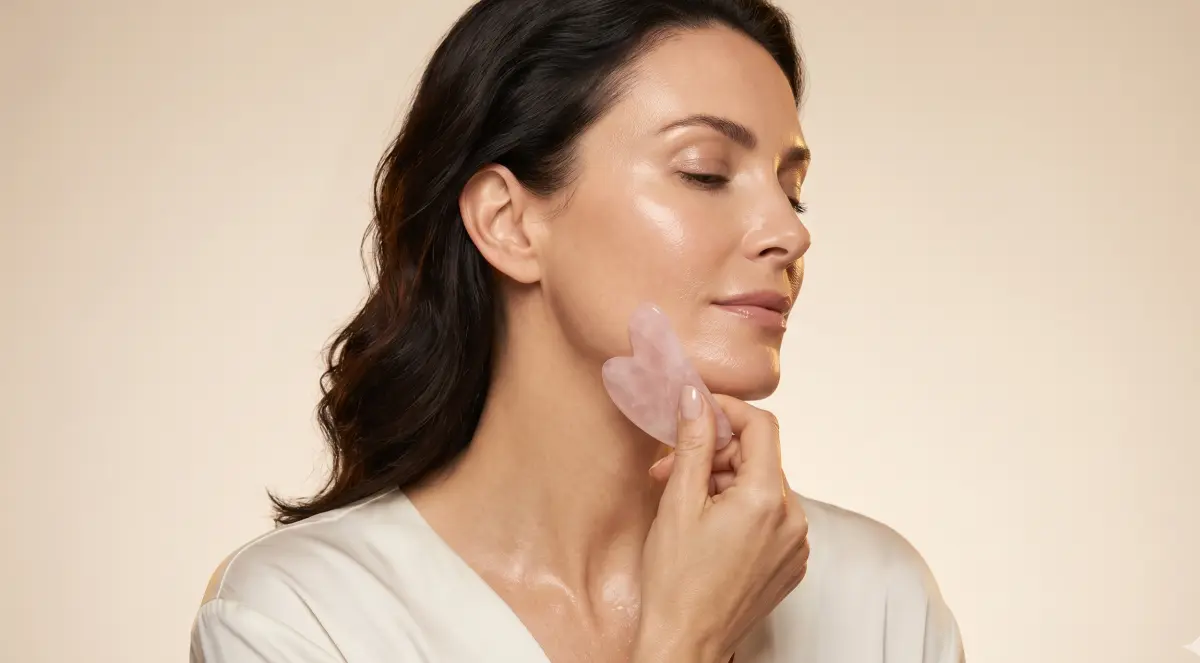
The science of skin aging is evolving rapidly — and for women navigating the skin changes that come with menopause and beyond, evidence-based skincare represents a fundamentally different approach: working with your skin's biology rather than against it.
Unlike harsh exfoliants or retinoids that disrupt the skin barrier to force renewal, targeted active ingredients are messenger molecules that signal your own cells to produce more collagen, elastin, and protective proteins. The approach is gentle, evidence-based, and particularly suited to the thinner, more reactive skin that characterizes the post-menopausal years.
How Hormonal Changes Accelerate Temple Hollowing After 45
Menopause represents a critical inflection point for temple volume, just as it does for the jawline, cheeks, and periorbital area. The temporal region is exquisitely sensitive to hormonal changes because all three tissue layers that provide temple volume — fat, muscle, and bone — are estrogen-responsive. Estrogen receptors are present on adipocytes in the superficial temporal fat pad, on the temporalis muscle fibers, and on the osteoblasts that maintain temporal bone density. When estrogen declines during perimenopause and menopause, all three tissues lose volume simultaneously, creating the accelerated hollowing that many women notice in their late 40s and 50s.[1]
The fat loss component is the most visually significant. The superficial temporal fat pad is a hormonally responsive fat depot — estrogen promotes fat deposition in the face (which is why premenopausal women maintain fuller facial contours than men of the same age), and estrogen withdrawal triggers fat redistribution away from the face toward the central body. This is why many menopausal women experience the paradox of gaining abdominal weight while simultaneously losing facial volume. The temporal fat pad is particularly vulnerable because it is a relatively small, discrete compartment — even modest volume loss (1-2mL per side) produces a visible concavity.
Clinical research confirms that bone resorption in the temporal region follows the same pattern as osteoporotic bone loss elsewhere in the skeleton. Shaw et al.'s CT analysis of facial aging demonstrated that the temporal bone loses measurable volume with each decade after 40, with the rate of loss accelerating after menopause. The orbital rim — which forms the anterior boundary of the temporal fossa — also retracts posteriorly and superiorly with age, effectively enlarging the temporal concavity from the front. This bony change is irreversible with non-surgical treatments, which is why injectable fillers and fat transfer add volume on top of the receded bone rather than restoring the bone itself.
For women entering perimenopause who want to proactively manage temple volume, several strategies can slow (though not prevent) the hollowing process. Maintaining adequate calcium and vitamin D intake supports temporal bone density. Avoiding extreme weight loss or very low body fat percentage preserves facial fat compartments. Regular resistance training helps maintain temporalis muscle mass. And a comprehensive skincare routine with retinoids and peptides maintains the dermal collagen that provides structural scaffolding over the temporal area. However, it is important to be realistic: these measures can delay but not eliminate the volume loss that is an inherent part of hormonal aging. For women with established hollowing, injectable volume restoration remains the most effective treatment, and starting earlier (when hollowing is mild) produces more natural results with less product.
Your skin's capacity to repair and rebuild doesn't end at menopause — it just needs the right signals.
— Dr. Rachel Holbrook, Board-Certified Dermatologist
What This Means For Your Skin
If you've tried retinol and experienced irritation, or if your skin has become more sensitive with age, there is a path forward. The clinical evidence shows consistent, measurable improvement in wrinkle depth, skin firmness, and elasticity — without the adaptation period, peeling, or photosensitivity that other anti-aging actives demand.
Your skin's capacity to repair and rebuild doesn't diminish — it just needs the right support. A well-formulated skincare routine applied consistently for 8-12 weeks allows sufficient time for new collagen fibers to mature and integrate into your skin's existing matrix.
The science is clear. The evidence is consistent. The results are measurable.
What happens next is up to you.