
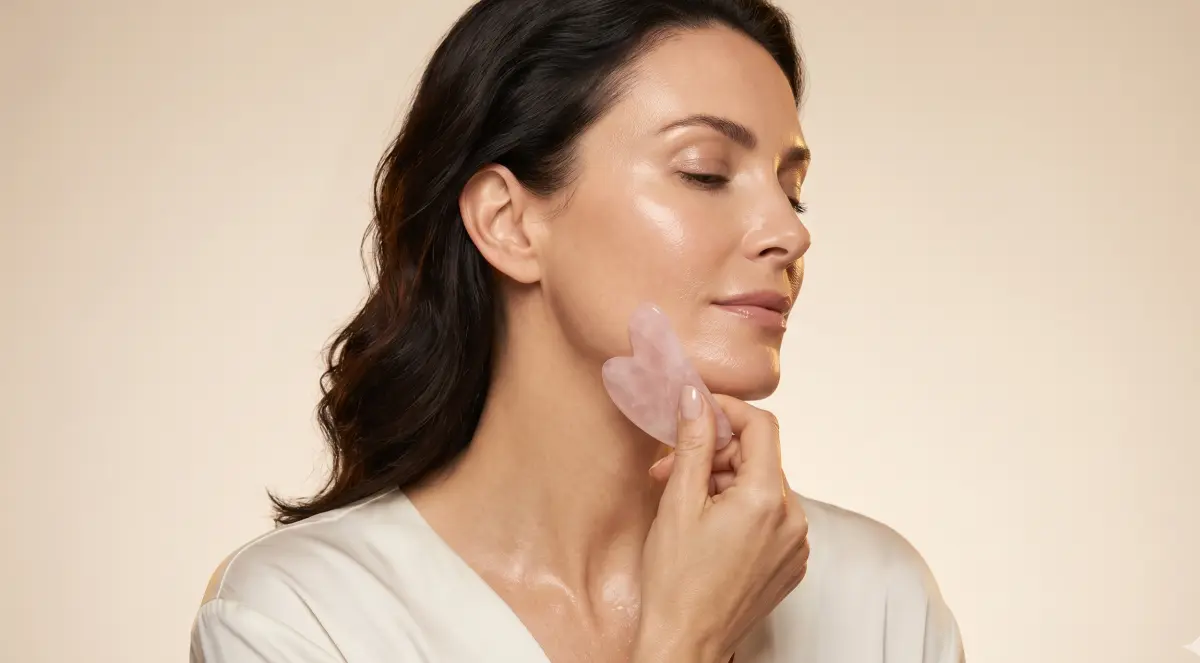
The science of skin aging is evolving rapidly — and for women navigating the skin changes that come with menopause and beyond, evidence-based skincare represents a fundamentally different approach: working with your skin's biology rather than against it.
Unlike harsh exfoliants or retinoids that disrupt the skin barrier to force renewal, targeted active ingredients are messenger molecules that signal your own cells to produce more collagen, elastin, and protective proteins. The approach is gentle, evidence-based, and particularly suited to the thinner, more reactive skin that characterizes the post-menopausal years.
Why the Face Loses Volume With Age and How to Slow It Down
Facial fat loss — technically termed 'facial lipoatrophy' when pathological, or age-related 'fat atrophy' in the normal aging context — is the primary driver of the volume changes that transform facial appearance after 40. The youthful face contains approximately 10-15mL of facial fat distributed across 20+ discrete compartments, each separated by fascial boundaries. These compartments do not lose volume uniformly: some deflate while others remain relatively preserved, creating the characteristic pattern of hollows (temples, periorbital area, buccal region) alternating with preserved or descended fullness (nasolabial fold, jowl area) that defines the aging face.[1]
The mechanisms of facial fat loss are multifactorial. Hormonal: estrogen promotes facial fat deposition, and its decline during menopause triggers fat redistribution away from the face. Vascular: blood supply to facial fat compartments diminishes with age, reducing nutrient delivery to adipocytes and impairing their ability to maintain volume. Metabolic: aging adipocytes become less responsive to lipogenic signals and more susceptible to lipolytic signals, creating a net volume reduction even when total body fat remains stable. Mechanical: the fascial framework that suspends fat compartments weakens with collagen loss, allowing compartments to deflate and descend under gravity.
Clinical research confirms that lifestyle factors significantly modulate the rate of facial fat loss. Chronic caloric restriction and very low body fat percentage accelerate facial fat depletion — this is why many lean, athletic women appear facially older than their less active peers despite being healthier overall. The 'runner's face' phenomenon reflects this trade-off: cardiovascular health at the expense of facial fat preservation. Rapid weight cycling (repeatedly gaining and losing weight) stretches the fascial framework around fat compartments, reducing their ability to maintain volume even when weight is regained. Smoking accelerates facial fat loss through vasoconstriction (reducing adipocyte blood supply) and chronic MMP activation (degrading the fascial scaffolding). UV exposure damages the vascular network that supports facial fat compartments.
Prevention strategies for facial fat loss focus on modifiable factors: maintaining stable body weight (avoiding extreme leanness and weight cycling), protecting from UV damage (sunscreen preserves the vascular support of fat compartments), smoking cessation, adequate nutrition (essential fatty acids and protein support adipocyte health), and managing stress (chronic cortisol promotes facial fat catabolism). Topical skincare cannot directly prevent fat loss — it operates at the epidermal and dermal levels, not the subcutaneous fat layer. However, maintaining strong dermal collagen with retinoids and peptides preserves the structural framework that supports overlying fat compartments, potentially slowing the descent and deflation that accompanies fat atrophy. For established volume loss, injectable treatments remain the most effective restoration option.
Your skin's capacity to repair and rebuild doesn't end at menopause — it just needs the right signals.
— Dr. Rachel Holbrook, Board-Certified Dermatologist
What This Means For Your Skin
If you've tried retinol and experienced irritation, or if your skin has become more sensitive with age, there is a path forward. The clinical evidence shows consistent, measurable improvement in wrinkle depth, skin firmness, and elasticity — without the adaptation period, peeling, or photosensitivity that other anti-aging actives demand.
Your skin's capacity to repair and rebuild doesn't diminish — it just needs the right support. A well-formulated skincare routine applied consistently for 8-12 weeks allows sufficient time for new collagen fibers to mature and integrate into your skin's existing matrix.
The science is clear. The evidence is consistent. The results are measurable.
What happens next is up to you.