
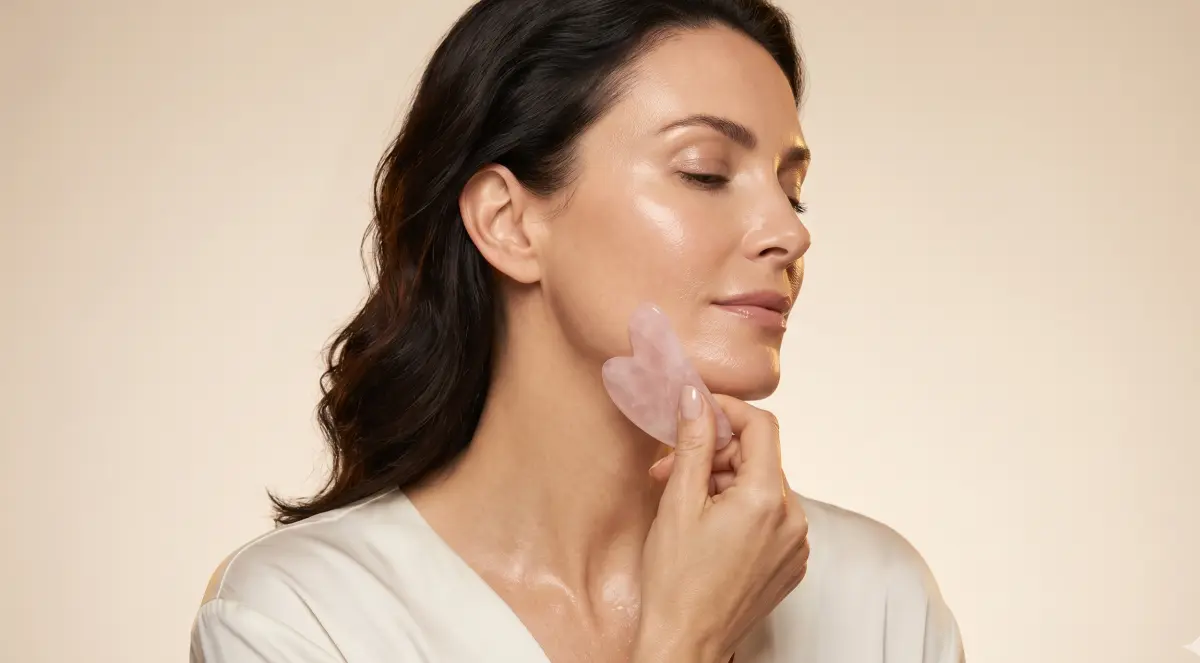
The science of skin aging is evolving rapidly — and for women navigating the skin changes that come with menopause and beyond, evidence-based skincare represents a fundamentally different approach: working with your skin's biology rather than against it.
Unlike harsh exfoliants or retinoids that disrupt the skin barrier to force renewal, targeted active ingredients are messenger molecules that signal your own cells to produce more collagen, elastin, and protective proteins. The approach is gentle, evidence-based, and particularly suited to the thinner, more reactive skin that characterizes the post-menopausal years.
How Temple Volume Loss Transforms Your Facial Silhouette
The geometric transformation of facial shape caused by temple hollowing is one of the most significant — yet least understood — contributors to the perception of aging. In youth, full temples create a smooth, convex transition from the forehead to the cheekbone, producing an oval or heart-shaped facial silhouette that is universally associated with youthfulness and attractiveness across cultures. As the temples hollow, this convex curve becomes concave, transforming the facial silhouette from oval to angular, rectangular, or even inverted-triangular. This shape change alters how light falls across the face, creates shadows in the temporal concavity, and disrupts the harmonious proportions that define a youthful appearance.[1]
The concept of facial 'ogee curve' is central to understanding temple hollowing's visual impact. The ogee curve is the S-shaped transition from the lower eyelid across the cheekbone to the lateral face — in a youthful face, this curve is smooth and continuous. Temple hollowing disrupts the upper portion of this curve by creating a concavity above the zygomatic arch that interrupts the smooth flow from forehead to midface. Experienced aesthetic physicians evaluate the ogee curve as a primary indicator of facial aging and use temple restoration as a key tool for re-establishing the smooth contour that communicates youth.
Clinical research confirms that the relationship between temple volume and brow position is clinically significant. The soft tissues of the temple provide physical support for the lateral brow — when temple volume is adequate, the lateral brow maintains its youthful arched position. As the temples hollow, this support is lost, and the lateral brow descends (lateral brow ptosis), creating a hooded appearance to the outer eyes that makes the face look tired and stern. Many women seek brow lifts or upper eyelid surgery for this hooded appearance, when the underlying cause is actually temple volume loss. Restoring temple volume with filler can produce a measurable lateral brow lift of 2-4mm — often sufficient to improve the hooded appearance without any surgical intervention on the brow or eyelid.
The face shape changes from temple hollowing also affect how other aging signs are perceived. Hollow temples make crow's feet appear deeper and more prominent by creating a concave backdrop that accentuates the linear creases. They make the orbital rim more visible, contributing to a 'sunken eye' appearance even when the periorbital tissues themselves are relatively preserved. And they create a visual imbalance where the lower face (which may retain fat or develop jowling) appears disproportionately heavy compared to the deflated upper face. This is why comprehensive facial rejuvenation approaches increasingly address the temples as a starting point — restoring upper face volume establishes the proportional framework within which other treatments (cheek filler, jawline contouring, periorbital rejuvenation) produce their most natural-appearing results.
Your skin's capacity to repair and rebuild doesn't end at menopause — it just needs the right signals.
— Dr. Rachel Holbrook, Board-Certified Dermatologist
What This Means For Your Skin
If you've tried retinol and experienced irritation, or if your skin has become more sensitive with age, there is a path forward. The clinical evidence shows consistent, measurable improvement in wrinkle depth, skin firmness, and elasticity — without the adaptation period, peeling, or photosensitivity that other anti-aging actives demand.
Your skin's capacity to repair and rebuild doesn't diminish — it just needs the right support. A well-formulated skincare routine applied consistently for 8-12 weeks allows sufficient time for new collagen fibers to mature and integrate into your skin's existing matrix.
The science is clear. The evidence is consistent. The results are measurable.
What happens next is up to you.