
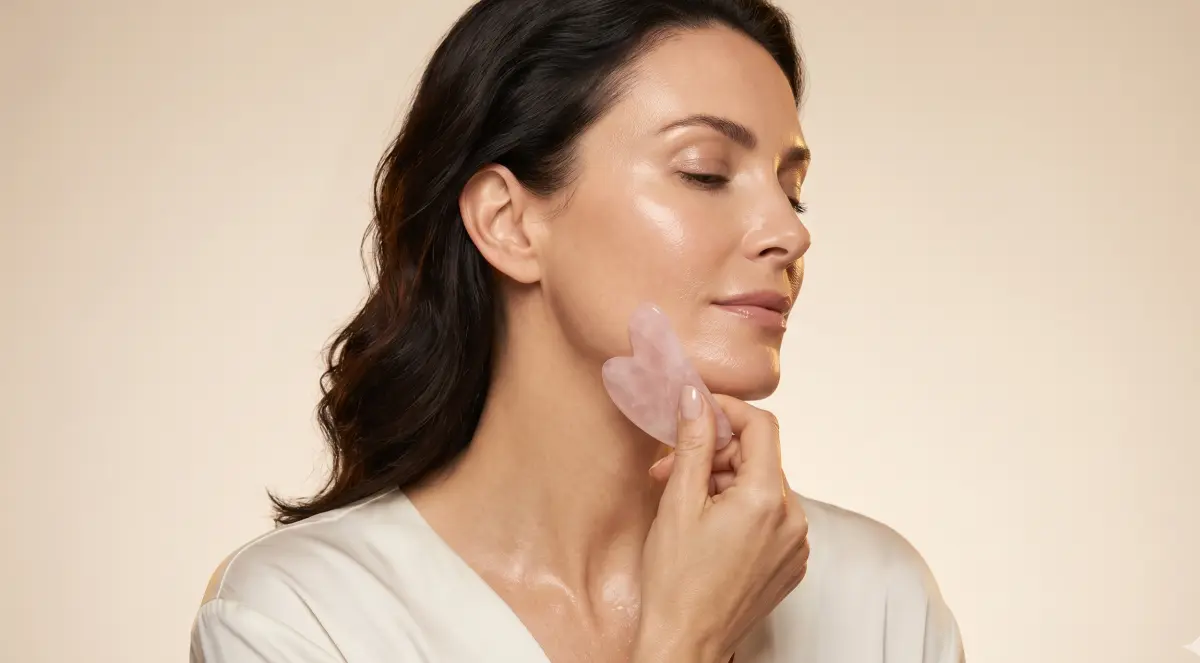
The science of skin aging is evolving rapidly — and for women navigating the skin changes that come with menopause and beyond, evidence-based skincare represents a fundamentally different approach: working with your skin's biology rather than against it.
Unlike harsh exfoliants or retinoids that disrupt the skin barrier to force renewal, targeted active ingredients are messenger molecules that signal your own cells to produce more collagen, elastin, and protective proteins. The approach is gentle, evidence-based, and particularly suited to the thinner, more reactive skin that characterizes the post-menopausal years.
How Upper and Midface Volume Loss Create Different Aging Patterns
Temple hollowing and cheek volume loss are frequently discussed together as 'facial volume loss,' but they represent distinct anatomical changes that produce different visual effects and require different treatment approaches. Understanding the distinction is important because treating only the cheeks while ignoring the temples — or vice versa — produces an unbalanced result that can actually accentuate the untreated area's deficiency. Comprehensive facial rejuvenation requires assessing both regions and addressing them in the correct sequence.[1]
Temple hollowing affects the upper third of the face — the area from the lateral brow to the hairline and from the lateral orbital rim to above the ear. When volume loss occurs here, the visual effects include: a widened, bony appearance of the forehead and upper face; visible depression lateral to the eye that creates a 'skulled' look; descent of the lateral brow as the soft tissue support weakens; and an overall facial shape that shifts from oval/heart-shaped to rectangular or angular. Temple hollowing tends to make the face look tired, gaunt, or ill — it communicates a loss of vitality rather than simply 'aging.'
Clinical research confirms that cheek volume loss affects the middle third of the face — the malar and submalar regions. When volume loss occurs here, the visual effects are different: flattening of the cheekbone prominence, deepening of the nasolabial fold as tissue descends, formation of 'tear troughs' beneath the eyes as the lid-cheek junction flattens, and development of jowls as midface tissue descends below the jawline. Cheek volume loss tends to make the face look saggy and heavy rather than gaunt — it communicates gravitational aging rather than illness.
The treatment sequencing matters significantly. Many experienced injectors recommend addressing temple hollowing first or simultaneously with cheek treatment, because temple volume restoration provides upper face scaffolding that supports the midface structures. Treating temples can produce a subtle lifting effect on the lateral brow and the lateral midface, which may reduce the amount of cheek filler needed. Conversely, treating only the cheeks while ignoring hollow temples creates a 'bottom-heavy' appearance where the plump cheeks contrast with the concave upper face, producing an unnatural result. The ideal approach evaluates the entire facial volume map and creates a treatment plan that restores proportional fullness from the temples through the midface to the jawline.
Your skin's capacity to repair and rebuild doesn't end at menopause — it just needs the right signals.
— Dr. Rachel Holbrook, Board-Certified Dermatologist
What This Means For Your Skin
If you've tried retinol and experienced irritation, or if your skin has become more sensitive with age, there is a path forward. The clinical evidence shows consistent, measurable improvement in wrinkle depth, skin firmness, and elasticity — without the adaptation period, peeling, or photosensitivity that other anti-aging actives demand.
Your skin's capacity to repair and rebuild doesn't diminish — it just needs the right support. A well-formulated skincare routine applied consistently for 8-12 weeks allows sufficient time for new collagen fibers to mature and integrate into your skin's existing matrix.
The science is clear. The evidence is consistent. The results are measurable.
What happens next is up to you.