
The science of skin aging is evolving rapidly — and for women navigating the skin changes that come with menopause and beyond, evidence-based skincare represents a fundamentally different approach: working with your skin's biology rather than against it.
Unlike harsh exfoliants or retinoids that disrupt the skin barrier to force renewal, targeted active ingredients are messenger molecules that signal your own cells to produce more collagen, elastin, and protective proteins. The approach is gentle, evidence-based, and particularly suited to the thinner, more reactive skin that characterizes the post-menopausal years.
Penetration Science and Layering Order for Maximum Absorption
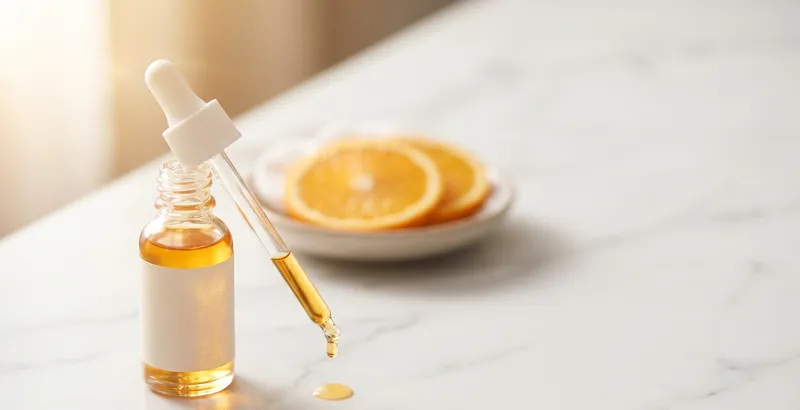
The application order of vitamin C serum relative to moisturizer is not merely a cosmetic preference but a decision with measurable impact on percutaneous absorption and biological efficacy, governed by the physicochemical principles of Fick's law of diffusion and the skin's complex multi-compartment barrier architecture. L-ascorbic acid, with a molecular weight of 176 Daltons and high water solubility (log P = -1.8), penetrates primarily through the aqueous pathway of the stratum corneum — intercellular water channels and transcellular routes through hydrated corneocytes. According to basic pharmaceutical principles, the optimal application sequence follows the thin-to-thick rule: lighter, more aqueous formulations (like vitamin C serums) should precede heavier, more occlusive formulations (like moisturizers) because occlusive agents create a hydrophobic film that physically impedes the passage of hydrophilic molecules like ascorbic acid. When moisturizer is applied first, its lipid components (dimethicone, petrolatum, mineral oil, plant oils, or synthesized ceramides) form a continuous or semi-continuous film over the stratum corneum that reduces the concentration gradient driving vitamin C diffusion by up to 60-80% depending on the occlusivity level of the moisturizer.[1]
The pH-dependent penetration of L-ascorbic acid adds another dimension to the layering question. At pH 2.5-3.5, approximately 85-99% of ascorbic acid molecules exist in their protonated, uncharged form (HA), which crosses the lipid-rich barrier more efficiently than the ionized ascorbate anion (A-) that predominates at higher pH. When vitamin C serum is applied to clean skin, the formulation's low pH is maintained at the skin surface for several minutes before the skin's natural buffering systems (primarily through the amino acid content of natural moisturizing factor) gradually neutralize it. This brief acidic window represents the primary penetration phase. If moisturizer is applied first, its buffering capacity (most moisturizers are formulated at pH 5.0-6.5) immediately raises the pH of the vitamin C serum upon contact, shifting the ionization equilibrium toward the charged, non-penetrating form. In mature skin over 40, this effect is compounded by reduced natural moisturizing factor content and altered stratum corneum water-holding capacity, making the pH-dependent penetration window even more critical to preserve through correct application order.
Clinical research confirms that however, the straightforward serum-first rule requires nuance for mature and sensitized skin where barrier compromise creates a different absorption dynamic. In women experiencing menopausal barrier dysfunction — characterized by increased transepidermal water loss above 15 g/m²/h, clinical xerosis, and reduced ceramide-to-cholesterol ratios — applying concentrated L-ascorbic acid (pH 2.5-3.0) directly to compromised skin can trigger irritant contact dermatitis. The disrupted barrier allows excessively rapid, uncontrolled penetration of both the ascorbic acid and the low-pH vehicle into viable epidermis, activating nociceptors and triggering inflammatory cascades that paradoxically worsen the skin aging being treated. In these cases, the sandwich or buffering technique — applying a thin layer of hydrating (non-occlusive) serum containing humectants like hyaluronic acid or glycerin before the vitamin C — creates a partial aqueous buffer that moderates the pH shock while still allowing diffusion of the small ascorbate molecule through the hydrophilic buffer layer. This technique reduces immediate stinging by approximately 60% while maintaining 70-85% of the penetration achieved by direct application, representing a favorable trade-off for sensitive mature skin.
Timing between layers significantly impacts ultimate bioavailability and should be calibrated to skin condition and formulation type. After applying vitamin C serum to bare skin, a waiting period of 10-15 minutes before moisturizer application allows maximum penetration during the low-pH window and prevents physical dilution or displacement of the serum before absorption is substantially complete. During this waiting period, approximately 60-75% of the applied ascorbic acid that will ultimately penetrate has already crossed the stratum corneum based on permeation kinetic studies. For time-pressed morning routines, a minimum of 3-5 minutes provides meaningful penetration — at this timepoint, approximately 40% of ultimate delivery has occurred, and the subsequent moisturizer layer actually enhances residual absorption through its humectant components hydrating the stratum corneum and creating a more favorable diffusion environment. The moisturizer's occlusive effect, while impeding initial penetration if applied first, paradoxically enhances sustained delivery when applied after the vitamin C has already begun partitioning into the barrier: the occlusive film increases hydration of the stratum corneum, swelling corneocytes and expanding intercellular channels, while preventing evaporation of the serum vehicle that maintains the concentration gradient. This two-phase absorption model — rapid initial penetration in the acidic window followed by enhanced sustained delivery under occlusion — represents the optimal approach for maximizing vitamin C bioavailability in mature skin.
Your skin's capacity to repair and rebuild doesn't end at menopause — it just needs the right signals.
— Dr. Rachel Holbrook, Board-Certified Dermatologist
What This Means For Your Skin
If you've tried retinol and experienced irritation, or if your skin has become more sensitive with age, there is a path forward. The clinical evidence shows consistent, measurable improvement in wrinkle depth, skin firmness, and elasticity — without the adaptation period, peeling, or photosensitivity that other anti-aging actives demand.
Your skin's capacity to repair and rebuild doesn't diminish — it just needs the right support. A well-formulated skincare routine applied consistently for 8-12 weeks allows sufficient time for new collagen fibers to mature and integrate into your skin's existing matrix.
The science is clear. The evidence is consistent. The results are measurable.
What happens next is up to you.