
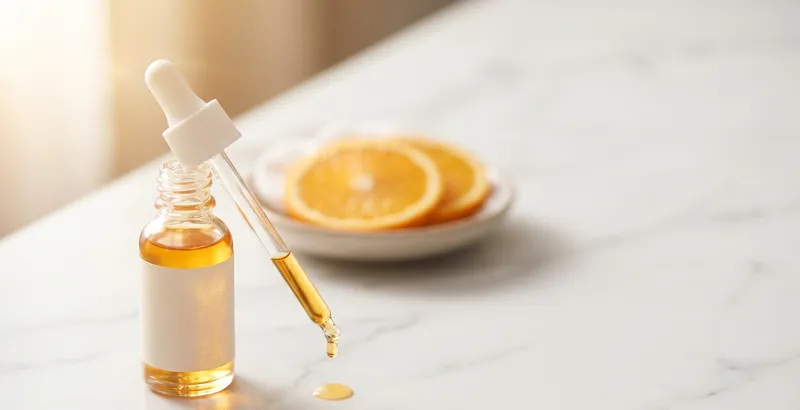
The science of skin aging is evolving rapidly — and for women navigating the skin changes that come with menopause and beyond, evidence-based skincare represents a fundamentally different approach: working with your skin's biology rather than against it.
Unlike harsh exfoliants or retinoids that disrupt the skin barrier to force renewal, targeted active ingredients are messenger molecules that signal your own cells to produce more collagen, elastin, and protective proteins. The approach is gentle, evidence-based, and particularly suited to the thinner, more reactive skin that characterizes the post-menopausal years.
Tyrosinase Inhibition and Melanocyte Regulation During Hormonal Shifts
Hyperpigmentation during menopause represents a distinct pathological entity driven by the complex interplay between declining ovarian hormones, accumulated UV damage, and dysregulated melanocyte signaling. Unlike simple solar lentigines that develop gradually from cumulative photoexposure, menopausal pigmentation often appears or worsens rapidly during the perimenopausal transition when estrogen and progesterone levels fluctuate unpredictably before their final decline. Estrogen normally exerts a regulatory influence on melanocyte activity through estrogen receptor beta (ERβ) signaling, which modulates the expression of microphthalmia-associated transcription factor (MITF) — the master regulator of melanogenesis. As estrogen levels drop, this regulatory brake is released, allowing MITF to upregulate tyrosinase, tyrosinase-related protein 1 (TRP-1), and dopachrome tautomerase (TRP-2), the three key enzymes in the melanin synthesis cascade. Simultaneously, the loss of estrogen's anti-inflammatory properties increases baseline cutaneous inflammation, generating prostaglandins and leukotrienes that act as paracrine signals stimulating neighboring melanocytes. Vitamin C addresses this multifactorial hyperpigmentation through several independent mechanisms that together produce clinically meaningful lightening of existing dark spots while preventing new lesion formation.[1]
The primary anti-pigmentary mechanism of L-ascorbic acid involves direct copper-chelating interaction with the tyrosinase enzyme active site. Tyrosinase is a copper-containing oxidase that catalyzes two critical steps in melanogenesis: the hydroxylation of tyrosine to DOPA and the subsequent oxidation of DOPA to dopaquinone. Ascorbic acid binds to the copper ions at the enzyme's catalytic center through its enediol moiety, reducing the essential Cu2+ to Cu+, which renders the enzyme temporarily inactive. This inhibition is competitive and concentration-dependent, requiring sustained tissue levels to maintain meaningful suppression of melanin production. Beyond direct enzyme inhibition, vitamin C reduces o-dopaquinone back to DOPA through its electron-donating capacity, diverting the synthetic pathway away from melanin formation even when tyrosinase is active. This dual mechanism — enzyme inhibition plus substrate reduction — produces approximately 40-60% reduction in melanin synthesis in cultured melanocytes at physiologically achievable concentrations. In clinical studies specifically enrolling menopausal women with melasma and lentigines, 15% L-ascorbic acid applied twice daily produced measurable reduction in Melanin Index (measured by Mexameter) within 8 weeks, with progressive improvement continuing through 24 weeks of treatment.
Clinical research confirms that the inflammatory component of menopausal pigmentation requires specific attention because standard brightening agents that only target tyrosinase often produce incomplete results when inflammation remains unchecked. Post-inflammatory hyperpigmentation (PIH) becomes more common after menopause due to impaired barrier function, increased skin reactivity, and slower resolution of inflammatory cascades. Every episode of subclinical irritation — from environmental pollutants, harsh cleansers, or even other active ingredients like retinoids — can trigger melanocyte stimulation through endothelin-1, stem cell factor, and alpha-melanocyte-stimulating hormone (α-MSH) released from activated keratinocytes. Vitamin C's potent anti-inflammatory properties, mediated through inhibition of NF-κB nuclear translocation and suppression of pro-inflammatory cytokines IL-1β, IL-6, and TNF-α, address this inflammatory amplification loop. Furthermore, ascorbic acid stabilizes mast cells and reduces histamine release in the dermis, decreasing vascular permeability and the erythematous component that often accompanies pigmented lesions in mature skin. This anti-inflammatory protection is particularly valuable when vitamin C is used in combination with other depigmenting agents (like niacinamide, tranexamic acid, or alpha-arbutin), as it mitigates the irritation that could otherwise trigger rebound pigmentation.
The distribution pattern of vitamin C within the epidermis is especially relevant to its depigmenting efficacy in menopausal skin. Melanocytes reside at the dermal-epidermal junction and transfer melanosomes to surrounding keratinocytes through dendritic processes — a process called melanosome transfer that vitamin C also inhibits by interfering with the PAR-2 receptor signaling and Rab27a-mediated vesicle transport. For topical vitamin C to reach melanocytes, it must penetrate through the full thickness of the epidermis, which in mature skin may be thinner (reduced keratinocyte layers) but paradoxically less permeable due to altered lipid composition and reduced water content. The formulation pH becomes crucial here: at pH 2.5-3.0, L-ascorbic acid exists predominantly in its uncharged, protonated form (pKa = 4.2), which crosses the lipid-rich stratum corneum more efficiently. However, this extremely low pH can destabilize melanocytes and trigger paradoxical PIH in reactive skin. A clinical compromise involves using 15% L-ascorbic acid at pH 3.0-3.5, which maintains approximately 60% of maximum penetration efficiency while reducing the risk of irritant-mediated melanocyte stimulation. Results are dose-dependent and cumulative: most clinical studies report maximum pigment reduction at 12-24 weeks of consistent twice-daily use, with maintenance application necessary indefinitely as the underlying hormonal drivers of pigmentation persist throughout postmenopause.
Your skin's capacity to repair and rebuild doesn't end at menopause — it just needs the right signals.
— Dr. Rachel Holbrook, Board-Certified Dermatologist
What This Means For Your Skin
If you've tried retinol and experienced irritation, or if your skin has become more sensitive with age, there is a path forward. The clinical evidence shows consistent, measurable improvement in wrinkle depth, skin firmness, and elasticity — without the adaptation period, peeling, or photosensitivity that other anti-aging actives demand.
Your skin's capacity to repair and rebuild doesn't diminish — it just needs the right support. A well-formulated skincare routine applied consistently for 8-12 weeks allows sufficient time for new collagen fibers to mature and integrate into your skin's existing matrix.
The science is clear. The evidence is consistent. The results are measurable.
What happens next is up to you.