
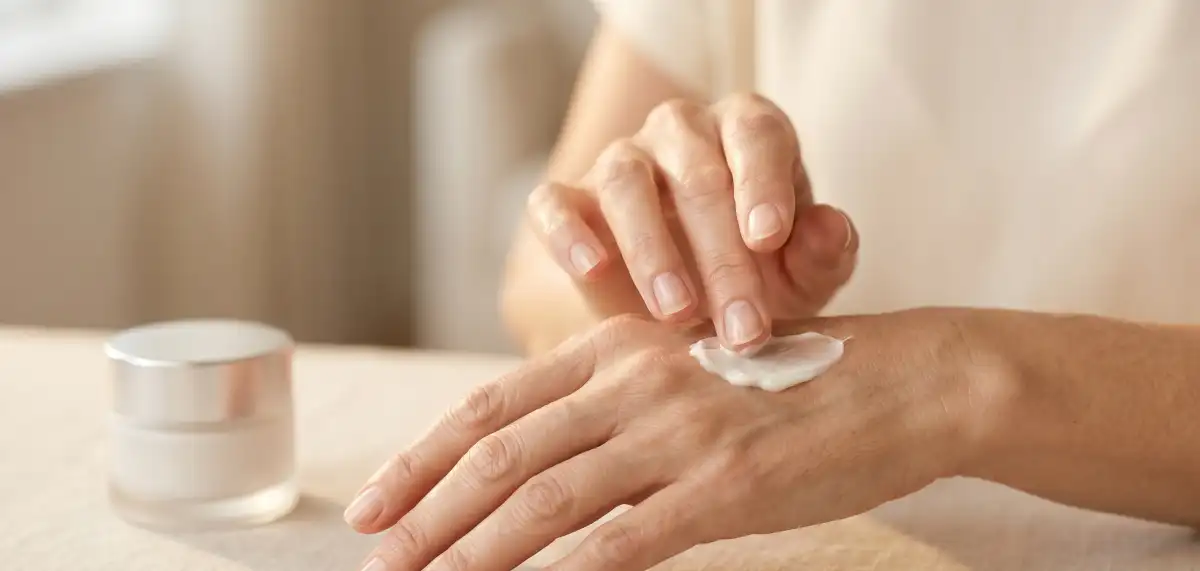
The science of skin aging is evolving rapidly — and for women navigating the skin changes that come with menopause and beyond, evidence-based skincare represents a fundamentally different approach: working with your skin's biology rather than against it.
Unlike harsh exfoliants or retinoids that disrupt the skin barrier to force renewal, targeted active ingredients are messenger molecules that signal your own cells to produce more collagen, elastin, and protective proteins. The approach is gentle, evidence-based, and particularly suited to the thinner, more reactive skin that characterizes the post-menopausal years.
From Topical Brighteners to Clinical Treatments
Age spots on hands — clinically termed solar lentigines — are the single most common reason women seek hand rejuvenation treatment. These flat, brown to dark-brown macules result from decades of UV-induced melanocyte hyperactivity in areas of cumulative photodamage. Unlike freckles (ephelides), which are genetically determined and fluctuate with sun exposure, solar lentigines represent permanent melanocyte changes: the affected melanocytes have undergone irreversible increases in melanin production capacity. A study in the Journal of Investigative Dermatology found that melanocytes within lentigines produce 2-3 times more melanin than surrounding normal melanocytes.[1]
The hands are disproportionately affected because they receive more cumulative UV radiation than almost any other body part. A dosimetry study published in Photodermatology measured UV exposure across body sites during typical daily activities and found that dorsal hands received 1.5-3 times the UV dose of the face — primarily because hands are rarely protected with sunscreen during routine activities (driving, walking, outdoor work) even by women who diligently protect their faces. This UV differential explains why hands often show more lentigines than faces in women who practice facial sun protection.
Clinical research confirms that topical approaches for hand lentigines work through tyrosinase inhibition — blocking the enzyme that catalyzes melanin production. Vitamin C (L-ascorbic acid 10-20%), niacinamide (4-5%), alpha arbutin (2%), and azelaic acid (15-20%) each target different steps in the melanin synthesis pathway. A comparative study found that the combination of vitamin C plus niacinamide reduced lentigine contrast by 35% over 12 weeks, outperforming either ingredient alone. The critical factor is consistent daily application — unlike facial pigmentation treatments that can rely on cosmetic base products for delivery, hand treatments must survive constant washing.
Sunscreen is both treatment and prevention for hand lentigines. A landmark Australian study — one of few to examine sunscreen's effect on existing age spots — found that daily SPF 30+ application to hands not only prevented new lentigines but reduced the visibility of existing spots by 20% over 18 months. The mechanism: by blocking the ongoing UV stimulus, sunscreen allows the skin's natural melanin turnover to gradually reduce the hyperpigmentation. Without consistent sunscreen, topical brightening agents work against a constant UV-driven melanin stimulus, dramatically reducing their effectiveness.
Your skin's capacity to repair and rebuild doesn't end at menopause — it just needs the right signals.
— Dr. Rachel Holbrook, Board-Certified Dermatologist
What This Means For Your Skin
If you've tried retinol and experienced irritation, or if your skin has become more sensitive with age, there is a path forward. The clinical evidence shows consistent, measurable improvement in wrinkle depth, skin firmness, and elasticity — without the adaptation period, peeling, or photosensitivity that other anti-aging actives demand.
Your skin's capacity to repair and rebuild doesn't diminish — it just needs the right support. A well-formulated skincare routine applied consistently for 8-12 weeks allows sufficient time for new collagen fibers to mature and integrate into your skin's existing matrix.
The science is clear. The evidence is consistent. The results are measurable.
What happens next is up to you.