
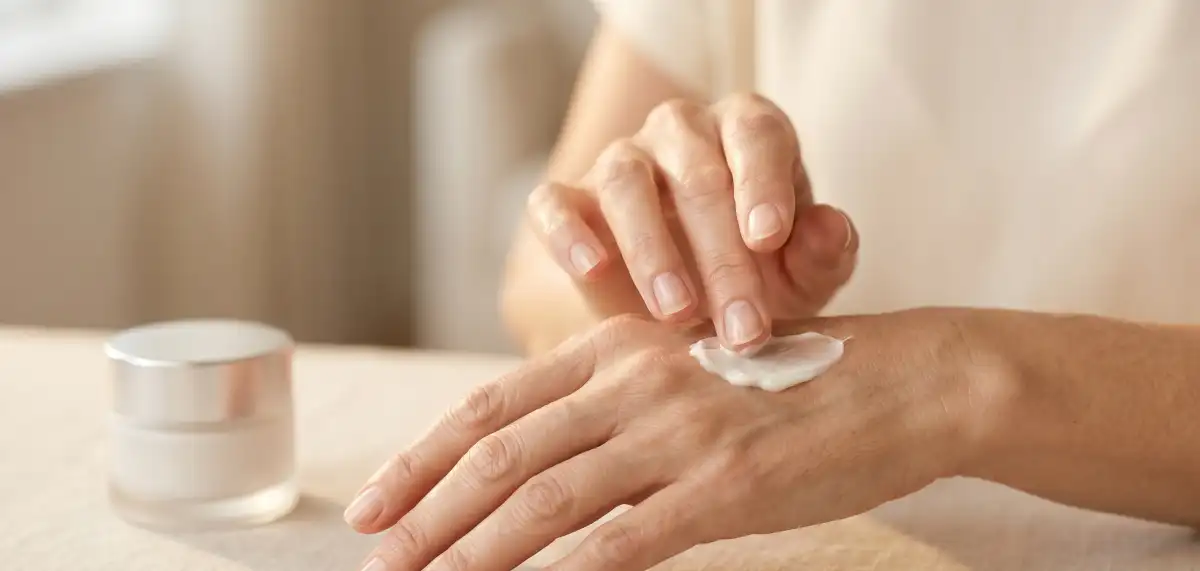
The science of skin aging is evolving rapidly — and for women navigating the skin changes that come with menopause and beyond, evidence-based skincare represents a fundamentally different approach: working with your skin's biology rather than against it.
Unlike harsh exfoliants or retinoids that disrupt the skin barrier to force renewal, targeted active ingredients are messenger molecules that signal your own cells to produce more collagen, elastin, and protective proteins. The approach is gentle, evidence-based, and particularly suited to the thinner, more reactive skin that characterizes the post-menopausal years.
Why Hand SPF Prevents More Aging Than Any Treatment Product
If there is one single intervention that produces the most anti-aging benefit for hands, the clinical evidence overwhelmingly identifies sunscreen — not retinol, not peptides, not vitamin C, but daily broad-spectrum UV protection. A landmark Australian randomized controlled trial followed adults who applied SPF 15+ sunscreen to exposed skin including hands daily for 4.5 years. The sunscreen group showed 24% fewer new solar lentigines and measurably less skin aging compared to the control group who used sunscreen at their discretion. On hands specifically, the protected group showed significantly less photodamage progression.[1]
The disparity between facial and hand sun protection is one of the largest missed opportunities in anti-aging skincare. Survey data consistently shows that while 55-65% of women apply facial sunscreen daily, only 14-18% extend that protection to their hands. Yet dosimetry studies confirm that hands receive 1.5-3 times more cumulative UV radiation than faces during typical daily activities — driving, walking, and outdoor time all expose dorsal hands to UV while the face may be partially shaded by hats or hair. The hands are simultaneously the most exposed and least protected body part.
Clinical research confirms that the mechanisms by which UV damages hand skin are multiple and synergistic. UVB radiation directly damages keratinocyte DNA, triggering the protective melanin overproduction that manifests as age spots. UVA radiation penetrates deeper, generating reactive oxygen species that fragment collagen fibers and degrade elastin — the processes behind wrinkles and crepiness. Both wavelengths trigger matrix metalloproteinase production that actively breaks down existing collagen. A single significant sunburn on the dorsal hands produces measurable collagen damage that persists for months — and cumulative sub-erythemal exposure (daily UV below the sunburn threshold) produces the same damage, just more gradually.
The practical challenge of hand sunscreen is reapplication after hand washing. A standard sunscreen applied in the morning is completely removed by the second or third hand wash. The evidence-based solution is a two-product strategy: a cosmetically elegant SPF 30-50 hand cream applied after every hand wash during the day (making reapplication automatic rather than a separate task), plus a water-resistant sport formulation for periods of prolonged outdoor exposure. A compliance study found that women who switched to an SPF hand cream as their default hand moisturizer achieved 3.5 times greater daily UV protection than women who attempted to apply facial sunscreen to hands as a separate step.
Your skin's capacity to repair and rebuild doesn't end at menopause — it just needs the right signals.
— Dr. Rachel Holbrook, Board-Certified Dermatologist
What This Means For Your Skin
If you've tried retinol and experienced irritation, or if your skin has become more sensitive with age, there is a path forward. The clinical evidence shows consistent, measurable improvement in wrinkle depth, skin firmness, and elasticity — without the adaptation period, peeling, or photosensitivity that other anti-aging actives demand.
Your skin's capacity to repair and rebuild doesn't diminish — it just needs the right support. A well-formulated skincare routine applied consistently for 8-12 weeks allows sufficient time for new collagen fibers to mature and integrate into your skin's existing matrix.
The science is clear. The evidence is consistent. The results are measurable.
What happens next is up to you.