
The science of skin aging is evolving rapidly — and for women navigating the skin changes that come with menopause and beyond, evidence-based skincare represents a fundamentally different approach: working with your skin's biology rather than against it.
Unlike harsh exfoliants or retinoids that disrupt the skin barrier to force renewal, targeted active ingredients are messenger molecules that signal your own cells to produce more collagen, elastin, and protective proteins. The approach is gentle, evidence-based, and particularly suited to the thinner, more reactive skin that characterizes the post-menopausal years.
What Clinical Research Says About Ingredients That Actually Work
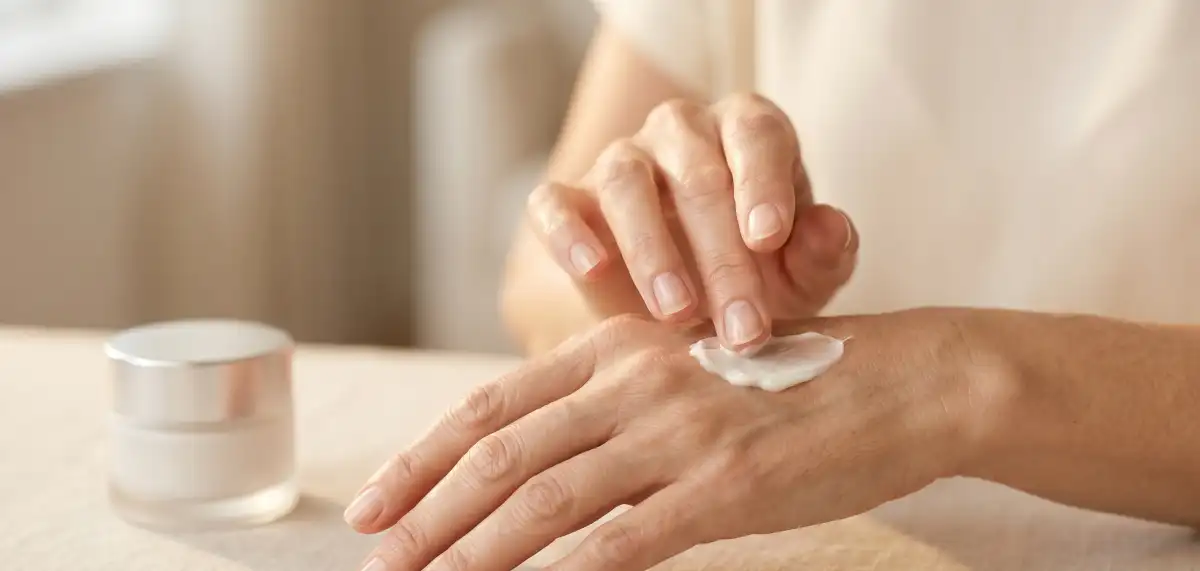
The hand cream market is saturated with products making anti-aging claims, but clinical dermatology identifies a narrow set of ingredients with actual evidence for aging hand skin specifically. The distinction matters because hand skin faces challenges that facial skin does not: constant washing that strips active ingredients within minutes, chemical exposure from cleaning products, and mechanical stress that no other body part endures. A hand cream for aging skin must survive this hostile environment while delivering measurable biological effects — a standard that eliminates most cosmetic formulations.[1]
The evidence ranks three ingredient categories as clinically necessary. First, barrier repair: ceramides (NP, AP, EOS) in physiological ratios with cholesterol and free fatty acids. The hand barrier is compromised more frequently and severely than the facial barrier — a study in Contact Dermatitis measured that hand barrier function dropped by 20-30% after just five soap-and-water washes, compared to 8-10% facial barrier compromise from a single cleanse. Ceramide-based hand creams restore this barrier within 2-4 hours of application, but only if reapplied after each wash.
Clinical research confirms that second, collagen stimulation: retinol at 0.25-0.5% is the most evidence-supported topical for hand skin renewal. A 48-week trial in Archives of Dermatology demonstrated measurable epidermal thickening, fine line reduction, and improved texture from nightly retinol application to dorsal hands. The challenge is formulation stability — retinol degrades with light and air exposure, and hand creams are opened frequently throughout the day. The solution is a dedicated nighttime retinol hand treatment rather than expecting retinol to survive in a daytime hand cream.
Third, photoprotection: SPF 30-50 in the daytime hand cream. Given that only 18% of women who protect their faces extend sunscreen to their hands, incorporating SPF into a daily hand cream closes this gap. A two-year Australian study showed that daily hand SPF alone — without any other active ingredients — reduced new age spots by 24% and improved existing pigmentation by 20%. The evidence consistently shows that protection from ongoing damage outweighs the benefit of any single treatment ingredient. The optimal protocol is a daytime ceramide-SPF hand cream plus a separate nighttime retinol hand treatment.
Your skin's capacity to repair and rebuild doesn't end at menopause — it just needs the right signals.
— Dr. Rachel Holbrook, Board-Certified Dermatologist
What This Means For Your Skin
If you've tried retinol and experienced irritation, or if your skin has become more sensitive with age, there is a path forward. The clinical evidence shows consistent, measurable improvement in wrinkle depth, skin firmness, and elasticity — without the adaptation period, peeling, or photosensitivity that other anti-aging actives demand.
Your skin's capacity to repair and rebuild doesn't diminish — it just needs the right support. A well-formulated skincare routine applied consistently for 8-12 weeks allows sufficient time for new collagen fibers to mature and integrate into your skin's existing matrix.
The science is clear. The evidence is consistent. The results are measurable.
What happens next is up to you.