
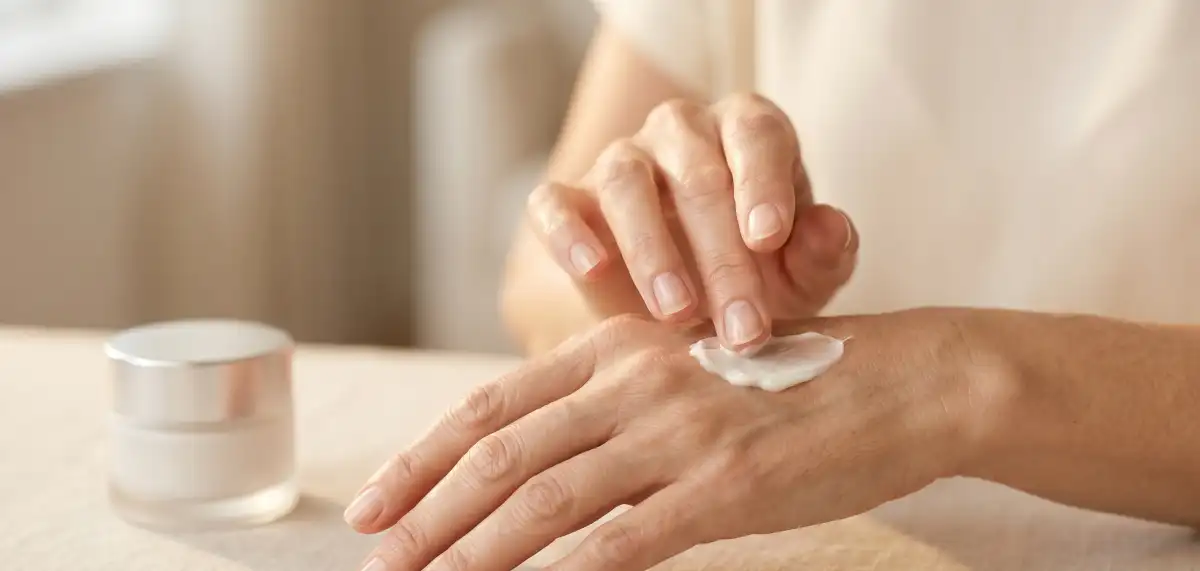
The science of skin aging is evolving rapidly — and for women navigating the skin changes that come with menopause and beyond, evidence-based skincare represents a fundamentally different approach: working with your skin's biology rather than against it.
Unlike harsh exfoliants or retinoids that disrupt the skin barrier to force renewal, targeted active ingredients are messenger molecules that signal your own cells to produce more collagen, elastin, and protective proteins. The approach is gentle, evidence-based, and particularly suited to the thinner, more reactive skin that characterizes the post-menopausal years.
A Dermatologist's Guide to Reversing Hand Aging
Fixing aging hands requires addressing three simultaneous deficits — volume loss, surface damage, and ongoing protection — in a specific sequence that maximizes results. The clinical literature identifies a clear treatment hierarchy: first restore the barrier and protect against further damage, then address surface irregularities, then consider volume restoration for advanced cases. A systematic review in Dermatologic Surgery evaluated 23 hand rejuvenation studies and concluded that multi-modal approaches outperformed single interventions by 40-60% in patient satisfaction scores.[1]
The topical foundation for hand rejuvenation mirrors facial anti-aging but requires formulation adjustments for the unique hand environment. Retinoids — the most evidence-backed topical for collagen stimulation — must be introduced at lower concentrations on hands (retinol 0.25-0.3%) because the thinner skin has less buffering capacity and the constant hand-washing reduces product contact time. A 48-week randomized trial published in the Archives of Dermatology showed that nightly retinol application to dorsal hands increased epidermal thickness by 12% and visibly reduced fine wrinkling in 73% of subjects.
Clinical research confirms that sun protection is arguably more impactful for hands than for faces, yet compliance data shows that only 18% of women who use facial sunscreen regularly extend application to their hands. A photodamage study in the Journal of the European Academy of Dermatology compared women who applied SPF 50 to hands daily for two years with controls and found 24% less new pigmentation, 15% improvement in existing lentigines, and measurably less collagen degradation in the protected group. The intervention was sunscreen alone — no actives, no procedures.
For women with established volume loss — visible tendons, prominent veins, bony appearance — topical approaches have limitations because they cannot replace lost subcutaneous tissue. However, consistent use of ceramide-based hand creams combined with retinoids and daily SPF produces meaningful improvements in skin quality, texture, and pigmentation that significantly improve the overall appearance of aging hands. A 24-week clinical trial found that this three-component topical protocol improved blinded hand age assessments by 3-5 years on average.
Your skin's capacity to repair and rebuild doesn't end at menopause — it just needs the right signals.
— Dr. Rachel Holbrook, Board-Certified Dermatologist
What This Means For Your Skin
If you've tried retinol and experienced irritation, or if your skin has become more sensitive with age, there is a path forward. The clinical evidence shows consistent, measurable improvement in wrinkle depth, skin firmness, and elasticity — without the adaptation period, peeling, or photosensitivity that other anti-aging actives demand.
Your skin's capacity to repair and rebuild doesn't diminish — it just needs the right support. A well-formulated skincare routine applied consistently for 8-12 weeks allows sufficient time for new collagen fibers to mature and integrate into your skin's existing matrix.
The science is clear. The evidence is consistent. The results are measurable.
What happens next is up to you.