
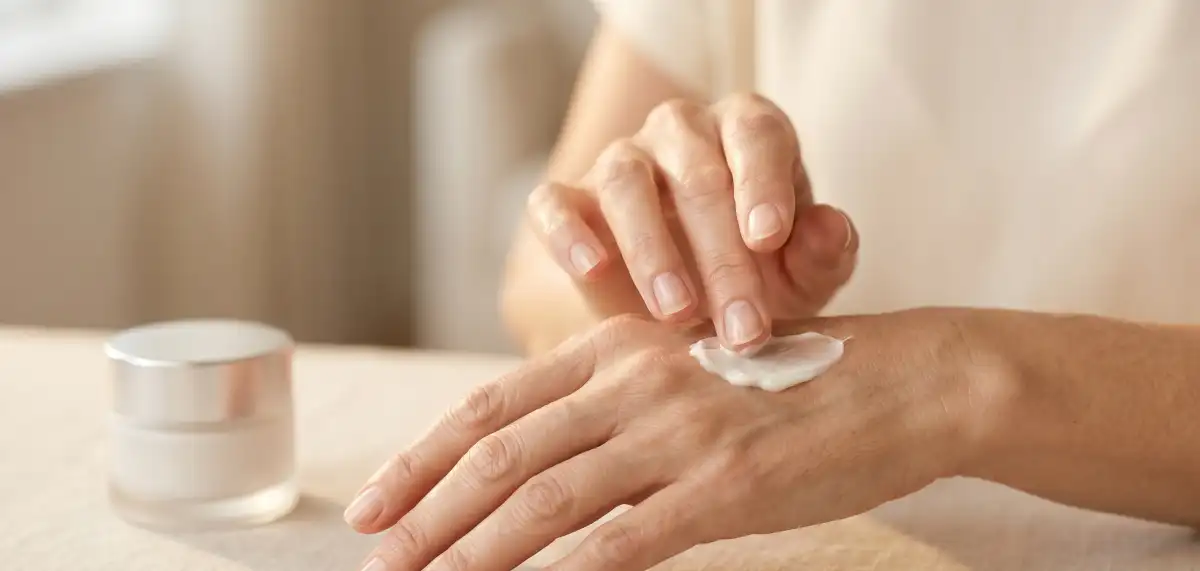
The science of skin aging is evolving rapidly — and for women navigating the skin changes that come with menopause and beyond, evidence-based skincare represents a fundamentally different approach: working with your skin's biology rather than against it.
Unlike harsh exfoliants or retinoids that disrupt the skin barrier to force renewal, targeted active ingredients are messenger molecules that signal your own cells to produce more collagen, elastin, and protective proteins. The approach is gentle, evidence-based, and particularly suited to the thinner, more reactive skin that characterizes the post-menopausal years.
Why Hands Age Faster Than Your Face — and What to Do
Hands reveal age more honestly than any other body part — and the biological reasons are measurable. The dorsal hand skin is among the thinnest on the body, averaging just 0.5mm of dermal thickness compared to 1.5-2.0mm on the face. This anatomical reality means that collagen loss, which averages 1-1.5% per year after age 30, produces visible structural changes on the hands years before the same degree of loss becomes apparent on the face. A study in the Journal of Cosmetic Dermatology found that blinded observers estimated hand age as 5-10 years older than facial age in 68% of women over 50.[1]
The hands face a unique combination of aging accelerators that no other body part endures simultaneously. Constant UV exposure — hands receive 2-4 times more cumulative sun damage than the face because they are rarely protected with sunscreen consistently. Chemical exposure from soaps, sanitizers, and cleaning products strips the lipid barrier repeatedly, up to 15-20 times daily. Mechanical stress from gripping, washing, and daily use subjects the thin dorsal skin to constant micro-trauma. A photodamage mapping study confirmed that the dorsal hands showed higher levels of solar elastosis than any facial zone in age-matched controls.
Clinical research confirms that the volume loss that makes hand aging particularly visible involves three distinct tissue layers. First, dermal collagen and elastin decline with age, producing thinning and crepiness. Second, subcutaneous fat — the cushioning layer beneath the skin — atrophies progressively after age 40, causing tendons, veins, and metacarpal bones to become prominently visible. Third, the intrinsic muscles of the hand undergo age-related atrophy, further reducing the fullness that characterizes youthful hands. MRI studies of aging hands documented a 40-50% reduction in dorsal soft tissue volume between ages 30 and 65.
The clinical significance of hand aging extends beyond aesthetics. Research published in Plastic and Reconstructive Surgery demonstrated that observers use hand appearance as a primary age estimator when facial cues are ambiguous — hands rated as 'old' increased overall perceived age by 7-8 years regardless of facial appearance. This disconnect between maintained facial appearance and neglected hand aging has driven increasing clinical attention to hand rejuvenation as an integral part of anti-aging strategy rather than an afterthought.
Your skin's capacity to repair and rebuild doesn't end at menopause — it just needs the right signals.
— Dr. Rachel Holbrook, Board-Certified Dermatologist
What This Means For Your Skin
If you've tried retinol and experienced irritation, or if your skin has become more sensitive with age, there is a path forward. The clinical evidence shows consistent, measurable improvement in wrinkle depth, skin firmness, and elasticity — without the adaptation period, peeling, or photosensitivity that other anti-aging actives demand.
Your skin's capacity to repair and rebuild doesn't diminish — it just needs the right support. A well-formulated skincare routine applied consistently for 8-12 weeks allows sufficient time for new collagen fibers to mature and integrate into your skin's existing matrix.
The science is clear. The evidence is consistent. The results are measurable.
What happens next is up to you.