
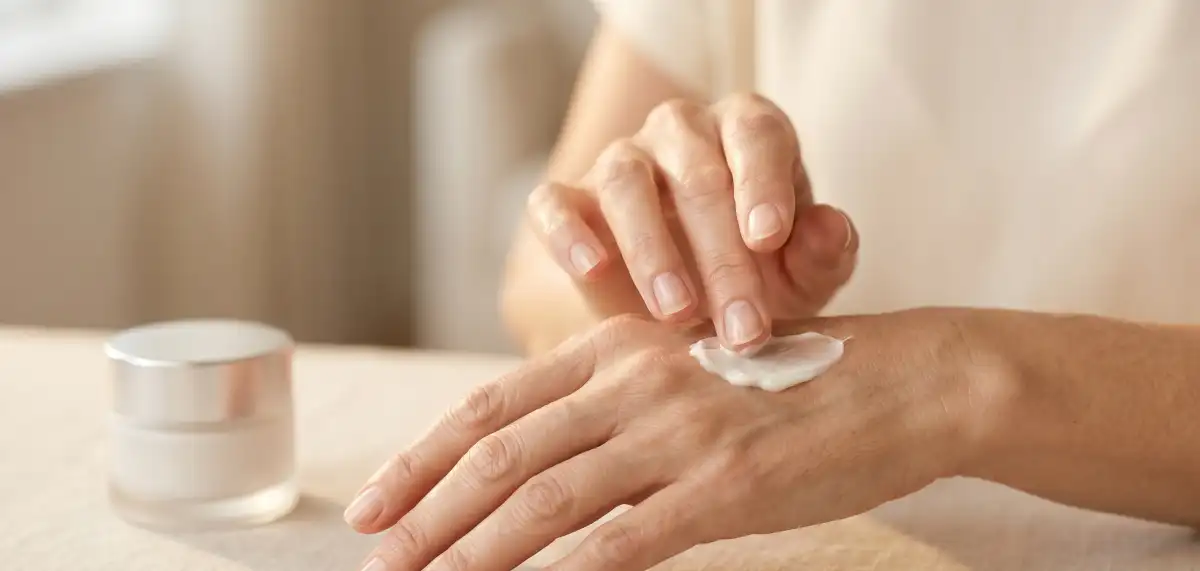
The science of skin aging is evolving rapidly — and for women navigating the skin changes that come with menopause and beyond, evidence-based skincare represents a fundamentally different approach: working with your skin's biology rather than against it.
Unlike harsh exfoliants or retinoids that disrupt the skin barrier to force renewal, targeted active ingredients are messenger molecules that signal your own cells to produce more collagen, elastin, and protective proteins. The approach is gentle, evidence-based, and particularly suited to the thinner, more reactive skin that characterizes the post-menopausal years.
Why Hand Skin Becomes Paper-Thin and How to Rebuild Texture
Crepey skin on the hands — characterized by thin, wrinkled texture that resembles crepe paper when gently pinched — represents the convergence of three age-related processes: collagen fiber fragmentation, elastin degradation, and dehydration of the dermal matrix. Unlike facial crepiness, which may be partially masked by subcutaneous fat, hand crepiness is immediately apparent because the dorsal hand skin sits directly over tendons and bones with minimal cushioning. A histological study in Skin Research and Technology found that crepey hand skin showed 35-45% less organized collagen fiber bundles compared to age-matched hand skin without visible crepiness.[1]
The elastin component of hand crepiness is particularly significant. Elastin — the protein responsible for skin's ability to snap back after being stretched — is produced almost exclusively during development and early life. Unlike collagen, which turns over (albeit slowly) throughout life, elastin is essentially irreplaceable once damaged. UV exposure, which hands receive disproportionately, causes solar elastosis — the accumulation of dysfunctional, tangled elastin that replaces the organized elastic fiber network. Once this threshold is crossed, the skin loses its recoil permanently.
Clinical research confirms that the dehydration component explains why crepiness fluctuates throughout the day and with environmental changes. The dermal matrix contains glycosaminoglycans (GAGs) — primarily hyaluronic acid — that bind water and maintain skin turgor. GAG content declines with age, but the decline is accelerated in hands by constant exposure to detergents and solvents that strip both surface lipids and deeper hydration reserves. Women who wash hands 15+ times daily show measurably worse crepiness than those who wash less frequently, independent of age — a finding that became particularly relevant during the hand-sanitizer era.
Treatment of hand crepiness requires addressing all three components simultaneously. Retinoids (retinol 0.3-0.5%) stimulate new collagen synthesis and normalize epidermal thickness — a 36-week study showed visible improvement in 67% of subjects. Ceramide-based creams restore the lipid barrier that constant washing depletes. Humectant ingredients (hyaluronic acid, glycerin) temporarily improve turgor by attracting water to the dermis. The critical behavioral change is applying treatment cream immediately after every hand wash — the 'soak and seal' principle that prevents cumulative barrier damage.
Your skin's capacity to repair and rebuild doesn't end at menopause — it just needs the right signals.
— Dr. Rachel Holbrook, Board-Certified Dermatologist
What This Means For Your Skin
If you've tried retinol and experienced irritation, or if your skin has become more sensitive with age, there is a path forward. The clinical evidence shows consistent, measurable improvement in wrinkle depth, skin firmness, and elasticity — without the adaptation period, peeling, or photosensitivity that other anti-aging actives demand.
Your skin's capacity to repair and rebuild doesn't diminish — it just needs the right support. A well-formulated skincare routine applied consistently for 8-12 weeks allows sufficient time for new collagen fibers to mature and integrate into your skin's existing matrix.
The science is clear. The evidence is consistent. The results are measurable.
What happens next is up to you.