
The science of skin aging is evolving rapidly — and for women navigating the skin changes that come with menopause and beyond, evidence-based skincare represents a fundamentally different approach: working with your skin's biology rather than against it.
Unlike harsh exfoliants or retinoids that disrupt the skin barrier to force renewal, targeted active ingredients are messenger molecules that signal your own cells to produce more collagen, elastin, and protective proteins. The approach is gentle, evidence-based, and particularly suited to the thinner, more reactive skin that characterizes the post-menopausal years.
Clinical Evidence for Using Retinoids on Dorsal Hand Skin
Retinol's anti-aging benefits are extensively documented for facial skin, but its efficacy on dorsal hand skin — while equally impressive — is less commonly discussed in consumer skincare education. The landmark study by Kafi et al. published in Archives of Dermatology provided definitive evidence: 0.4% retinol applied to dorsal hand skin nightly for 24 weeks produced statistically significant improvements in fine wrinkle severity, overall photodamage scoring, and histological measures of collagen fiber organization. The improvements on hands were comparable in magnitude to those achieved on facial skin in similar retinol trials.[1]
Hand skin responds to retinol through the same retinoic acid receptor-mediated pathways as facial skin, but with important practical differences. Hand skin is thinner, has fewer sebaceous glands (less natural lubrication), and is subjected to constant washing that removes applied product. These factors mean that retinol application to hands requires dosing and technique modifications: start at lower concentration (0.25% for hands versus 0.5% for face), apply only at night (daytime application is washed off too frequently), and always follow with a ceramide moisturizer to buffer potential irritation on the more vulnerable hand skin.
Clinical research confirms that the timeline of retinol benefits on hands follows a predictable sequence documented across multiple studies. Weeks 1-4: initial irritation phase (dryness, mild flaking on dorsal surface) — this is expected and managed with ceramide cream. Weeks 4-12: first visible improvements in skin texture and smoothness as epidermal turnover normalizes. Weeks 12-24: measurable increase in epidermal thickness, visible reduction in fine lines, initial fading of superficial pigmentation. Weeks 24-48: maximum topical retinol benefits achieved — the collagen stimulation has matured, skin quality has measurably improved across all parameters.
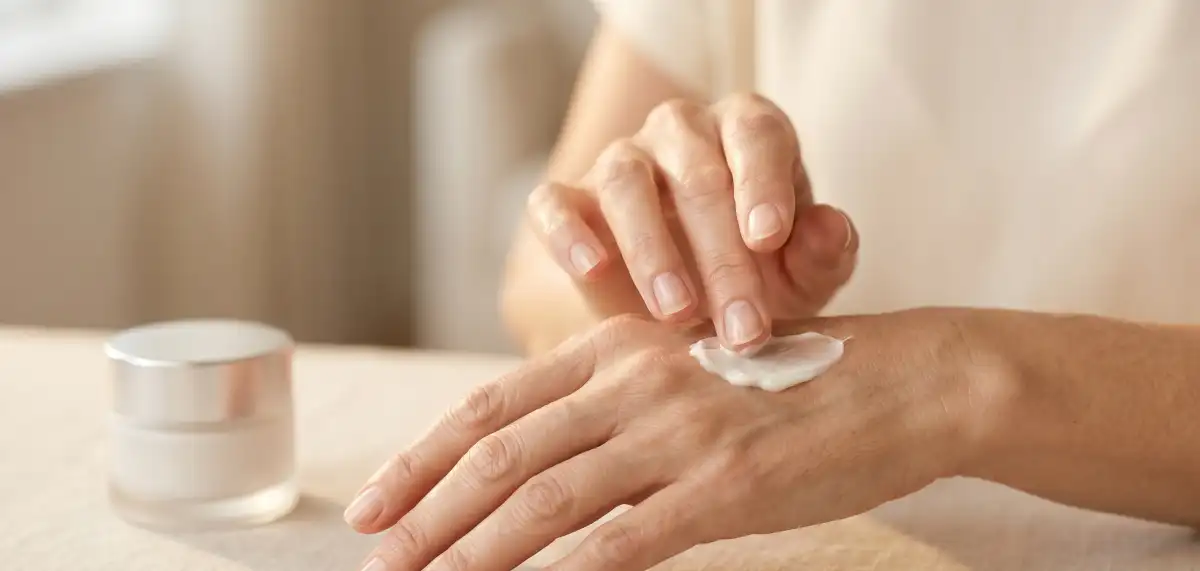
The practical protocol for hand retinol maximizes efficacy while minimizing irritation. Apply a pea-sized amount of retinol product to each hand dorsum after the evening's last hand wash, when the skin will remain undisturbed for 7-8 hours. Distribute evenly across the dorsal surface, including the finger dorsa and between the knuckles. After 15 minutes of absorption, apply ceramide night cream. Cotton gloves are optional but recommended — they prevent retinol transfer to bedsheets and increase product contact time by approximately 40%. Skip retinol on nights when hands show active irritation, cuts, or fissures — retinol impedes wound healing and should not be applied to compromised skin.
Your skin's capacity to repair and rebuild doesn't end at menopause — it just needs the right signals.
— Dr. Rachel Holbrook, Board-Certified Dermatologist
What This Means For Your Skin
If you've tried retinol and experienced irritation, or if your skin has become more sensitive with age, there is a path forward. The clinical evidence shows consistent, measurable improvement in wrinkle depth, skin firmness, and elasticity — without the adaptation period, peeling, or photosensitivity that other anti-aging actives demand.
Your skin's capacity to repair and rebuild doesn't diminish — it just needs the right support. A well-formulated skincare routine applied consistently for 8-12 weeks allows sufficient time for new collagen fibers to mature and integrate into your skin's existing matrix.
The science is clear. The evidence is consistent. The results are measurable.
What happens next is up to you.