
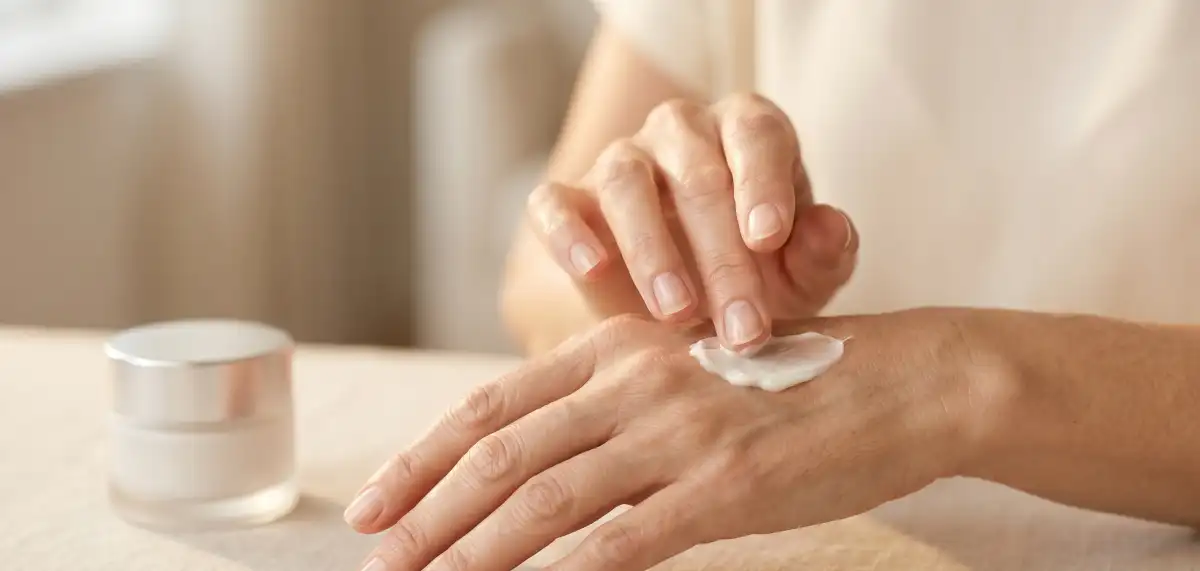
The science of skin aging is evolving rapidly — and for women navigating the skin changes that come with menopause and beyond, evidence-based skincare represents a fundamentally different approach: working with your skin's biology rather than against it.
Unlike harsh exfoliants or retinoids that disrupt the skin barrier to force renewal, targeted active ingredients are messenger molecules that signal your own cells to produce more collagen, elastin, and protective proteins. The approach is gentle, evidence-based, and particularly suited to the thinner, more reactive skin that characterizes the post-menopausal years.
Clinical Approaches to Reducing Fine Lines on Aging Hands
Hand wrinkles form through a different biomechanical process than facial wrinkles, which is why facial anti-wrinkle strategies don't translate directly to hands. Facial wrinkles form primarily along lines of repeated muscular expression — crow's feet from orbicularis oculi contraction, forehead lines from frontalis. Hand wrinkles form from a combination of collagen degradation, constant mechanical stretching (gripping, flexing), and cumulative photodamage. The result is a pattern of fine cross-hatched lines across the dorsal surface rather than the deep linear creases characteristic of facial expression wrinkles.[1]
The mechanical component of hand wrinkling is underappreciated. Every gripping action stretches the dorsal hand skin, and in youthful skin with intact elastin, the skin rebounds completely. As elastin degrades with age and UV exposure, each stretch leaves a slightly more permanent deformation. Over thousands of daily grip-and-release cycles across decades, these micro-deformations accumulate into the visible fine lines that characterize aging hands. A biomechanical study using skin extensometry found that dorsal hand skin in women over 55 showed 40% less elastic recovery than in women under 35.
Clinical research confirms that topical retinoids remain the most evidence-supported treatment for hand wrinkles specifically. A randomized, vehicle-controlled study published in the Journal of Drugs in Dermatology evaluated retinol 0.5% applied to dorsal hands nightly for 24 weeks. The retinol group showed statistically significant improvements in fine line severity (physician-graded and objectively measured), epidermal thickness, and overall skin quality compared to vehicle alone. The study noted that hand skin was more prone to retinoid irritation than facial skin, recommending gradual introduction over 4-6 weeks.
Combination approaches show the best outcomes for established hand wrinkles. A clinical protocol pairing nightly retinol with daily vitamin C serum (15% L-ascorbic acid) and broad-spectrum SPF 50 produced measurable wrinkle reduction in 78% of participants over 12 weeks. The vitamin C serves dual functions: as a collagen synthesis cofactor and as a photoprotective antioxidant. Peptide formulations containing palmitoyl pentapeptide-4 offer an alternative for women who cannot tolerate retinoids, with one study showing statistically significant wrinkle reduction at 12 weeks — smaller in magnitude than retinoids but achieved without irritation.
Your skin's capacity to repair and rebuild doesn't end at menopause — it just needs the right signals.
— Dr. Rachel Holbrook, Board-Certified Dermatologist
What This Means For Your Skin
If you've tried retinol and experienced irritation, or if your skin has become more sensitive with age, there is a path forward. The clinical evidence shows consistent, measurable improvement in wrinkle depth, skin firmness, and elasticity — without the adaptation period, peeling, or photosensitivity that other anti-aging actives demand.
Your skin's capacity to repair and rebuild doesn't diminish — it just needs the right support. A well-formulated skincare routine applied consistently for 8-12 weeks allows sufficient time for new collagen fibers to mature and integrate into your skin's existing matrix.
The science is clear. The evidence is consistent. The results are measurable.
What happens next is up to you.