
The science of skin aging is evolving rapidly — and for women navigating the skin changes that come with menopause and beyond, evidence-based skincare represents a fundamentally different approach: working with your skin's biology rather than against it.
Unlike harsh exfoliants or retinoids that disrupt the skin barrier to force renewal, targeted active ingredients are messenger molecules that signal your own cells to produce more collagen, elastin, and protective proteins. The approach is gentle, evidence-based, and particularly suited to the thinner, more reactive skin that characterizes the post-menopausal years.
The Collagen Timeline Behind Increasingly Fragile Hand Skin
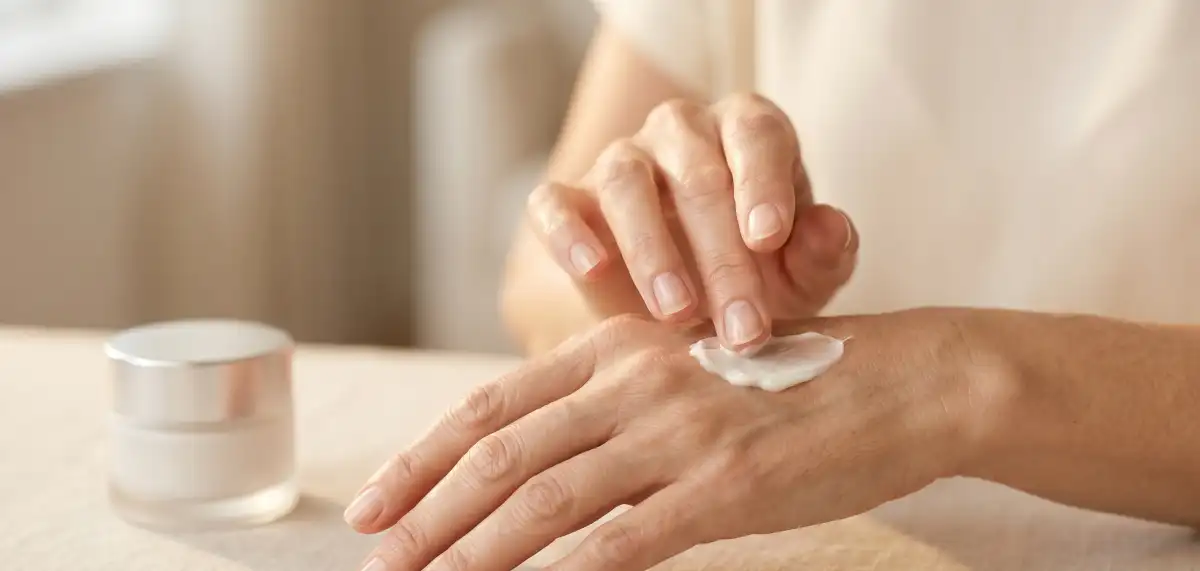
Thin skin on the hands is the most frequent dermatological complaint among women over 55, and the most physiologically inevitable. Dorsal hand skin begins thinner than most body sites — averaging 0.5mm versus 1.5-2.0mm on the face — and loses thickness at approximately 1.13% per year after menopause. By age 70, a woman's dorsal hand skin may be 25-35% thinner than it was at age 40. This thinning is not merely cosmetic: it increases susceptibility to tearing, bruising, and slow wound healing, making daily activities potentially damaging to hand skin integrity.[1]
The thinning involves all three layers of hand skin simultaneously. The epidermis flattens as the rete ridges — the finger-like projections that interlock epidermis and dermis — gradually disappear with age. This flattening reduces the epidermal-dermal junction surface area by up to 35%, weakening the mechanical attachment between layers and increasing susceptibility to shear injuries. The dermis thins as collagen content decreases and the remaining collagen fibers become fragmented and disorganized. The hypodermis atrophies as subcutaneous fat diminishes, removing the protective cushioning layer entirely in advanced cases.
Clinical research confirms that uV exposure accelerates hand skin thinning through a specific mechanism: photoaged skin accumulates disorganized elastic material (solar elastosis) that displaces normal collagen architecture. The paradox is that photoaged skin may appear thickened microscopically due to this elastic debris, but the functional collagen — the organized fiber network that provides structural strength — is actually reduced. This explains why chronically sun-exposed hands can feel both leathery (from solar elastosis) and fragile (from collagen loss) simultaneously.
Thickening thin hand skin is achievable within biological limits. Retinoids increase epidermal thickness by 10-15% over 6-12 months through accelerated keratinocyte proliferation and improved rete ridge architecture. Vitamin C (15% L-ascorbic acid) provides the cofactor necessary for new collagen cross-linking. Consistent ceramide application maintains the lipid barrier that prevents transepidermal water loss — critical because dehydrated thin skin tears more easily than hydrated thin skin. The behavioral component is equally important: wearing gloves for cleaning and gardening, avoiding alcohol-based hand sanitizers, and applying hand cream after every wash collectively reduce the mechanical and chemical insults that compound biological thinning.
Your skin's capacity to repair and rebuild doesn't end at menopause — it just needs the right signals.
— Dr. Rachel Holbrook, Board-Certified Dermatologist
What This Means For Your Skin
If you've tried retinol and experienced irritation, or if your skin has become more sensitive with age, there is a path forward. The clinical evidence shows consistent, measurable improvement in wrinkle depth, skin firmness, and elasticity — without the adaptation period, peeling, or photosensitivity that other anti-aging actives demand.
Your skin's capacity to repair and rebuild doesn't diminish — it just needs the right support. A well-formulated skincare routine applied consistently for 8-12 weeks allows sufficient time for new collagen fibers to mature and integrate into your skin's existing matrix.
The science is clear. The evidence is consistent. The results are measurable.
What happens next is up to you.