
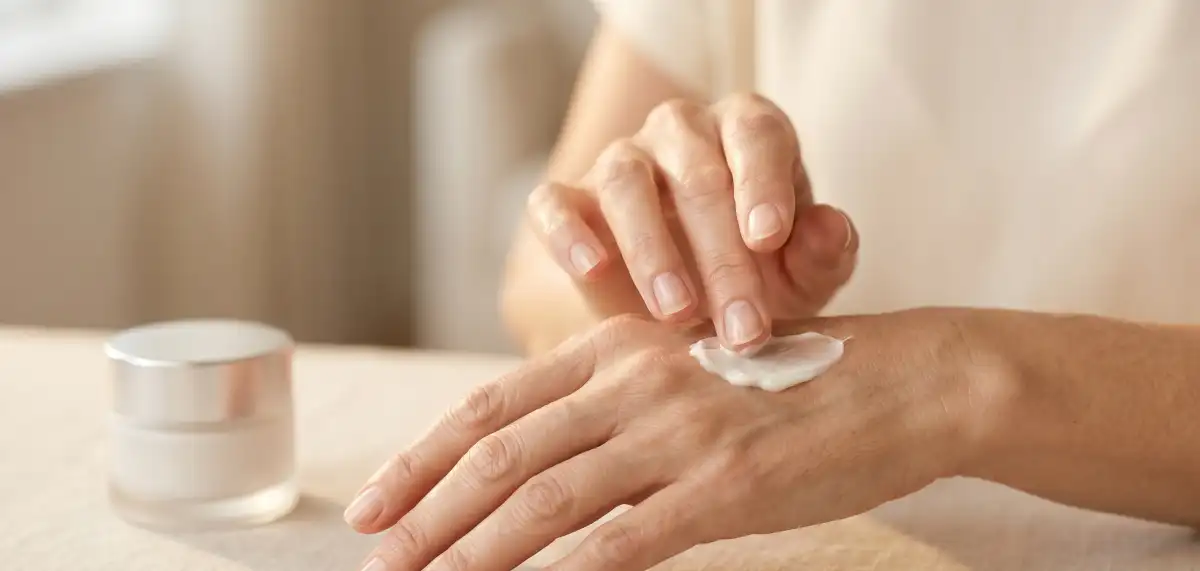
The science of skin aging is evolving rapidly — and for women navigating the skin changes that come with menopause and beyond, evidence-based skincare represents a fundamentally different approach: working with your skin's biology rather than against it.
Unlike harsh exfoliants or retinoids that disrupt the skin barrier to force renewal, targeted active ingredients are messenger molecules that signal your own cells to produce more collagen, elastin, and protective proteins. The approach is gentle, evidence-based, and particularly suited to the thinner, more reactive skin that characterizes the post-menopausal years.
Why Veins Become Visible and What Restores a Smoother Appearance
Prominent veins on the dorsal hands are one of the most reliable indicators of biological hand age — and one of the most difficult to address topically. The mechanism is straightforward: the subcutaneous fat layer that normally cushions and conceals dorsal hand veins atrophies progressively after age 40. Simultaneously, the overlying skin thins as collagen is lost, reducing the opaque tissue layer between the vein and the surface. The result is veins that were always present becoming increasingly visible, prominent, and — in advanced cases — tortuous. Volumetric MRI studies document a 30-50% reduction in dorsal hand soft tissue volume between ages 30 and 70.[1]
The hormonal connection to hand vein prominence is significant but rarely discussed. Estrogen promotes subcutaneous fat deposition throughout the body, including the hands. During menopause, as estrogen declines, subcutaneous fat redistributes — moving away from the extremities (hands, forearms, lower legs) toward the trunk. This hormonal redistribution accelerates the hand volume loss that aging alone produces. A cross-sectional study found that hand vein prominence increased measurably within 2-3 years of menopause onset, suggesting that the hormonal transition triggers a relatively rapid phase of hand aging.
Clinical research confirms that skin thinning compounds the vein visibility problem through a separate mechanism. As dermal collagen decreases (at approximately 1-1.5% per year after menopause), the skin loses both its thickness and its optical opacity — becoming more translucent. This translucency allows not only veins but also tendons and metacarpal bones to become visible through the skin surface. A study using optical coherence tomography confirmed that dorsal hand skin translucency increased by 15-25% between ages 40 and 65, correlating directly with subjective vein prominence ratings.
While topical products cannot replace lost subcutaneous fat or reduce vein diameter, they can meaningfully improve the skin quality that overlays the veins. Consistent retinoid use increases epidermal thickness by 10-15%, adding a modest but visible layer of opacity. Ceramide-based moisturizers maintain the skin's surface smoothness and light-reflecting properties. Daily SPF prevents the additional collagen degradation that UV exposure accelerates. Women who follow this topical protocol consistently report that while veins remain visible, the overall hand appearance improves significantly — the skin looks healthier, smoother, and less fragile.
Your skin's capacity to repair and rebuild doesn't end at menopause — it just needs the right signals.
— Dr. Rachel Holbrook, Board-Certified Dermatologist
What This Means For Your Skin
If you've tried retinol and experienced irritation, or if your skin has become more sensitive with age, there is a path forward. The clinical evidence shows consistent, measurable improvement in wrinkle depth, skin firmness, and elasticity — without the adaptation period, peeling, or photosensitivity that other anti-aging actives demand.
Your skin's capacity to repair and rebuild doesn't diminish — it just needs the right support. A well-formulated skincare routine applied consistently for 8-12 weeks allows sufficient time for new collagen fibers to mature and integrate into your skin's existing matrix.
The science is clear. The evidence is consistent. The results are measurable.
What happens next is up to you.