
The science of skin aging is evolving rapidly — and for women navigating the skin changes that come with menopause and beyond, evidence-based skincare represents a fundamentally different approach: working with your skin's biology rather than against it.
Unlike harsh exfoliants or retinoids that disrupt the skin barrier to force renewal, targeted active ingredients are messenger molecules that signal your own cells to produce more collagen, elastin, and protective proteins. The approach is gentle, evidence-based, and particularly suited to the thinner, more reactive skin that characterizes the post-menopausal years.
Why Hands Become Bony and Skeletal After Menopause
The transformation of hands from smooth and full to bony and skeletal is primarily a story of fat loss — specifically, the atrophy of the dorsal subcutaneous fat pad that gives youthful hands their smooth, cushioned appearance. This fat pad is relatively thin even in youth (3-5mm on average), making it one of the first body sites where age-related fat loss becomes visible. MRI volumetric studies document that dorsal hand soft tissue volume decreases by 40-50% between ages 30 and 70, with the steepest decline occurring between ages 45 and 60 — coinciding with the perimenopausal and menopausal transition.[1]
The hormonal connection to hand fat loss is direct and significant. Estrogen promotes subcutaneous fat deposition throughout the body through estrogen receptor-alpha signaling in adipocytes. During menopause, as estrogen levels decline permanently, the body's fat distribution shifts: subcutaneous fat migrates away from the extremities (hands, forearms, lower legs, face) toward central visceral storage. This redistribution is measurable within 2-3 years of menopause onset and explains the rapid hand aging many women notice during the menopausal transition — even before significant collagen loss becomes apparent.
Clinical research confirms that the visual consequences of dorsal hand fat loss are dramatic because the hand contains prominent structures just beneath the fat layer — extensor tendons, metacarpal bones, dorsal veins, and interosseous muscles. When the concealing fat pad thins, these structures become progressively visible, creating the 'skeletal' or 'bony' appearance that patients describe. The tendons create raised ridges, the veins become prominent and tortuous, and the metacarpal heads become visible as bony prominences — each change contributing to an older appearance.
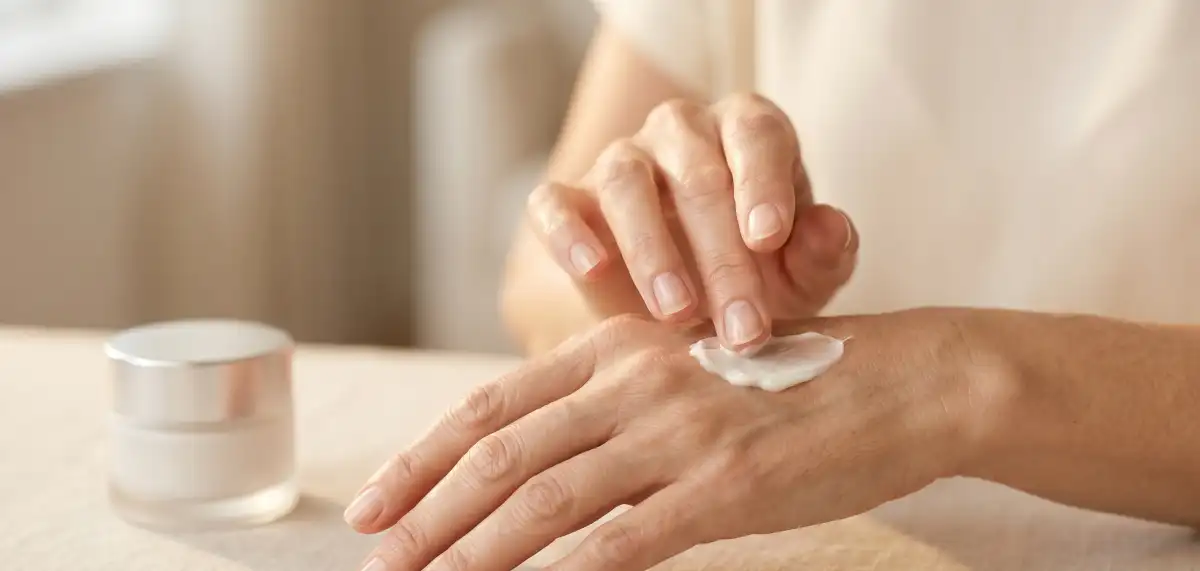
While topical products cannot replace lost subcutaneous fat, they can meaningfully improve the skin quality that reveals the underlying anatomy. Consistent retinoid use increases epidermal thickness, adding a modest but visible layer of tissue over the bony structures. Ceramide-based moisturizers maintain skin hydration, which provides temporary volumizing effect — well-hydrated skin appears fuller than dehydrated skin. Daily SPF prevents the additional collagen degradation that would accelerate skin thinning over the already-depleted fat layer. The goal of topical care is not to restore youthful hand volume — that is beyond topical capability — but to ensure the remaining tissue is as healthy, thick, and resilient as possible.
Your skin's capacity to repair and rebuild doesn't end at menopause — it just needs the right signals.
— Dr. Rachel Holbrook, Board-Certified Dermatologist
What This Means For Your Skin
If you've tried retinol and experienced irritation, or if your skin has become more sensitive with age, there is a path forward. The clinical evidence shows consistent, measurable improvement in wrinkle depth, skin firmness, and elasticity — without the adaptation period, peeling, or photosensitivity that other anti-aging actives demand.
Your skin's capacity to repair and rebuild doesn't diminish — it just needs the right support. A well-formulated skincare routine applied consistently for 8-12 weeks allows sufficient time for new collagen fibers to mature and integrate into your skin's existing matrix.
The science is clear. The evidence is consistent. The results are measurable.
What happens next is up to you.