
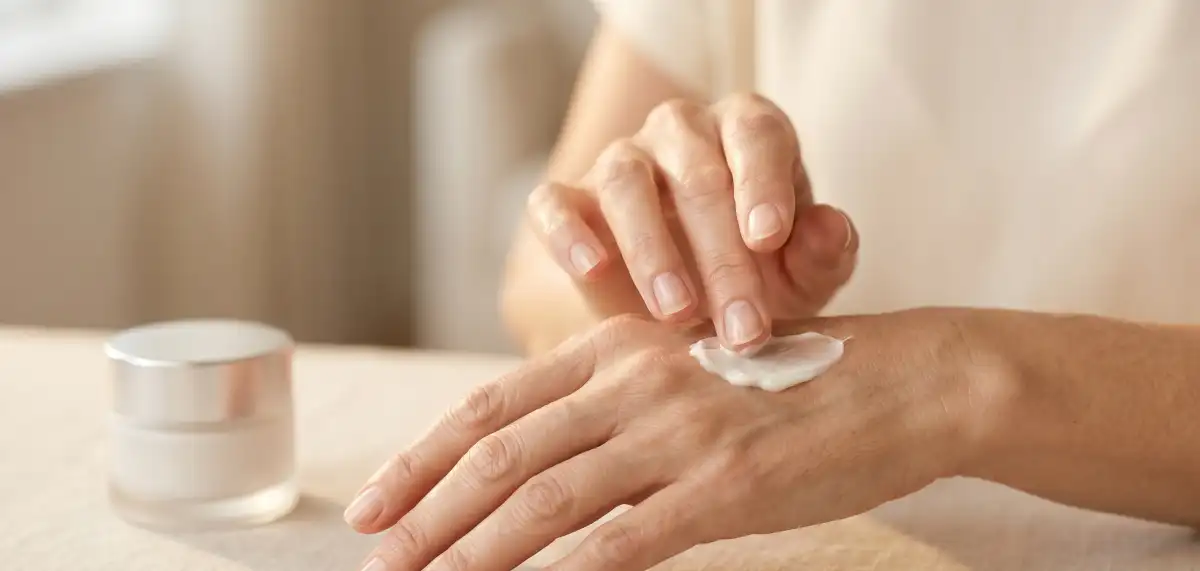
The science of skin aging is evolving rapidly — and for women navigating the skin changes that come with menopause and beyond, evidence-based skincare represents a fundamentally different approach: working with your skin's biology rather than against it.
Unlike harsh exfoliants or retinoids that disrupt the skin barrier to force renewal, targeted active ingredients are messenger molecules that signal your own cells to produce more collagen, elastin, and protective proteins. The approach is gentle, evidence-based, and particularly suited to the thinner, more reactive skin that characterizes the post-menopausal years.
The Anatomical and Behavioral Gap That Ages Hands Faster
The disconnect between a well-maintained face and visibly aged hands is so common that dermatologists have a term for it: the face-hand age gap. A study in Aesthetic Surgery Journal quantified this gap by having blinded observers estimate the age of faces and hands independently in 200 women aged 45-70. The average face was estimated 4 years younger than chronological age (reflecting skincare investment), while the average hands were estimated 6 years older than chronological age — creating a face-hand gap of approximately 10 years. In 23% of subjects, the gap exceeded 15 years.[1]
Three factors explain why hands age faster than faces despite being made of the same biological material. First, anatomical disadvantage: dorsal hand skin is 60-70% thinner than facial skin, with less subcutaneous fat cushioning and fewer sebaceous glands (which provide natural moisturization). This means identical collagen loss percentages produce more visible structural change on hands than on faces. Second, behavioral neglect: the average woman applies skincare products to her face twice daily but applies hand cream less than once daily — creating a massive treatment differential that compounds over decades.
Clinical research confirms that third, environmental assault: hands endure chemical and mechanical insults that facial skin is largely spared. The average person washes their hands 8-10 times daily, each wash stripping 20-30% of the lipid barrier. Cleaning products, hand sanitizers, and even frequent contact with paper (which is surprisingly abrasive) subject hand skin to constant low-grade damage. A contact dermatitis study measured that occupational hand exposure to soap and water alone — without additional chemical exposure — was sufficient to produce measurable barrier compromise within two weeks of starting a hand-intensive job.
Closing the face-hand gap requires extending facial skincare principles to hands with modifications for the hand-specific challenges. The evidence suggests three changes produce the most impact: applying facial SPF to hands every morning (closes the UV protection gap), using a ceramide hand cream after every wash (closes the barrier repair gap), and applying retinol to hands at night (closes the active treatment gap). A study tracking women who adopted this three-step protocol found that the face-hand age gap decreased from an average of 8 years to 3 years over 24 weeks — not elimination, but significant improvement.
Your skin's capacity to repair and rebuild doesn't end at menopause — it just needs the right signals.
— Dr. Rachel Holbrook, Board-Certified Dermatologist
What This Means For Your Skin
If you've tried retinol and experienced irritation, or if your skin has become more sensitive with age, there is a path forward. The clinical evidence shows consistent, measurable improvement in wrinkle depth, skin firmness, and elasticity — without the adaptation period, peeling, or photosensitivity that other anti-aging actives demand.
Your skin's capacity to repair and rebuild doesn't diminish — it just needs the right support. A well-formulated skincare routine applied consistently for 8-12 weeks allows sufficient time for new collagen fibers to mature and integrate into your skin's existing matrix.
The science is clear. The evidence is consistent. The results are measurable.
What happens next is up to you.