
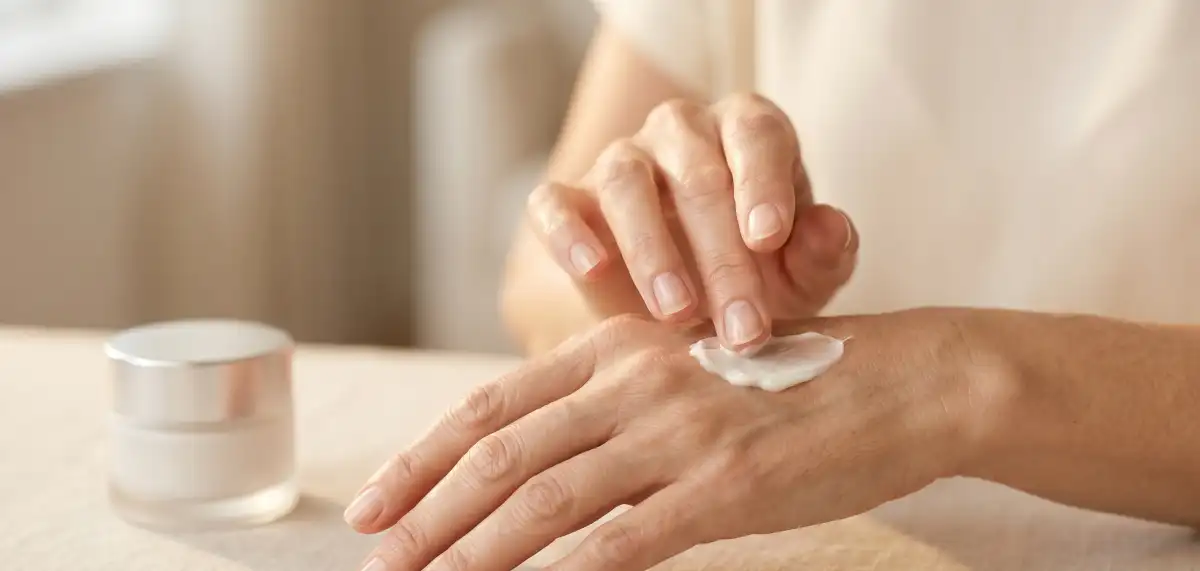
The science of skin aging is evolving rapidly — and for women navigating the skin changes that come with menopause and beyond, evidence-based skincare represents a fundamentally different approach: working with your skin's biology rather than against it.
Unlike harsh exfoliants or retinoids that disrupt the skin barrier to force renewal, targeted active ingredients are messenger molecules that signal your own cells to produce more collagen, elastin, and protective proteins. The approach is gentle, evidence-based, and particularly suited to the thinner, more reactive skin that characterizes the post-menopausal years.
How to Tell the Difference and When to See a Dermatologist
Distinguishing between benign solar lentigines (age spots) and acral melanoma on the hands is a question with genuine clinical stakes. While the vast majority of dark spots on hands are harmless lentigines, acral melanoma — though rare — does occur on the dorsal hands and nail beds, and it carries a worse prognosis than other melanoma subtypes partly because it is often diagnosed late due to being mistaken for age spots or nail bruises. A study in the Journal of the American Academy of Dermatology found that the average delay from first noticing an acral melanoma to diagnosis was 27 months — significantly longer than for other melanoma types.[1]
Solar lentigines have characteristic features that distinguish them from melanoma. They are uniformly colored (consistent tan to light brown), have well-defined regular borders, are flat (not raised above the surrounding skin), and remain stable in size over time. They may darken slightly with sun exposure and lighten during winter, but they do not change fundamentally. Multiple lentigines on the same hand will appear similar to each other — consistent in color and character. These features reflect their benign nature: lentigines are focal areas of increased melanin production by otherwise normal melanocytes.
Clinical research confirms that the ABCDE criteria provide a clinically validated framework for identifying concerning lesions on the hands. Asymmetry: one half of the spot looks different from the other. Border irregularity: edges are jagged, notched, or blurred rather than smooth and round. Color variation: multiple shades of brown, black, red, or blue within a single lesion. Diameter: larger than 6mm (though smaller melanomas exist). Evolution: any change in size, shape, color, or elevation over weeks to months. Any spot on the hands meeting even one of these criteria warrants dermatological evaluation — the ABCDE system has a sensitivity of 83-97% for melanoma detection.
Specific to hands, two additional warning signs merit attention. First, subungual melanoma: a dark streak appearing under a fingernail (especially the thumbnail) that widens over time, is darker at the base, or shows pigment extending to the surrounding nail fold (Hutchinson's sign). Second, amelanotic presentation: some hand melanomas are partially or completely unpigmented — appearing as persistent pink or red spots rather than dark lesions. These unpigmented variants are the most frequently missed because they don't match the typical 'dark spot' expectation. Any new spot on the hands that persists beyond 4-6 weeks without explanation, any existing spot that changes, or any spot that bleeds or itches should be evaluated by a board-certified dermatologist.
Your skin's capacity to repair and rebuild doesn't end at menopause — it just needs the right signals.
— Dr. Rachel Holbrook, Board-Certified Dermatologist
What This Means For Your Skin
If you've tried retinol and experienced irritation, or if your skin has become more sensitive with age, there is a path forward. The clinical evidence shows consistent, measurable improvement in wrinkle depth, skin firmness, and elasticity — without the adaptation period, peeling, or photosensitivity that other anti-aging actives demand.
Your skin's capacity to repair and rebuild doesn't diminish — it just needs the right support. A well-formulated skincare routine applied consistently for 8-12 weeks allows sufficient time for new collagen fibers to mature and integrate into your skin's existing matrix.
The science is clear. The evidence is consistent. The results are measurable.
What happens next is up to you.