
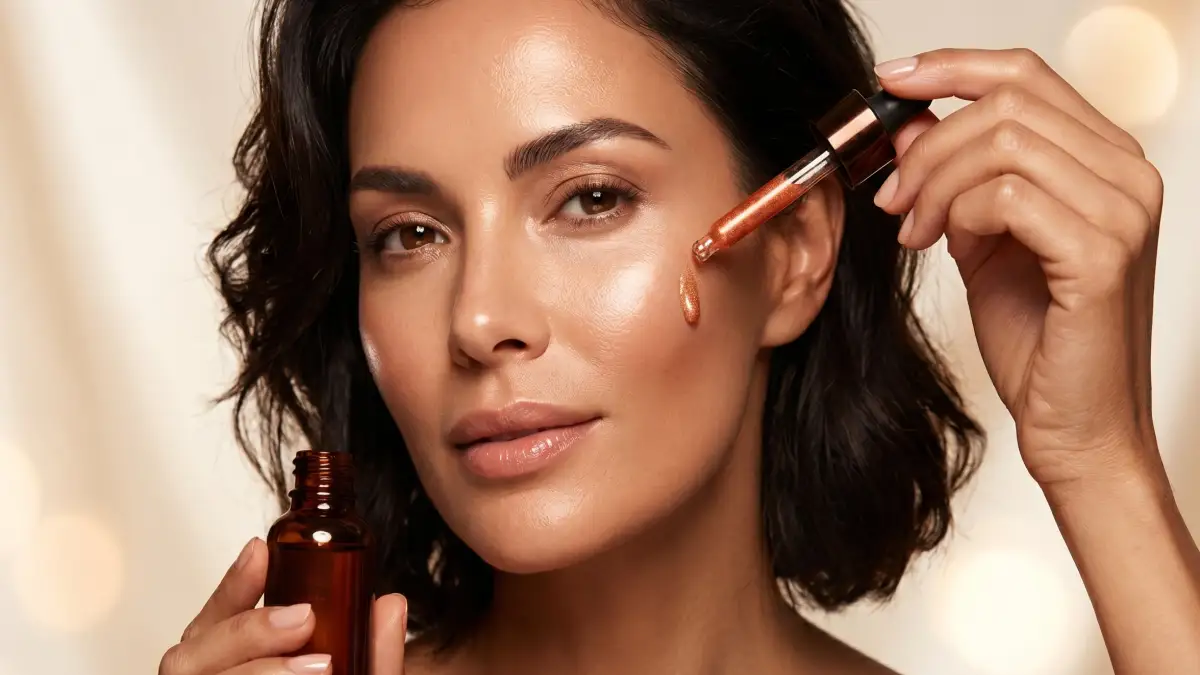
The science of skin aging is evolving rapidly — and for women navigating the skin changes that come with menopause and beyond, evidence-based skincare represents a fundamentally different approach: working with your skin's biology rather than against it.
Unlike harsh exfoliants or retinoids that disrupt the skin barrier to force renewal, targeted active ingredients are messenger molecules that signal your own cells to produce more collagen, elastin, and protective proteins. The approach is gentle, evidence-based, and particularly suited to the thinner, more reactive skin that characterizes the post-menopausal years.
How to Safely Combine GHK-Cu and Retinol
Combining copper peptides with retinol is one of the most effective evidence-based strategies for maximizing collagen stimulation through topical skincare, but the combination requires thoughtful timing and formulation awareness to achieve optimal results. The fundamental principle is temporal separation: GHK-Cu and retinol should be applied at different times of day rather than layered in the same routine step. This separation is necessary for two interrelated reasons. First, the copper(II) ion in GHK-Cu is a known catalyst for oxidative reactions and can accelerate the degradation of retinol (which is inherently unstable and susceptible to oxidation) if applied simultaneously. Second, the optimal pH ranges for these ingredients differ — retinol is most stable and penetrates most effectively at pH 4-5.5, while GHK-Cu's copper binding stability is optimal at near-physiological pH of 5.5-7.0. Applying both at the same pH level may compromise one ingredient's efficacy.[1]
The evidence-based protocol positions copper peptides in the morning routine and retinol in the evening routine. Morning application of GHK-Cu is strategically advantageous because the peptide's antioxidant properties — upregulation of superoxide dismutase, catalase, and glutathione — provide protective benefit against daytime oxidative stress from UV exposure and environmental pollution. GHK-Cu also does not cause photosensitivity, making it safe and beneficial for daytime use. The morning routine sequence should be: cleanser, copper peptide serum (applied to damp skin for optimal absorption), moisturizer, and broad-spectrum sunscreen. Evening application of retinol leverages the skin's nighttime repair cycle when cellular turnover and gene expression related to tissue repair are naturally elevated. The evening sequence should be: cleanser, wait until skin is completely dry (5-10 minutes), retinol product, wait 15-20 minutes for absorption, then moisturizer.
Clinical research confirms that for women new to this combination, a gradual introduction protocol minimizes the risk of irritation while allowing skin to acclimate. Begin with copper peptide serum every morning for 2 weeks before introducing retinol. This initial period allows GHK-Cu to begin its anti-inflammatory and barrier-strengthening effects, which can actually improve tolerance to retinol when it is subsequently introduced. Start retinol at 2-3 nights per week, gradually increasing frequency over 4-8 weeks as tolerated. Women who have never used retinol before should begin with a lower concentration (0.025-0.05% retinaldehyde or 0.3% retinol) and increase strength after 8-12 weeks of established tolerance. Those already using retinol can add copper peptide serum to their morning routine immediately, as GHK-Cu is well tolerated by virtually all skin types and does not require an acclimation period.
The synergistic benefits of this dual-pathway approach have a strong biological rationale even though head-to-head studies of the specific combination are limited. Retinol activates collagen synthesis primarily through nuclear retinoic acid receptor-mediated gene transcription, while GHK-Cu stimulates collagen through cell surface receptor-mediated signaling cascades and broader gene expression modulation. These are genuinely different molecular pathways converging on the same biological outcome — increased collagen deposition. Additionally, GHK-Cu's upregulation of tissue inhibitor of metalloproteinases (TIMPs) helps protect the collagen that both ingredients stimulate from enzymatic degradation, while its anti-inflammatory effects counteract the low-grade inflammation that retinol can trigger in some users. The net result is a routine where each ingredient enhances the other's benefits while partially offsetting the other's limitations.
Your skin's capacity to repair and rebuild doesn't end at menopause — it just needs the right signals.
— Dr. Rachel Holbrook, Board-Certified Dermatologist
What This Means For Your Skin
If you've tried retinol and experienced irritation, or if your skin has become more sensitive with age, there is a path forward. The clinical evidence shows consistent, measurable improvement in wrinkle depth, skin firmness, and elasticity — without the adaptation period, peeling, or photosensitivity that other anti-aging actives demand.
Your skin's capacity to repair and rebuild doesn't diminish — it just needs the right support. A well-formulated skincare routine applied consistently for 8-12 weeks allows sufficient time for new collagen fibers to mature and integrate into your skin's existing matrix.
The science is clear. The evidence is consistent. The results are measurable.
What happens next is up to you.