
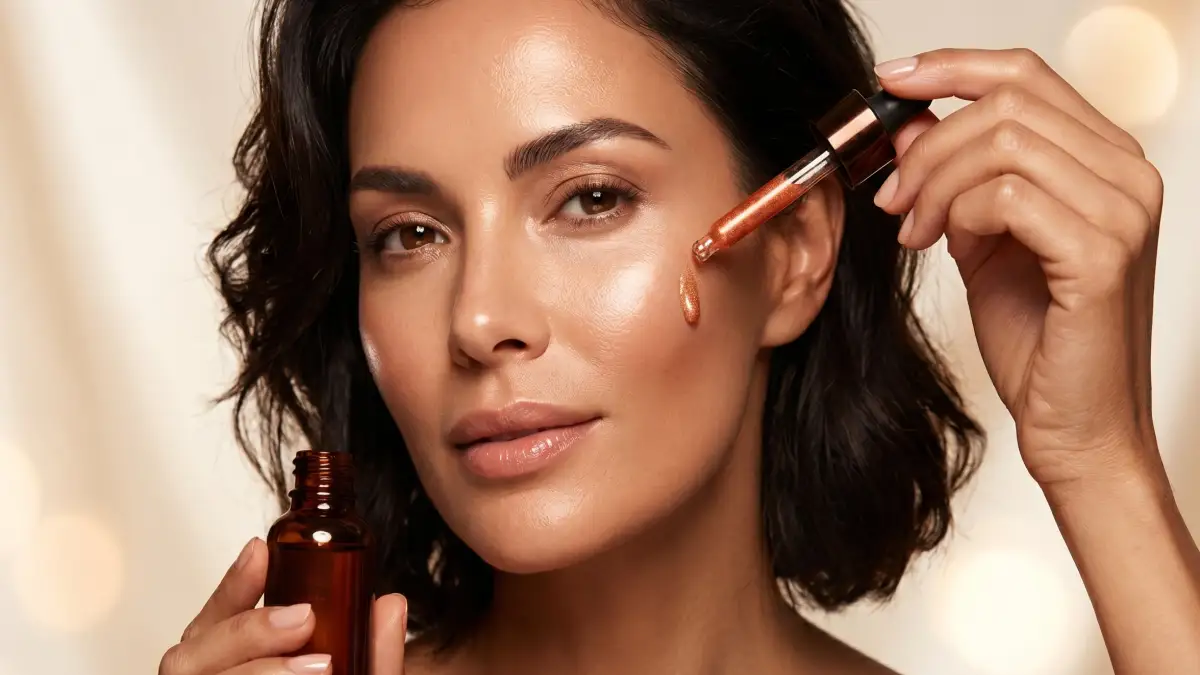
The science of skin aging is evolving rapidly — and for women navigating the skin changes that come with menopause and beyond, evidence-based skincare represents a fundamentally different approach: working with your skin's biology rather than against it.
Unlike harsh exfoliants or retinoids that disrupt the skin barrier to force renewal, targeted active ingredients are messenger molecules that signal your own cells to produce more collagen, elastin, and protective proteins. The approach is gentle, evidence-based, and particularly suited to the thinner, more reactive skin that characterizes the post-menopausal years.
How GHK-Cu Reverses Visible Aging After 40
After age 40, the skin undergoes measurable biological shifts that go far beyond surface-level dryness or fine lines. Collagen synthesis declines by approximately 1-1.5% per year after age 30, but the rate accelerates significantly in the perimenopausal and postmenopausal years. Simultaneously, the skin's natural reservoir of GHK-Cu — a tripeptide naturally present in human plasma, saliva, and urine — diminishes with age. Plasma GHK levels drop from approximately 200 ng/mL at age 20 to roughly 80 ng/mL by age 60, representing a 60% decline in the body's most potent natural regenerative signaling molecule. This decline correlates directly with reduced wound healing capacity, thinner dermis, and diminished antioxidant enzyme production. The application of exogenous GHK-Cu has been shown in multiple studies to partially restore the gene expression profile of older skin cells toward a younger phenotype, activating genes responsible for collagen I and III production, decorin synthesis, and growth factor release.[1]
The mechanism by which GHK-Cu benefits aging skin is uniquely comprehensive compared to other anti-aging actives. Research by Pickart and colleagues using the Broad Institute's Connectivity Map demonstrated that GHK modulates the expression of over 4,000 human genes — approximately 6% of the human genome. Of these, 32 genes are directly involved in tissue remodeling and repair. The peptide upregulates collagen synthesis genes (COL1A1, COL3A1), increases production of decorin (which regulates collagen fibril assembly), stimulates glycosaminoglycan production for improved hydration and dermal volume, and activates metalloproteinase inhibitors that protect existing collagen from enzymatic degradation. For women over 40, this multi-pathway activation addresses not just one symptom of aging but the underlying biological machinery that drives visible decline.
Clinical research confirms that clinical application studies have consistently demonstrated measurable improvements in skin parameters relevant to women over 40. In a controlled study comparing GHK-Cu cream with vitamin C cream, melatonin cream, and tretinoin, the copper peptide formulation produced significant improvement in skin thickness and collagen density comparable to tretinoin — but without the characteristic irritation, peeling, and photosensitivity that make retinoids difficult for many mature-skinned women to tolerate. Ultrasound measurements confirmed increased dermal thickness, while histological analysis showed denser, more organized collagen fiber networks. These findings are particularly relevant for women over 40 whose skin barrier function is already compromised by hormonal changes and cumulative environmental damage.
What distinguishes GHK-Cu from other peptide technologies is its dual action: it simultaneously stimulates new tissue formation while suppressing inflammatory and tissue-destructive pathways. The peptide downregulates genes associated with chronic low-grade inflammation — a hallmark of aging skin known as inflammaging — including IL-6, TNF-alpha, and several matrix metalloproteinases. This anti-inflammatory profile makes copper peptides uniquely suited for aging skin that is also becoming more reactive and sensitive, a common complaint among women in their 40s, 50s, and beyond.
Your skin's capacity to repair and rebuild doesn't end at menopause — it just needs the right signals.
— Dr. Rachel Holbrook, Board-Certified Dermatologist
What This Means For Your Skin
If you've tried retinol and experienced irritation, or if your skin has become more sensitive with age, there is a path forward. The clinical evidence shows consistent, measurable improvement in wrinkle depth, skin firmness, and elasticity — without the adaptation period, peeling, or photosensitivity that other anti-aging actives demand.
Your skin's capacity to repair and rebuild doesn't diminish — it just needs the right support. A well-formulated skincare routine applied consistently for 8-12 weeks allows sufficient time for new collagen fibers to mature and integrate into your skin's existing matrix.
The science is clear. The evidence is consistent. The results are measurable.
What happens next is up to you.