
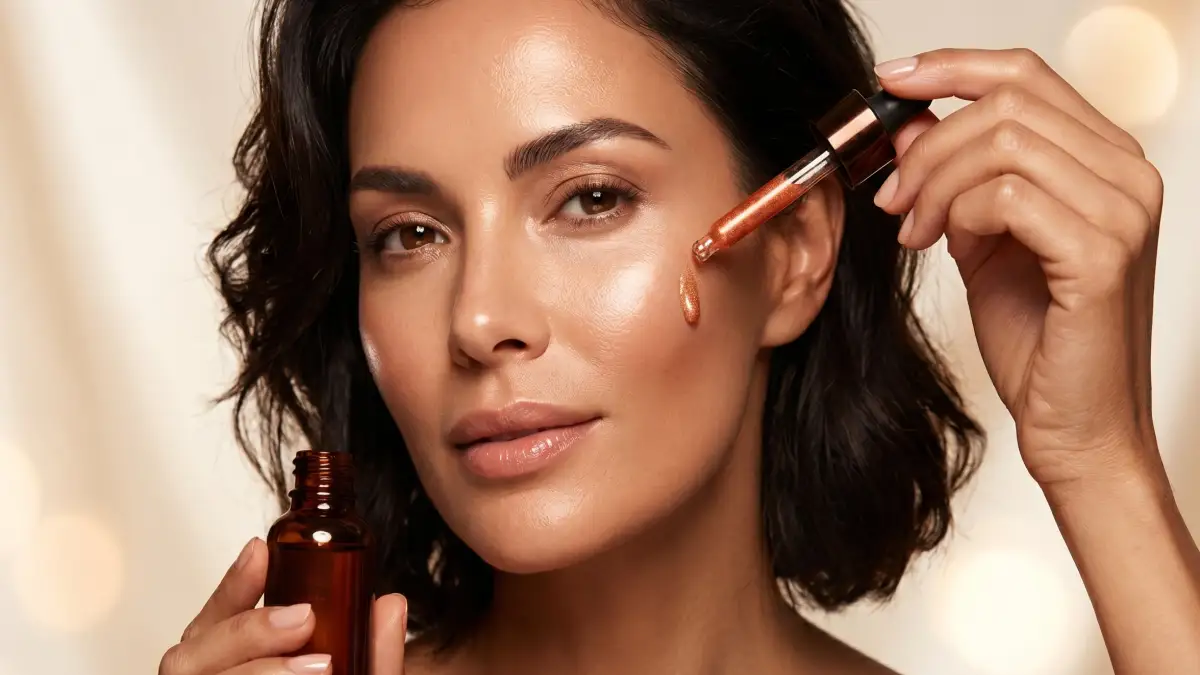
The science of skin aging is evolving rapidly — and for women navigating the skin changes that come with menopause and beyond, evidence-based skincare represents a fundamentally different approach: working with your skin's biology rather than against it.
Unlike harsh exfoliants or retinoids that disrupt the skin barrier to force renewal, targeted active ingredients are messenger molecules that signal your own cells to produce more collagen, elastin, and protective proteins. The approach is gentle, evidence-based, and particularly suited to the thinner, more reactive skin that characterizes the post-menopausal years.
How GHK-Cu Stimulates Collagen at the Gene Level
The collagen-stimulating mechanism of GHK-Cu is fundamentally different from — and more comprehensive than — other topical collagen boosters. While vitamin C supports collagen synthesis by serving as an essential enzymatic cofactor for prolyl and lysyl hydroxylases (enzymes required for collagen fiber cross-linking), and retinoids stimulate collagen by activating nuclear retinoic acid receptors, GHK-Cu operates at the level of gene expression programming. The peptide directly upregulates the genes encoding collagen type I (COL1A1) and collagen type III (COL3A1), increases expression of decorin (a proteoglycan critical for organizing collagen fibrils into functional bundles), stimulates production of tissue inhibitors of metalloproteinases (TIMPs) that protect newly synthesized collagen from enzymatic degradation, and enhances glycosaminoglycan production that provides the hydrated matrix in which collagen fibers are properly assembled. This multi-level control over the collagen lifecycle — from gene activation through fiber assembly to degradation protection — is unique among topical ingredients.[1]
Research published in BioMed Research International demonstrated that GHK-Cu's collagen stimulation involves both direct and indirect pathways. The direct pathway involves peptide binding to fibroblast cell surface receptors, triggering intracellular signaling cascades (including the MAPK/ERK pathway) that increase transcription of collagen genes. The indirect pathway involves GHK-Cu's modulation of the fibroblast microenvironment: by increasing glycosaminoglycan synthesis, reducing inflammatory cytokine levels, and enhancing growth factor availability, the peptide creates conditions that favor sustained collagen production over the catabolic state that characterizes aging skin. In vitro studies using human dermal fibroblasts from donors of different ages showed that GHK-Cu treatment increased collagen synthesis rates in both young and aged fibroblasts, but the magnitude of increase was proportionally greater in aged cells — suggesting that the peptide partially restores the collagen-producing capacity that fibroblasts lose with age.
Clinical research confirms that the clinical significance of GHK-Cu's collagen mechanism extends to the quality and organization of newly produced collagen, not merely its quantity. Histological analysis from the Abdulghani study revealed that skin treated with copper peptide cream showed not only increased collagen density but improved collagen fiber organization — more regular, properly cross-linked fibers arranged in functional bundles rather than the disordered, fragmented collagen characteristic of photoaged skin. This qualitative improvement is critically important because skin's mechanical properties (firmness, elasticity, resilience) depend on collagen fiber architecture, not just total collagen content. A dense but disorganized collagen network provides less structural support than a less dense but well-organized one. GHK-Cu's simultaneous stimulation of collagen synthesis, decorin production, and metalloproteinase inhibition creates conditions for organized, functional collagen deposition.
For practical skincare application, understanding GHK-Cu's collagen mechanism informs optimal usage strategies. Because the peptide works through gene activation rather than direct enzymatic support, its effects are dose-dependent but plateau at relatively modest concentrations — typically 0.01-1% in topical formulations. Higher concentrations do not proportionally increase collagen production and may actually reduce efficacy due to copper ion-mediated oxidative stress at supraphysiological levels. The collagen-stimulating effect is cumulative and requires consistent application to maintain upregulated gene expression; discontinuation leads to gradual return to baseline collagen production rates over 4-8 weeks as gene expression normalizes. This biological reality underscores the importance of sustained, consistent use rather than intermittent application.
Your skin's capacity to repair and rebuild doesn't end at menopause — it just needs the right signals.
— Dr. Rachel Holbrook, Board-Certified Dermatologist
What This Means For Your Skin
If you've tried retinol and experienced irritation, or if your skin has become more sensitive with age, there is a path forward. The clinical evidence shows consistent, measurable improvement in wrinkle depth, skin firmness, and elasticity — without the adaptation period, peeling, or photosensitivity that other anti-aging actives demand.
Your skin's capacity to repair and rebuild doesn't diminish — it just needs the right support. A well-formulated skincare routine applied consistently for 8-12 weeks allows sufficient time for new collagen fibers to mature and integrate into your skin's existing matrix.
The science is clear. The evidence is consistent. The results are measurable.
What happens next is up to you.