
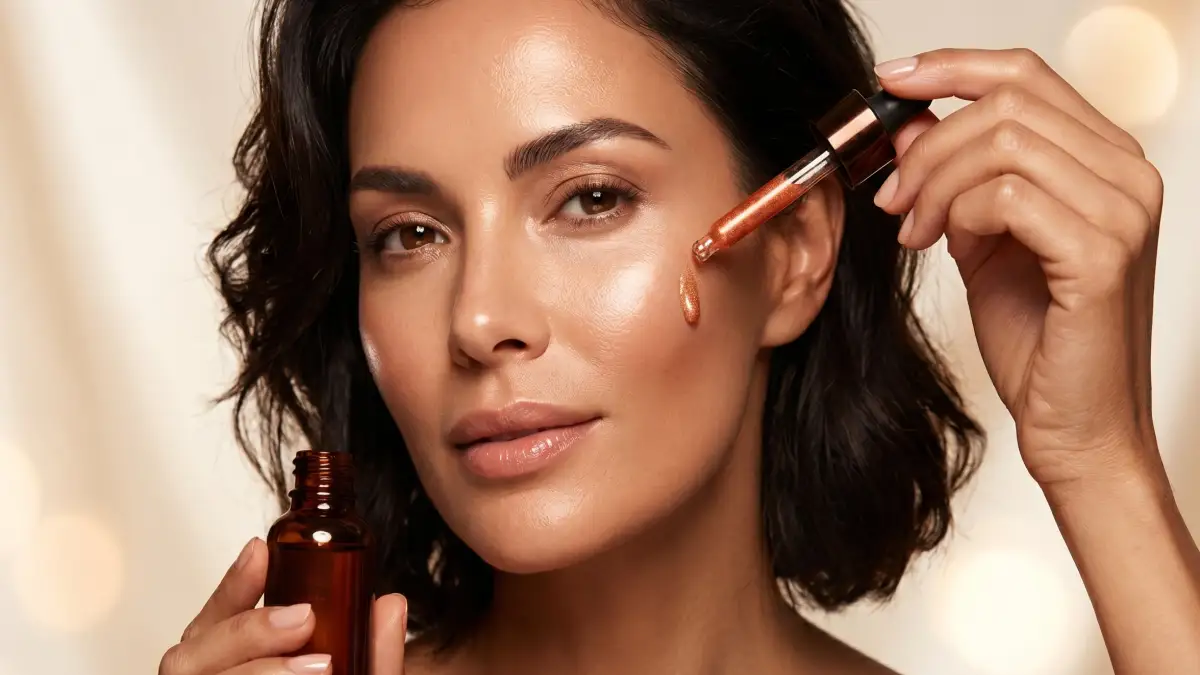
The science of skin aging is evolving rapidly — and for women navigating the skin changes that come with menopause and beyond, evidence-based skincare represents a fundamentally different approach: working with your skin's biology rather than against it.
Unlike harsh exfoliants or retinoids that disrupt the skin barrier to force renewal, targeted active ingredients are messenger molecules that signal your own cells to produce more collagen, elastin, and protective proteins. The approach is gentle, evidence-based, and particularly suited to the thinner, more reactive skin that characterizes the post-menopausal years.
Addressing Menopausal Collagen Loss With GHK-Cu
Menopause triggers the most dramatic acceleration of skin aging in a woman's lifetime. Estrogen decline during the menopausal transition directly impacts dermal biology: collagen content decreases by approximately 30% in the first five years after menopause, dermal thickness declines by approximately 1.13% per year, and skin elasticity deteriorates measurably as elastic fiber networks degrade. These changes are driven by the loss of estrogen's protective effects on fibroblast function — estrogen normally stimulates collagen synthesis, promotes glycosaminoglycan production, maintains dermal vascularity, and modulates inflammatory pathways. The abrupt withdrawal of these estrogenic effects leaves postmenopausal skin in a catabolic state where collagen degradation outpaces synthesis. GHK-Cu is particularly relevant in this context because it activates many of the same regenerative pathways that estrogen supports, providing a topical alternative to partially compensate for hormonal collagen loss without the systemic effects or contraindications of hormone replacement therapy.[1]
The molecular overlap between estrogen's dermal effects and GHK-Cu's gene activation profile is striking. Both estrogen and GHK-Cu stimulate collagen I and III gene expression in dermal fibroblasts. Both upregulate glycosaminoglycan and hyaluronic acid production. Both enhance dermal vascularity through growth factor release. Both suppress inflammatory cytokines that accelerate collagen degradation. And both promote antioxidant defense systems that protect against oxidative damage. While GHK-Cu cannot replicate all of estrogen's systemic effects, its topical application provides localized activation of key regenerative pathways at the dermal level — precisely where menopausal collagen loss manifests most visibly. Gene expression analysis suggests that GHK-Cu may partially restore the fibroblast gene expression pattern toward a pre-menopausal profile, though the degree of restoration is less complete than systemic estrogen replacement.
Clinical research confirms that clinical evidence supports the use of copper peptides in postmenopausal women specifically. The Abdulghani study included postmenopausal women in its subject population and found that copper peptide cream produced measurable improvements in dermal thickness and collagen density in this demographic — improvements that were clinically comparable to tretinoin. For postmenopausal women, the tolerability advantage of GHK-Cu over retinoids is even more pronounced than in younger demographics, because menopausal skin changes include increased sensitivity, decreased barrier function, and reduced sebum production that make retinoid-induced irritation more severe and more difficult to manage. Many postmenopausal women who attempt retinoid therapy discontinue due to intolerable dryness, peeling, and irritation — losing the collagen-stimulating benefit entirely. Copper peptides provide the collagen stimulation without the barrier compromise.
For postmenopausal women building an evidence-based anti-aging routine, copper peptides serve as an ideal foundational active because they address the core biological deficit (reduced collagen synthesis and increased degradation) without the tolerability barriers that limit other potent actives. The recommended approach combines morning application of a GHK-Cu serum with an intensive barrier-supporting moisturizer and broad-spectrum sunscreen, paired with evening use of a retinoid at whatever strength is tolerated — even if that is a gentle retinol or retinaldehyde rather than prescription tretinoin. This dual-pathway strategy maximizes collagen stimulation through complementary mechanisms while the morning copper peptide application provides anti-inflammatory and antioxidant protection that can actually improve retinoid tolerance at night. Women who cannot tolerate retinoids at all can rely on the copper peptide pathway alone, supplemented with vitamin C and niacinamide for additional collagen support through non-irritating mechanisms.
Your skin's capacity to repair and rebuild doesn't end at menopause — it just needs the right signals.
— Dr. Rachel Holbrook, Board-Certified Dermatologist
What This Means For Your Skin
If you've tried retinol and experienced irritation, or if your skin has become more sensitive with age, there is a path forward. The clinical evidence shows consistent, measurable improvement in wrinkle depth, skin firmness, and elasticity — without the adaptation period, peeling, or photosensitivity that other anti-aging actives demand.
Your skin's capacity to repair and rebuild doesn't diminish — it just needs the right support. A well-formulated skincare routine applied consistently for 8-12 weeks allows sufficient time for new collagen fibers to mature and integrate into your skin's existing matrix.
The science is clear. The evidence is consistent. The results are measurable.
What happens next is up to you.