
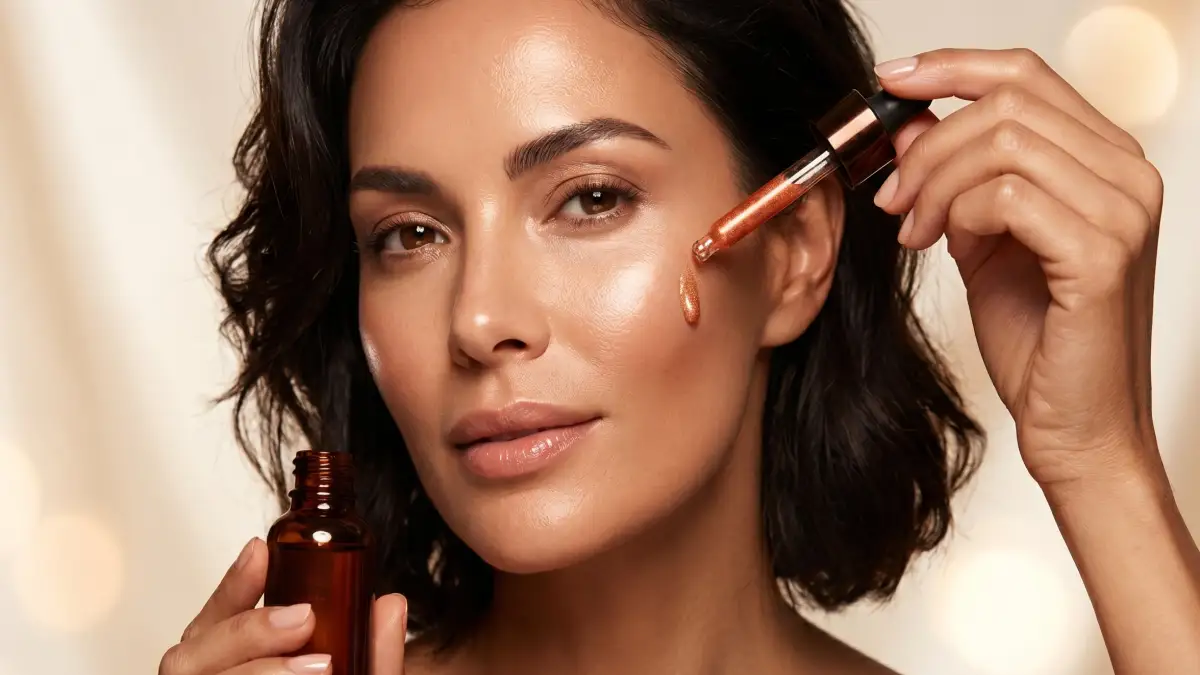
The science of skin aging is evolving rapidly — and for women navigating the skin changes that come with menopause and beyond, evidence-based skincare represents a fundamentally different approach: working with your skin's biology rather than against it.
Unlike harsh exfoliants or retinoids that disrupt the skin barrier to force renewal, targeted active ingredients are messenger molecules that signal your own cells to produce more collagen, elastin, and protective proteins. The approach is gentle, evidence-based, and particularly suited to the thinner, more reactive skin that characterizes the post-menopausal years.
Effective GHK-Cu Dosing and Formulation Science
Understanding the optimal concentration of GHK-Cu in topical formulations is critical for achieving therapeutic benefit, because copper peptides follow a biphasic dose-response curve that makes both under-dosing and over-dosing counterproductive. The effective concentration range for topical GHK-Cu has been established through in vitro cell culture studies, animal wound healing models, and human clinical trials at approximately 0.01% to 1% (weight/volume). Within this range, the peptide demonstrates dose-dependent stimulation of collagen synthesis, glycosaminoglycan production, and fibroblast proliferation. However, at concentrations above approximately 1-2%, the copper ion component begins to generate oxidative stress through Fenton-type chemistry — producing reactive hydroxyl radicals that damage the very cells the peptide is meant to stimulate. This biphasic behavior means that the most expensive, highest-concentration copper peptide serums on the market may actually be less effective than moderately concentrated ones.[1]
The clinical studies that have demonstrated efficacy for GHK-Cu in skin rejuvenation have used formulations in the range of 0.01-0.1% concentration. The Abdulghani study that showed improvements comparable to tretinoin used a cream containing copper-binding peptides at concentrations within this therapeutic window. In vitro studies on human dermal fibroblasts have confirmed that GHK-Cu at 10^-9 to 10^-6 molar concentrations (roughly 0.0001% to 0.1%) produces optimal stimulation of collagen synthesis, with peak activity typically observed at 10^-7 to 10^-6 molar. Above 10^-5 molar (roughly 0.5-1%), the stimulatory effect plateaus and begins to decline as copper-mediated oxidative effects become significant. These data suggest that the optimal concentration for most topical applications falls in the 0.01-0.1% range — corresponding to the concentrations used in the most rigorous clinical trials.
Clinical research confirms that formulation stability is equally important as concentration for therapeutic efficacy. GHK-Cu is relatively stable compared to many bioactive peptides, but the copper(II) ion creates specific formulation challenges. In aqueous solution at physiological pH, the GHK-Cu complex has a half-life of approximately 30 days — meaning that in a simple water-based serum, half the active GHK-Cu will have degraded within a month of manufacturing. Effective formulations address this through pH buffering (maintaining pH 5.5-6.5 where copper binding is most stable), inclusion of chelation-protective excipients, minimization of free water activity through appropriate vehicle selection, and protective packaging (airless pumps, opaque containers) that limit oxidative degradation. The vehicle system also significantly affects percutaneous absorption: GHK-Cu is hydrophilic and relatively small (molecular weight approximately 404 Da), which favors aqueous penetration through the stratum corneum, but absorption is enhanced by humectant-rich formulations that maintain skin hydration during application.
For consumers evaluating copper peptide products, several formulation indicators suggest quality and likely efficacy. Products should specify GHK-Cu or copper tripeptide-1 as the active ingredient (rather than generic copper complexes, which may not share GHK-Cu's biological activity). The ingredient should appear within the first 10-15 ingredients on the INCI list for serums, indicating a meaningful concentration. The product should be packaged in an airless pump or single-dose format rather than an open jar, which exposes the peptide to repeated oxidative degradation. A slightly blue or blue-green tint to the product is normal and indicates the presence of copper(II) ions. Products claiming copper peptide concentrations above 2-3% should be viewed skeptically, as this exceeds the evidence-based therapeutic range and enters the zone where oxidative damage may offset regenerative benefits.
Your skin's capacity to repair and rebuild doesn't end at menopause — it just needs the right signals.
— Dr. Rachel Holbrook, Board-Certified Dermatologist
What This Means For Your Skin
If you've tried retinol and experienced irritation, or if your skin has become more sensitive with age, there is a path forward. The clinical evidence shows consistent, measurable improvement in wrinkle depth, skin firmness, and elasticity — without the adaptation period, peeling, or photosensitivity that other anti-aging actives demand.
Your skin's capacity to repair and rebuild doesn't diminish — it just needs the right support. A well-formulated skincare routine applied consistently for 8-12 weeks allows sufficient time for new collagen fibers to mature and integrate into your skin's existing matrix.
The science is clear. The evidence is consistent. The results are measurable.
What happens next is up to you.