
The science of skin aging is evolving rapidly — and for women navigating the skin changes that come with menopause and beyond, evidence-based skincare represents a fundamentally different approach: working with your skin's biology rather than against it.
Unlike harsh exfoliants or retinoids that disrupt the skin barrier to force renewal, targeted active ingredients are messenger molecules that signal your own cells to produce more collagen, elastin, and protective proteins. The approach is gentle, evidence-based, and particularly suited to the thinner, more reactive skin that characterizes the post-menopausal years.
Two Related But Distinct Conditions Requiring Different Treatment Strategies
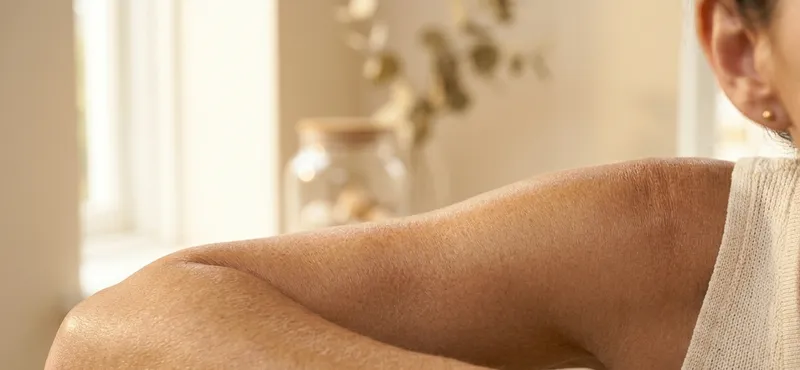
Crepey skin and loose skin are frequently confused because they often coexist on the same body area, but they represent fundamentally different structural problems requiring different treatment approaches. Crepey skin is a texture deterioration: the skin develops a thin, papery, finely wrinkled surface that resembles crêpe paper, caused by depletion of collagen density, elastic fiber fragmentation, and glycosaminoglycan loss within the dermis. The skin may still be attached firmly to the underlying tissue — it simply looks wrinkled, dry, and delicate when you examine it. Loose skin is a volume and attachment problem: the skin has separated from or exceeded the volume of the underlying tissue, creating visible draping, hanging, or sagging. Loose skin occurs when subcutaneous fat is lost (through weight loss, aging, or hormonal changes), when the fascial connections between skin and underlying structures weaken, or when significant collagen loss removes the structural integrity that kept the skin taut.[1]
The diagnostic distinction: gently pinch the skin on the affected area between thumb and forefinger. If the pinched skin feels thin, papery, and shows fine wrinkles but releases and re-attaches smoothly to the underlying tissue — that is primarily crepey skin (texture problem). If the skin lifts easily away from the underlying tissue, doesn't snap back when released, and shows visible redundancy (more skin than needed to cover the area) — that is primarily loose skin (volume/attachment problem). Most women over 50 have a combination of both: crepey texture on skin that is also somewhat loose. The treatment strategy must address both components for optimal improvement.
Clinical research confirms that treatment differences: Crepey skin (texture) — highly responsive to topical treatment. Retinol stimulates collagen that thickens the dermis, AHAs smooth the rough surface and stimulate GAG production, ceramides repair the barrier to reduce chronic dehydration, and peptides provide additional collagen stimulation. Expected improvement from topical treatment: 30-50% visible texture improvement over 6-12 months. This is sufficient for most women with mild-to-moderate crepey texture. Loose skin (volume/sagging) — poorly responsive to topical treatment. Topical products cannot recreate lost subcutaneous fat volume, re-attach weakened fascial connections, or tighten skin that has physically exceeded the volume of the underlying tissue. Topical treatment can improve the quality of the loose skin (making it smoother, more hydrated, and less crepey) but cannot make it tighter. For significant skin laxity, professional treatments (radiofrequency skin tightening, ultrasound-based tightening like Ultherapy, or surgical excision) are needed to address the structural excess.
The practical strategy for the combined presentation: Start with 3-6 months of comprehensive topical treatment targeting the crepey texture component. As the skin quality improves (thicker, smoother, more hydrated), reassess the laxity component. In many cases, the improved skin quality makes the laxity less noticeable — thicker, plumper skin drapes more smoothly over the underlying structure, reducing the visual impact of moderate looseness. If significant laxity remains after skin quality optimization, consult with a dermatologist about professional tightening options. The topical pre-treatment improves outcomes of professional procedures: skin that has been pre-conditioned with retinol, ceramides, and peptides responds better to radiofrequency and ultrasound tightening, heals faster after surgical excision, and maintains results longer. The women who achieve the best overall body skin appearance are those who understand that topical treatment addresses texture while professional treatment addresses tightening — and that optimizing texture first makes any subsequent tightening procedure more effective.
Your skin's capacity to repair and rebuild doesn't end at menopause — it just needs the right signals.
— Dr. Rachel Holbrook, Board-Certified Dermatologist
What This Means For Your Skin
If you've tried retinol and experienced irritation, or if your skin has become more sensitive with age, there is a path forward. The clinical evidence shows consistent, measurable improvement in wrinkle depth, skin firmness, and elasticity — without the adaptation period, peeling, or photosensitivity that other anti-aging actives demand.
Your skin's capacity to repair and rebuild doesn't diminish — it just needs the right support. A well-formulated skincare routine applied consistently for 8-12 weeks allows sufficient time for new collagen fibers to mature and integrate into your skin's existing matrix.
The science is clear. The evidence is consistent. The results are measurable.
What happens next is up to you.