
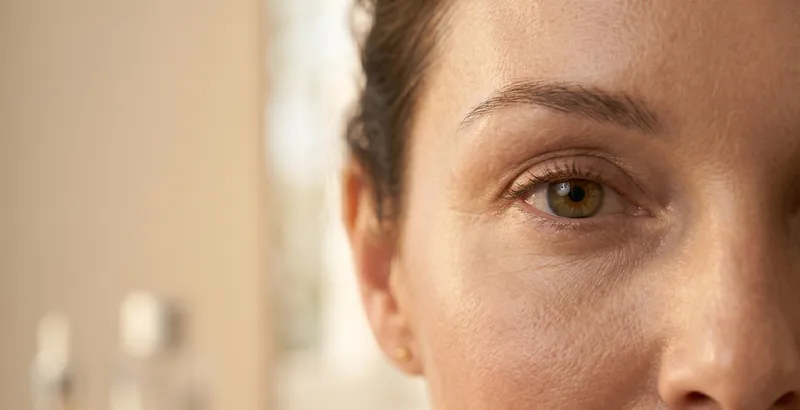
The science of skin aging is evolving rapidly — and for women navigating the skin changes that come with menopause and beyond, evidence-based skincare represents a fundamentally different approach: working with your skin's biology rather than against it.
Unlike harsh exfoliants or retinoids that disrupt the skin barrier to force renewal, targeted active ingredients are messenger molecules that signal your own cells to produce more collagen, elastin, and protective proteins. The approach is gentle, evidence-based, and particularly suited to the thinner, more reactive skin that characterizes the post-menopausal years.
How Nasal Congestion Creates Under-Eye Darkening Through Venous Pooling
Allergic shiners — the distinctive dark, puffy discoloration under the eyes associated with allergies — represent a unique dark circle mechanism that is completely different from age-related or hereditary dark circles. The mechanism is venous congestion: the veins that drain blood from the periorbital area flow through the nasal and paranasal tissue on their way to the jugular vein. When allergic rhinitis (hay fever) or chronic sinusitis causes inflammation and swelling of the nasal mucosa, these venous drainage pathways become partially obstructed. The reduced venous outflow causes blood to pool in the periorbital venous plexus, dilating the small veins and capillaries under the eyes and creating the characteristic dark, puffy appearance. The color is typically a deep blue-purple (reflecting the deoxygenated venous blood) with significant edema (fluid that leaks from the congested vessels into the surrounding tissue).[1]
Why allergic shiners matter for women over 40: perimenopause often coincides with new or worsening allergies. Hormonal fluctuations affect the immune system — estrogen modulates mast cell activity and histamine release, and the changing hormonal environment of perimenopause can trigger new allergic sensitivities or worsen pre-existing allergies. Women who never had allergies may develop them during perimenopause, and those with existing allergies may notice worsening symptoms. The resulting allergic shiners layer on top of the age-related dark circle mechanisms (thinning skin, collagen loss, volume depletion), creating particularly severe periorbital darkening that seems disproportionate to the aging changes alone. The diagnostic clue: dark circles that fluctuate with allergy symptoms (worse during pollen season, better after antihistamine use, accompanied by nasal congestion or itchy eyes) have an allergic component that must be addressed for meaningful improvement.
Clinical research confirms that treatment of the allergic component produces the fastest dark circle improvement because removing the venous congestion immediately reduces the blood pooling that creates the darkness. Antihistamine therapy — second-generation oral antihistamines (cetirizine, loratadine, fexofenadine) reduce the nasal mucosal swelling that obstructs venous drainage. For many women, consistent daily antihistamine use during allergy season produces visible improvement in dark circles within 1-2 weeks. Intranasal corticosteroid spray — fluticasone or mometasone nasal spray reduces nasal inflammation more effectively than oral antihistamines alone, further improving venous drainage. Allergen avoidance — identifying and reducing exposure to specific allergens (dust mites, pet dander, pollen) reduces the inflammatory trigger. For women with perimenopausal-onset allergies, allergy testing can identify new sensitivities that weren't present before the hormonal transition.
The integrated approach for women with both allergic and age-related dark circles: Treat the allergy — daily antihistamine plus nasal corticosteroid spray during symptomatic periods. This addresses the venous congestion component and produces relatively quick improvement. Treat the aging component simultaneously — the full topical dark circle protocol (peptide eye cream, caffeine serum, retinol, ceramide barrier support) addresses the structural deterioration that persists even when the allergic component is controlled. The combination produces greater improvement than either approach alone because it eliminates the allergic amplification while rebuilding the age-related structural support. An important distinction: antihistamine eye drops (for itchy, watery eyes) should be used cautiously because some formulations contain vasoconstrictors that provide immediate cosmetic improvement but can cause rebound vasodilation with chronic use, potentially worsening dark circles long-term. If antihistamine eye drops are needed, use mast cell stabilizer formulations (cromolyn sodium) rather than those containing naphazoline or tetrahydrozoline vasoconstrictors.
Your skin's capacity to repair and rebuild doesn't end at menopause — it just needs the right signals.
— Dr. Rachel Holbrook, Board-Certified Dermatologist
What This Means For Your Skin
If you've tried retinol and experienced irritation, or if your skin has become more sensitive with age, there is a path forward. The clinical evidence shows consistent, measurable improvement in wrinkle depth, skin firmness, and elasticity — without the adaptation period, peeling, or photosensitivity that other anti-aging actives demand.
Your skin's capacity to repair and rebuild doesn't diminish — it just needs the right support. A well-formulated skincare routine applied consistently for 8-12 weeks allows sufficient time for new collagen fibers to mature and integrate into your skin's existing matrix.
The science is clear. The evidence is consistent. The results are measurable.
What happens next is up to you.