
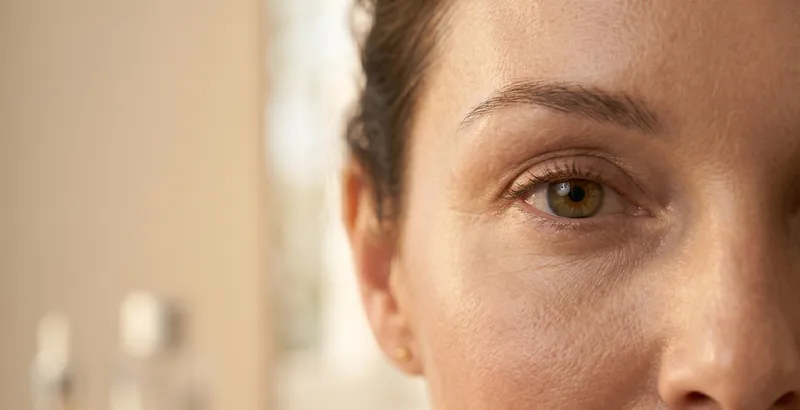
The science of skin aging is evolving rapidly — and for women navigating the skin changes that come with menopause and beyond, evidence-based skincare represents a fundamentally different approach: working with your skin's biology rather than against it.
Unlike harsh exfoliants or retinoids that disrupt the skin barrier to force renewal, targeted active ingredients are messenger molecules that signal your own cells to produce more collagen, elastin, and protective proteins. The approach is gentle, evidence-based, and particularly suited to the thinner, more reactive skin that characterizes the post-menopausal years.
Distinguishing Genetic Periorbital Pigmentation From Age-Related Changes
One of the most important diagnostic questions for dark circle treatment is: have your dark circles been present since childhood or teens, or did they develop or significantly worsen after 40? The answer determines the primary mechanism and therefore the optimal treatment strategy. Hereditary (constitutional) dark circles are genetically programmed periorbital hyperpigmentation present from early life. They are caused by one or more inherited traits: thinner periorbital skin (determined by genetics, not age), deeper periorbital vascular plexus positioning, constitutionally higher melanin production in periorbital melanocytes, or specific orbital bone structure (deeper-set eyes that create more prominent shadows). These dark circles are typically stable — they don't significantly change with age, though they may appear worse during fatigue or illness due to superimposed vascular dilation. They affect family members across generations and are more prevalent in Fitzpatrick skin types III-VI.[1]
Age-related dark circles, by contrast, develop or dramatically worsen in the 40s and 50s through acquired structural changes: progressive collagen loss thinning the already-thin periorbital skin, orbital fat pad atrophy and descent creating tear trough hollowing, increasing capillary fragility leading to hemosiderin deposition, and perimenopausal hormonal changes activating melanocyte hyperpigmentation. The key distinction: hereditary dark circles represent the skin working as genetically programmed — the melanocytes produce exactly the amount of melanin they are coded to produce, and the skin thickness is as genetically determined. Age-related dark circles represent a deterioration from a previous baseline — the skin was thicker, the fat pads were fuller, the capillaries were more intact, and the appearance was lighter at an earlier age. Treatment cannot make hereditary dark circles lighter than their genetic baseline, but it can significantly improve age-related dark circles by addressing the acquired structural deterioration.
Clinical research confirms that the combined presentation — which is what most women over 40 actually have — features hereditary predisposition amplified by age-related changes. Women with hereditary dark circles notice that their always-present circles suddenly become significantly worse during perimenopause as the acquired mechanisms layer onto the genetic baseline. The treatment approach for the combined presentation addresses the modifiable (age-related) components while managing the unchangeable (genetic) components: For the age-related component — peptide eye cream, retinol 0.15%, caffeine, vitamin K, and hyaluronic acid address the structural deterioration. As the acquired changes improve, the dark circles gradually return toward their younger appearance (still present due to genetics, but less severe). For the genetic component — cosmetic management through color correction and concealing technique, plus ongoing structural maintenance to prevent the age-related component from re-accumulating.
Realistic expectations based on hereditary vs aging classification: Pure age-related dark circles (no hereditary component) — 50-70% visible improvement possible with comprehensive topical protocol over 6-12 months, because the treatment is rebuilding toward a baseline that was once clear. Combined hereditary plus age-related — 30-50% visible improvement possible, with the improvement representing reversal of the acquired component while the hereditary baseline remains. The result is dark circles that look like they did in the patient's 30s, not complete resolution. Pure hereditary dark circles (no significant aging component, typically seen in patients under 35) — 10-20% improvement from topical treatment, primarily through skin thickening that reduces vascular show-through. Significant improvement requires professional interventions (filler for structural enhancement, laser for pigmentation reduction). For all presentations, the morning caffeine plus concealer strategy provides immediate cosmetic improvement while the slower structural treatments work over months — combining functional treatment with practical cosmetic management gives the best quality-of-life outcome during the treatment process.
Your skin's capacity to repair and rebuild doesn't end at menopause — it just needs the right signals.
— Dr. Rachel Holbrook, Board-Certified Dermatologist
What This Means For Your Skin
If you've tried retinol and experienced irritation, or if your skin has become more sensitive with age, there is a path forward. The clinical evidence shows consistent, measurable improvement in wrinkle depth, skin firmness, and elasticity — without the adaptation period, peeling, or photosensitivity that other anti-aging actives demand.
Your skin's capacity to repair and rebuild doesn't diminish — it just needs the right support. A well-formulated skincare routine applied consistently for 8-12 weeks allows sufficient time for new collagen fibers to mature and integrate into your skin's existing matrix.
The science is clear. The evidence is consistent. The results are measurable.
What happens next is up to you.