
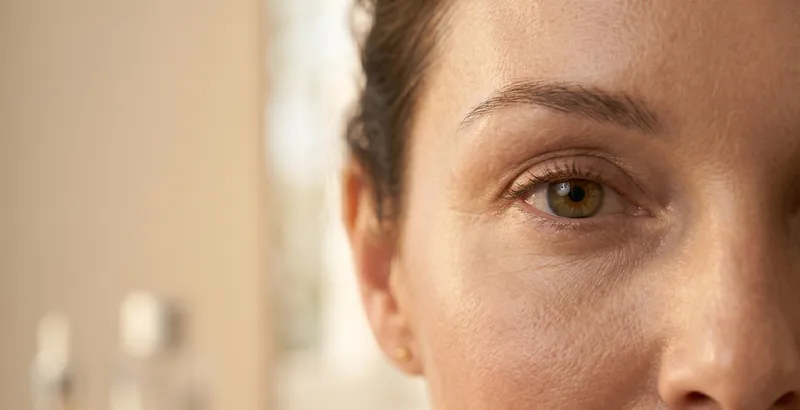
The science of skin aging is evolving rapidly — and for women navigating the skin changes that come with menopause and beyond, evidence-based skincare represents a fundamentally different approach: working with your skin's biology rather than against it.
Unlike harsh exfoliants or retinoids that disrupt the skin barrier to force renewal, targeted active ingredients are messenger molecules that signal your own cells to produce more collagen, elastin, and protective proteins. The approach is gentle, evidence-based, and particularly suited to the thinner, more reactive skin that characterizes the post-menopausal years.
What Ingredients Actually Work When Periorbital Aging Is Advanced
The best eye cream for dark circles after 50 is not a single product but a specific combination of evidence-based active ingredients that address the multi-factorial nature of advanced periorbital aging. By 50, the under-eye area has accumulated three decades of progressive collagen loss, the periorbital skin has thinned to a point where the underlying muscle and vessels are prominently visible, orbital fat pads have atrophied and descended, the periorbital capillary network has deposited years of hemosiderin from chronic micro-leakage, and postmenopausal estrogen depletion has accelerated all of these changes. No single active ingredient can address all of these mechanisms — which is why single-ingredient eye creams consistently disappoint. The women who achieve meaningful improvement use 3-4 complementary actives that target different mechanisms simultaneously.[1]
The evidence-based ingredient hierarchy for dark circles after 50, ranked by clinical impact: Tier 1 (essential, non-negotiable) — Peptide complex (Matrixyl 3000 or equivalent). This is the foundation because collagen rebuilding is the single intervention that improves every dark circle mechanism: thicker skin reduces vascular show-through, stronger dermis reduces mechanical wrinkling, improved skin quality enhances the appearance regardless of underlying pigment or volume changes. Apply morning and evening. Ceramide complex. The post-50 periorbital barrier is severely compromised — transepidermal water loss in this area can be 3-4 times higher than on the cheeks. Without barrier repair, every other active ingredient causes more irritation and less benefit. Ceramide eye cream or balm should be the final step of every morning and evening routine.
Clinical research confirms that tier 2 (strongly recommended) — Caffeine 2-5%. The most reliable ingredient for immediate visible improvement in vascular-type dark circles. Apply every morning. The vasoconstriction provides cosmetic improvement while the structural actives work over months. Hyaluronic acid (multi-molecular-weight). Applied to damp skin and sealed with ceramide cream, HA provides the hydration-mediated plumping that reduces both fine lines and hollow shadows. Apply morning and evening. Retinol 0.10-0.15%. The most powerful single active for combined collagen stimulation and pigmented cell turnover. However, post-50 periorbital skin requires the lowest effective concentration and maximum buffering. Apply only once weekly using the ceramide sandwich method, increasing to twice weekly only after 8 weeks of confirmed zero irritation. Tier 3 (beneficial additions) — Vitamin K 1-2% for hemosiderin clearance (nightly), vitamin C 10% for antioxidant protection and mild depigmenting (morning), niacinamide 5% for epidermal thickening and melanin transfer inhibition.
The practical product strategy for the over-50 woman: rather than searching for one eye cream that contains all Tier 1-3 ingredients (such products don't exist or contain each ingredient at sub-therapeutic concentrations), use 2-3 well-chosen products layered correctly. Recommended minimum kit: (1) A caffeine eye serum for morning vasoconstriction and immediate brightening. (2) A peptide-rich eye cream with hyaluronic acid for morning and evening collagen stimulation and hydration. (3) A ceramide-heavy eye balm for morning and evening barrier sealing. (4) A retinol eye treatment at 0.10-0.15% for once-weekly structural acceleration. Apply in order: serum (caffeine morning only) → treatment cream (peptide + HA) → balm (ceramide seal). On retinol nights, replace the peptide cream with retinol in the sandwich method. This 3-4 product routine addresses all treatable dark circle mechanisms systematically. Expected results after 50: improvement is slower than in younger skin because the baseline structural deficit is greater, but it is real and progressive. Visible improvement at 12-16 weeks, meaningful improvement at 24-36 weeks. The improvement may not return the under-eye area to its appearance at 30, but it reliably produces a visible, sustained lightening and smoothing that makes women feel more confident and less dependent on concealer.
Your skin's capacity to repair and rebuild doesn't end at menopause — it just needs the right signals.
— Dr. Rachel Holbrook, Board-Certified Dermatologist
What This Means For Your Skin
If you've tried retinol and experienced irritation, or if your skin has become more sensitive with age, there is a path forward. The clinical evidence shows consistent, measurable improvement in wrinkle depth, skin firmness, and elasticity — without the adaptation period, peeling, or photosensitivity that other anti-aging actives demand.
Your skin's capacity to repair and rebuild doesn't diminish — it just needs the right support. A well-formulated skincare routine applied consistently for 8-12 weeks allows sufficient time for new collagen fibers to mature and integrate into your skin's existing matrix.
The science is clear. The evidence is consistent. The results are measurable.
What happens next is up to you.