
The science of skin aging is evolving rapidly — and for women navigating the skin changes that come with menopause and beyond, evidence-based skincare represents a fundamentally different approach: working with your skin's biology rather than against it.
Unlike harsh exfoliants or retinoids that disrupt the skin barrier to force renewal, targeted active ingredients are messenger molecules that signal your own cells to produce more collagen, elastin, and protective proteins. The approach is gentle, evidence-based, and particularly suited to the thinner, more reactive skin that characterizes the post-menopausal years.
Rebuilding Periorbital Collagen to Reduce Translucency and Improve Skin Thickness
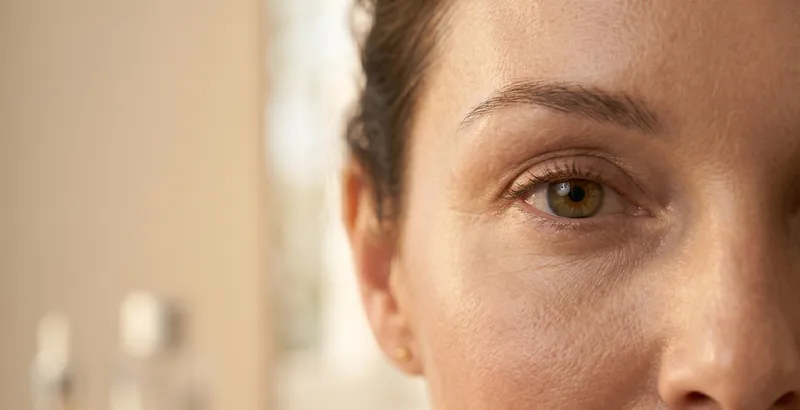
Peptide eye creams represent the most important long-term treatment for age-related dark circles because they address the fundamental structural change that amplifies every other darkening mechanism: the progressive thinning of periorbital skin with age. The under-eye skin starts as the thinnest on the body — approximately 0.5mm compared to 1.0-1.5mm on the cheeks — and loses collagen at the same annual rate as other facial skin (1-2% per year after 30, accelerating to 2-3% during perimenopause). But because the starting thickness is so minimal, each percentage point of collagen loss produces proportionally greater visible change. By 50, a woman may have lost 30-40% of her periorbital collagen density, reducing the under-eye skin to a tissue barely thicker than a sheet of paper — thin enough to reveal the underlying purple orbicularis muscle, the blue-red capillary network, and any hemosiderin deposits in exquisite detail.[1]
The peptides most effective for periorbital collagen stimulation: Matrixyl 3000 (palmitoyl tripeptide-1 + palmitoyl tetrapeptide-7) — the best-studied peptide complex for anti-aging, with clinical evidence showing up to 44% reduction in wrinkle depth at 2 months through TGF-beta-mediated collagen and fibrillin stimulation. For the eye area, this translates to measurable thickening of the periorbital dermis that reduces vascular show-through. Haloxyl (palmitoyl tetrapeptide-7 + chrysin + N-hydroxysuccinimide) — specifically developed for under-eye darkening, this complex combines peptide-driven collagen stimulation with chrysin (a flavonoid that helps clear bilirubin deposits) and an iron-chelating agent that assists hemosiderin removal. Clinical studies showed 19% reduction in dark circle darkness at 56 days. Argireline (acetyl hexapeptide-3) — a neurotransmitter-inhibiting peptide that reduces the micro-contractions of the orbicularis oculi muscle, softening the expression lines that cast shadows and deepen the apparent dark circles.
Clinical research confirms that application technique for peptide eye cream is critical because the periorbital area requires both effective delivery and extreme gentleness. Use the ring finger (weakest finger, least pressure) to apply a rice-grain-sized amount per eye. Starting at the inner corner of the orbital bone (not on the eyelid), tap gently in an arc following the orbital rim outward and upward. Never drag, pull, or rub — the thin periorbital skin stretches permanently with repeated mechanical stress, creating additional laxity that worsens the shadow effect. Apply morning and evening — the twice-daily application provides continuous peptide stimulation that maximizes collagen synthesis. The peptide cream should be the last active layer before SPF (morning) or the last active layer before occlusive eye balm (evening). Peptides are stable and compatible with virtually all other actives — they can be layered with caffeine, vitamin C, vitamin K, and retinol without interaction concerns.
Expected results from peptide eye cream for dark circles: the collagen stimulation process is biological and cannot be rushed — new collagen fibers require 8-12 weeks to reach maturity after stimulation. Initial improvement (subtle reduction in vascular show-through as the first new collagen thickens the dermis) appears at 8-12 weeks. Meaningful improvement (visible lightening of dark circles, reduced hollow appearance, smoother skin texture) at 16-24 weeks. Maximum improvement at 6-12 months of continuous use, with the periorbital skin measurably thicker and more resilient. The improvement is cumulative and sustained — unlike caffeine's temporary vasoconstriction, the collagen rebuilding provides lasting structural improvement that persists even if the product is temporarily discontinued. However, since collagen degradation continues with age, ongoing use is recommended to maintain the improvement and continue building density. The women who see the best results are those who use peptide eye cream consistently for 6+ months — the slow, steady collagen rebuilding eventually produces a visible transformation that friends describe as looking rested and refreshed, even though the improvement was too gradual to notice day-to-day.
Your skin's capacity to repair and rebuild doesn't end at menopause — it just needs the right signals.
— Dr. Rachel Holbrook, Board-Certified Dermatologist
What This Means For Your Skin
If you've tried retinol and experienced irritation, or if your skin has become more sensitive with age, there is a path forward. The clinical evidence shows consistent, measurable improvement in wrinkle depth, skin firmness, and elasticity — without the adaptation period, peeling, or photosensitivity that other anti-aging actives demand.
Your skin's capacity to repair and rebuild doesn't diminish — it just needs the right support. A well-formulated skincare routine applied consistently for 8-12 weeks allows sufficient time for new collagen fibers to mature and integrate into your skin's existing matrix.
The science is clear. The evidence is consistent. The results are measurable.
What happens next is up to you.