
The science of skin aging is evolving rapidly — and for women navigating the skin changes that come with menopause and beyond, evidence-based skincare represents a fundamentally different approach: working with your skin's biology rather than against it.
Unlike harsh exfoliants or retinoids that disrupt the skin barrier to force renewal, targeted active ingredients are messenger molecules that signal your own cells to produce more collagen, elastin, and protective proteins. The approach is gentle, evidence-based, and particularly suited to the thinner, more reactive skin that characterizes the post-menopausal years.
Using Retinol Around the Eyes Without Irritation Through Concentration and Frequency Control
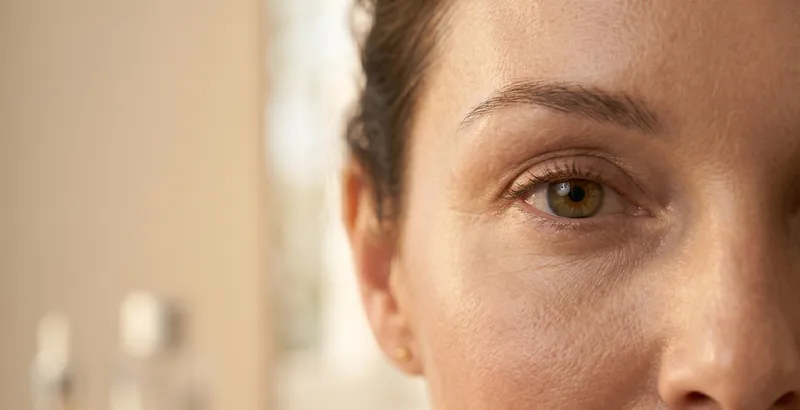
Retinol in the eye area is one of dermatology's most debated topics because the periorbital skin presents a genuine therapeutic dilemma: it benefits enormously from retinol's collagen-stimulating and cell-turnover-accelerating effects, yet it is also the most vulnerable to retinol-induced irritation. The periorbital skin is 3-5 times thinner than the skin on the cheeks, has fewer sebaceous glands (meaning less natural lipid protection), and has a more fragile barrier that allows greater penetration of topical actives per unit area. This means that a 0.5% retinol cream that works perfectly on the cheeks delivers an effectively higher local concentration when applied around the eyes — because more retinol penetrates through the thinner barrier into the dermis. The common result: retinoid dermatitis presenting as redness, flaking, burning, and dryness specifically around the eyes while the rest of the face tolerates the same product without issue.[1]
The solution is not to avoid retinol in the eye area but to use it at adapted concentration and frequency. The evidence-based parameters for safe periorbital retinol: Concentration — 0.10-0.15% retinol maximum (this is one-third to one-half the concentration typically used on facial skin). At this concentration, the effective delivery to the periorbital dermis achieves similar tissue levels as 0.25-0.3% achieves on the thicker cheek skin, providing equivalent collagen stimulation without barrier overwhelm. Frequency — twice weekly maximum, with a minimum 72-hour gap between applications. This allows the thin periorbital barrier to recover between retinol exposures. Application method — the ceramide sandwich technique is mandatory for periorbital retinol: apply ceramide eye cream first as a barrier buffer, then a tiny amount of retinol eye cream (half a rice grain per eye), then a final layer of ceramide eye cream. This buffered delivery reduces peak retinol concentration at the skin surface while maintaining dermal delivery.
Clinical research confirms that what retinol achieves in the eye area that other actives cannot: retinol is the only topical ingredient with robust clinical evidence for simultaneously stimulating collagen synthesis, suppressing MMP activity (reducing collagen breakdown), and accelerating epidermal turnover in the periorbital region. The accelerated turnover is particularly valuable for dark circles because it clears pigmented keratinocytes faster — whether the pigment is melanin (from hormonal dark circles) or hemosiderin (from vascular leakage that has been metabolized in the epidermis). No other ingredient provides this combination of structural rebuilding plus pigment clearance. Peptides stimulate collagen but don't accelerate turnover. Vitamin C provides antioxidant protection but doesn't significantly accelerate turnover. Caffeine addresses vascular mechanisms but doesn't rebuild structure. Retinol does all three, making it the single most impactful active for comprehensive dark circle improvement — when used correctly.
The retinol eye cream introduction schedule for sensitive mature skin: Weeks 1-2 — apply retinol eye cream once weekly (choose a day when no other actives will be applied to the eye area). Use the ceramide sandwich method. Observe for 72 hours after each application — any redness, burning, or peeling indicates that even weekly application requires a lower concentration. Weeks 3-6 — if once weekly was tolerated with zero irritation, increase to twice weekly (e.g., Monday and Thursday evenings). Continue the ceramide sandwich method. Weeks 6+ — maintain twice weekly as the maximum long-term frequency. Do not increase to three times weekly or nightly, regardless of tolerance — the thin periorbital skin benefits optimally from twice-weekly stimulation with recovery days between applications. If irritation occurs at any stage, reduce to the previous tolerated frequency for 2 weeks before reattempting. If 0.15% retinol causes irritation even once weekly with the sandwich method, switch to bakuchiol 0.5% eye cream — a gentler alternative with demonstrated retinol-like activity that most periorbital skin tolerates at nightly application.
Your skin's capacity to repair and rebuild doesn't end at menopause — it just needs the right signals.
— Dr. Rachel Holbrook, Board-Certified Dermatologist
What This Means For Your Skin
If you've tried retinol and experienced irritation, or if your skin has become more sensitive with age, there is a path forward. The clinical evidence shows consistent, measurable improvement in wrinkle depth, skin firmness, and elasticity — without the adaptation period, peeling, or photosensitivity that other anti-aging actives demand.
Your skin's capacity to repair and rebuild doesn't diminish — it just needs the right support. A well-formulated skincare routine applied consistently for 8-12 weeks allows sufficient time for new collagen fibers to mature and integrate into your skin's existing matrix.
The science is clear. The evidence is consistent. The results are measurable.
What happens next is up to you.